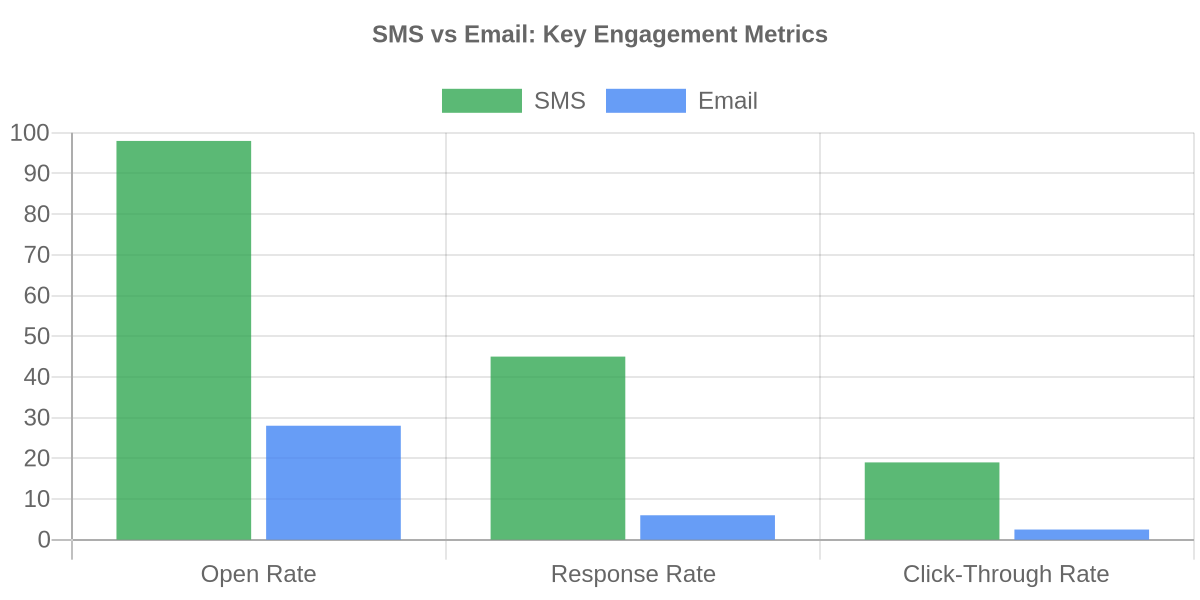
Your last email campaign probably landed somewhere between the Promotions tab and the digital void. The average business email open rate hovers around 20 to 37%. That’s the optimistic number. The realistic one, after spam filters and auto-opens from Apple Mail Privacy Protection artificially skew your dashboard, is probably lower. Meanwhile, text messages carry a 98% open rate and a 45% response rate. That’s not a marginal advantage; it’s a structural one, and understanding why it exists will change how you think about every customer touchpoint you run.
The Numbers That Actually Matter
Let’s put the core comparison on the table. Not because stats win arguments, but because these figures reveal something real about how people relate to different channels.
| Metric | SMS / Text | Email
|
| Open Rate | 98% | 20–37% |
| Response Rate | 45% | 6% |
| Avg. Response Time | 3 minutes | 90 minutes |
| Click-Through Rate | 19–20% | 0.77–4.36% |
| Conversion Rate (optimized) | 21–30% | ~12% |
Sources: Industry benchmarks compiled from multiple 2025–2026 SMS marketing research reports.
The click-through gap is the one that stings most for teams who’ve spent years perfecting email subject lines. But the response time gap is where the real business consequence lives. The average response time for SMS is 3 minutes, compared to 90 minutes for email. If you’re following up on a quote, confirming an appointment, or nudging a warm lead, those 87 minutes are not a minor inconvenience. They’re the window in which your prospect answers a competitor instead.
Why SMS Lives in a Different Inbox Than Email
Email competes in a chaotic environment. Spam filters, promotional tabs, algorithmic sorting, and Apple’s pixel-blocking all work against you before your subject line even gets a chance. SMS has none of that friction. There’s no spam folder for texts. No promotions tab. No algorithm deciding whether your message deserves to be seen today or next Tuesday.
The structural reason SMS wins isn’t that people like texts more. It’s that texts arrive in the same mental space as messages from family and friends, and that context creates immediate attention. 83% of consumers consider texting their top activity on their smartphones throughout the day, ahead of social media, email, and music streaming. You’re not interrupting someone’s day when you text them. You’re meeting them where they already are.
Opt-in behavior tells the same story. Text message marketing grew in 2025, with 75% of businesses using SMS marketing software to text their customers at the start of 2026. The consumer side is keeping pace: 84% of consumers are subscribed to business texts. These aren’t passive subscribers who forgot they opted in. They’re an audience that made an active, considered choice.
According to research aggregated by Electroiq in 2026, 48% of customers prefer to receive business communication via text message, and nearly 70% of businesses increased their SMS marketing budgets in 2024. The preference is real, and it’s been building for years.
The “STOP-REPLY Audit” Framework for Keeping Your List Clean
High engagement numbers come with a responsibility that a lot of businesses underestimate. The main deal-breakers customers named for opting out of SMS lists were messaging too frequently (55%), spam-like content (21%), and messages that lack relevance (13%). Those are three completely avoidable mistakes, and the fix for all three is the same: send fewer, better, more targeted messages.
Here’s a framework I’d call the STOP-REPLY Audit. Run it quarterly on any SMS program you operate:
- STOP rate: If your opt-out rate climbs above 1.5% in any 30-day window, you’ve either increased send frequency too fast or your content drifted irrelevant. Investigate before the next send.
- Reply rate: Healthy two-way text programs see replies on 20 to 40% of non-broadcast messages. If nobody’s replying, your messages read like billboards, not conversations. Rewrite them.
- Opt-in source: Check where new subscribers came from in the last quarter. Consent tied to a single touchpoint decays faster than consent earned across multiple interactions. Diversify your opt-in paths.
- Segment overlap: If the same subscriber gets three different campaign types in a week, they’ll feel like they’re being shouted at. Deduplicate across segments before every batch send.
Running this audit takes about 90 minutes. Skipping it costs you subscribers you spent real money acquiring.
Compliance Is Not Optional, and the Rules Just Got Stricter
The TCPA has always required written consent before sending marketing texts, but the regulatory landscape tightened significantly in 2024 and 2025. The FCC’s updated consent revocation rules took effect on April 11, 2025. Consumers can now revoke consent through any reasonable method, not just keyword replies, including email, phone calls, website forms, chatbots, or in-person requests.
The financial exposure for getting this wrong is not small. Non-compliant text message campaigns can trigger statutory damages of $500 to $1,500 per violation, class action litigation, and FCC enforcement risk. A 100,000-message campaign sent without proper consent doesn’t just generate complaints. It generates exposure that can wipe out a year of marketing budget.
The official FCC document on the updated one-to-one consent requirement, published by the Federal Communications Commission in 2024, clarifies that consent cannot be shared across brands or sold to third parties — a direct response to the “lead-generator loophole” that allowed a single consumer opt-in to be distributed to hundreds of unrelated senders. Each sender now needs its own documented consent from each subscriber.
Practically speaking, this means your opt-in copy needs to name your brand explicitly. A checkbox buried in a terms-of-service page won’t survive scrutiny. Get the consent language reviewed, document the timestamp and method for every subscriber, and honor opt-outs within 10 business days.
“The TCPA requires callers to obtain the consent of the called party before making certain calls or texts using an automatic telephone dialing system.”, Federal Communications Commission, September 2024 Order (DA-24-910A1)
Where Automation Changes the Whole Equation
Here’s a concrete scenario. A home services company gets 40 inbound form submissions on a busy Saturday. Without automation, the sales rep follows up Monday morning. By then, 60 to 70% of those leads have already booked with someone else. With an automated text triggered the moment the form is submitted, that same rep walks into Monday with conversations already in progress, leads who’ve already confirmed interest, asked questions, and in some cases booked.
That’s the core value proposition of a well-configured text automation tool: collapsing the gap between the moment someone raises their hand and the moment your business responds. Human speed can’t match it. But automation running on a defined workflow can.
The use cases scale across industries. Appointment reminders sent by text cut no-show rates more than email reminders do, because the message lands 3 minutes after it’s sent, not 3 hours later when the appointment is in 45 minutes. Payment reminders that feel conversational collect faster than form letters. Post-purchase check-ins sent via SMS generate review responses that email campaigns rarely do.
According to Pew Research Center data tracking American communication behavior, texting became Americans’ most frequently used mobile feature well over a decade ago, and adoption has only deepened since. The channel your customers grew up using is the same one your business can now reach them on, at scale, with measurable results.
Four Things to Do Before Your First Automated Text Campaign
- Audit your opt-in list. Any subscriber whose consent predates your current documentation practices needs to be re-opted in or removed. Old lists are compliance landmines.
- Write for conversation, not broadcast. A text that reads like a press release will be ignored or deleted. Write it like a person with relevant information, not a brand with a message.
- Set send-time windows. TCPA restricts marketing texts to 8 a.m. to 9 p.m. in the recipient’s local time zone. Configure this at the platform level so it’s never a manual decision.
- Test reply handling first. Send to your own team before your list. Confirm that two-way replies route to the right inbox, that STOP responses trigger immediate suppression, and that autoresponders don’t fire on opt-out confirmations.
The 98% open rate is real. So is the liability if you treat it carelessly. Build a texting program that earns the channel’s trust rather than burning it, and your response rates will tell you exactly when you’ve gotten it right.