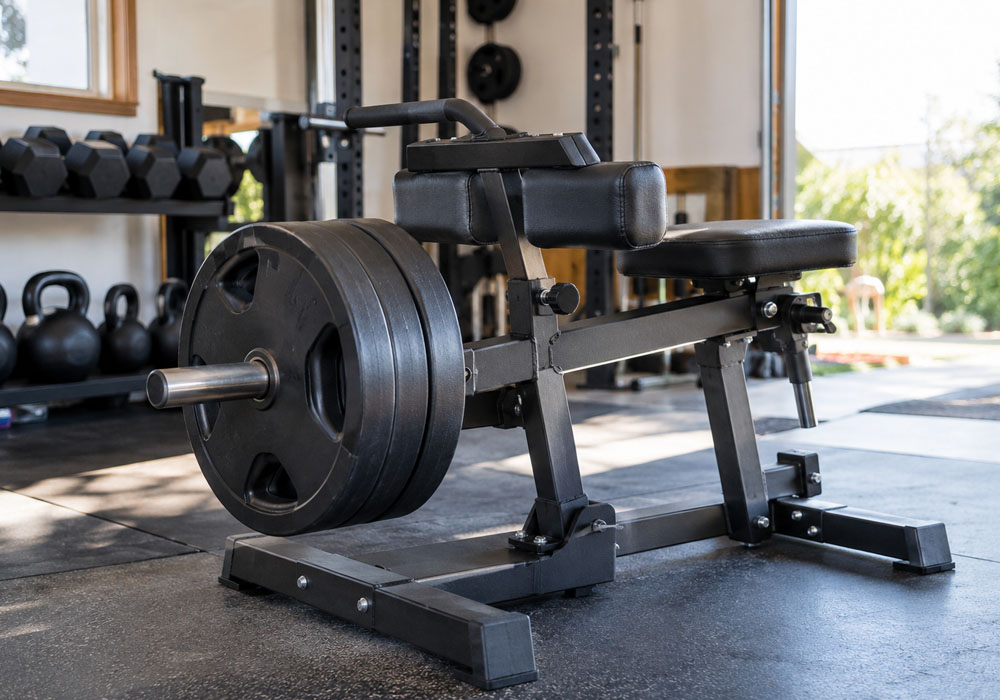
Buying a seated calf raise machine is not just about choosing the model with the highest weight capacity. Plate format, user adjustment, resistance style, and available space can all affect how well the machine works in a real home-gym setup.
A seated calf raise machine is a relatively simple piece of strength equipment, but models from Titan Fitness, Powerline by Body-Solid, and HVO Fitness take different approaches to loading, adjustment, resistance, and user fit. For home-gym buyers, plate compatibility, positioning, loading capacity, and price are some of the most useful factors to compare. The right machine should fit into the equipment system already in the gym rather than forcing the user to change plates, add unnecessary accessories, or work around an awkward training position.
Start With the Plates You Already Own
Plate compatibility is easy to overlook when comparing calf machines.
A home gym built around Olympic plates has different requirements from one that still uses standard 1-inch plates. If a new machine requires a different plate format or an additional adapter, it can make an otherwise simple setup more complicated.
For buyers who already own racks, benches, or plate-loaded strength machines, compatibility with existing weights can be more useful than a higher theoretical loading capacity.
The main question is simple: can the machine work with the plates already in the gym?
Look at How the Machine Adjusts to the User
A seated calf raise machine should hold the thighs securely while allowing the feet to remain stable throughout the movement.
Adjustment matters because users differ in leg length and body proportions. A machine that only changes pad height may work well for one person, while a shared home gym may benefit from adjustment at more than one contact point.
Useful features can include:
- Multiple thigh-pad heights
- Fore-aft positioning
- Stable foot placement
- Easy-to-reset adjustment points
More settings are not automatically better. What matters is whether the adjustments actually change the user’s training position.
Resistance Design Is More Than Plate Capacity
Maximum loading is important for progressive strength training, but it is only one part of the resistance system.
Some seated calf machines use direct plate loading. Others use leverage to increase effective resistance, while some designs allow resistance bands to supplement conventional plates.
Each approach creates a different training experience.
A high plate capacity gives experienced lifters more room for heavier progression. Leverage systems can generate substantial resistance with fewer plates. Band attachments provide another way to change the resistance profile without adding more weight.
For a home gym, the best format depends on how the user trains and what equipment is already available.
Titan Fitness Seated Calf Raise Machine
Functions
Titan Fitness uses a traditional plate-loaded seated calf raise format.
- Plate-loaded calf training
- 90-degree seated position
- Dual Olympic loading sleeves
- Adjustable thigh pads
The machine has a published plate capacity of 550 lb.
Positioning
Titan is built around heavy-duty Olympic-plate training.
Its frame uses 2 × 3-inch, 11-gauge steel, while two 9.5-inch Olympic sleeves handle the load. Diamond-plated foot bars and a vertical hand grip help maintain a stable training position.
Strengths
High loading capacity:
The 550 lb published rating provides substantial room for progressive loading.
Heavy-duty construction:
The 11-gauge frame gives the machine a more substantial strength-equipment profile.
Simple adjustment:
Four thigh-pad positions allow users to change fit without adding a complicated setup.
Limitation
Titan is designed for 2-inch Olympic plates only. Users whose home gyms rely on 1-inch standard plates cannot use those weights directly.
Its adjustment system is also relatively straightforward, with less emphasis on changing multiple body-positioning points.
Powerline by Body-Solid PSC43X
Functions
The Powerline PSC43X stays focused on seated calf training.
- Plate-loaded seated calf raise
- 1:3 resistance ratio
- Angled non-slip foot platform
- Adjustable user positioning
The 1:3 resistance system is the main feature separating it from conventional direct-loading machines.
Positioning
Powerline is designed as a residential calf machine with mechanical leverage.
Body-Solid classifies the PSC43X for residential use, and its listed dimensions are 47 × 21 × 32 inches.
Strengths
1:3 resistance ratio:
The lever system increases effective resistance relative to the amount of plate weight loaded.
Residential design:
Its construction and dimensions are specifically oriented toward home use.
Simple specialization:
The machine remains focused on one exercise rather than combining unrelated functions.
Limitation
The standard loading post is designed for 1-inch plates.
Olympic plates require a separate adapter sleeve, which adds another component for users whose home gyms already rely on 2-inch plates.
The machine also uses one primary resistance method rather than combining plates with another loading option.
HVO Seated Calf Raise Machine 501
Functions
HVO 501 combines conventional seated calf training with an additional resistance option.
- Plate-loaded resistance
- Four resistance-band attachment points
- Six leg-pad height settings
- Four support-rod positions
- Compatibility with 1-inch and 2-inch plates
Its current reviewed U.S. listing is $229.99, with a published maximum plate capacity of 330 lb and maximum user weight of 330 lb.
Positioning
HVO positions the 501 for adjustable home and garage-gym calf training.
The machine is particularly relevant to households that already own standard or Olympic plates and want to add a dedicated calf station without introducing another plate system.
Strengths
Two resistance methods:
Users can train with plates, resistance bands, or a combination of both.
Broader fit adjustment:
Six leg-pad settings and four support-rod positions provide adjustment at two body-positioning points.
Dual plate compatibility:
Both 1-inch standard and 2-inch Olympic plates can be used.
Lower reviewed entry price:
At $229.99, HVO has the lowest listed price among the three machines reviewed here.
Limitation
Its published maximum plate capacity is lower than Titan’s 550 lb rating.
The listed 50.2-inch width also means buyers should measure the available training area rather than assuming that a home-oriented machine will automatically have the smallest footprint.
Quick Comparison for Home Gyms
| Machine | Listed Price Reviewed | Space Profile | Best Fit |
| Titan Fitness Seated Calf Raise | $309.99 | Permanent dedicated station | Users prioritizing heavier progressive loading |
| Powerline PSC43X | $320.00 | Narrow residential footprint | Users who prefer amplified resistance from fewer plates |
| HVO 501 | $229.99 | Home / garage-gym oriented | Users seeking flexible resistance and lower entry cost |
The three machines occupy different positions.
Titan provides the highest published loading capacity and a heavy-duty Olympic-plate setup.
Powerline is defined more by its 1:3 leverage system than by broad plate compatibility.
HVO combines the lowest reviewed entry price with standard and Olympic plate compatibility, band attachment points, and adjustment at two body-positioning areas.
Which Setup Fits Which Training Priority?
For higher-load Olympic-plate training, Titan provides the clearest fit because of its 550 lb published plate capacity and heavier frame.
For residential leverage-based training, Powerline PSC43X offers a simpler single-purpose design built around its 1:3 resistance ratio.
For a home gym that already owns different types of plates, HVO 501 provides broader compatibility and more positioning adjustment while remaining the lowest-priced machine in this comparison.
The deciding factor should not be a single specification. The better choice is the machine whose resistance system, adjustment range, plate format, and space requirements fit the way the home gym is already used.
FAQ
Why use a seated calf raise machine instead of standing calf raises?
The seated position stabilizes the body and creates a repeatable calf-training setup. It is especially useful when the goal is dedicated lower-leg volume rather than adding calf raises to another compound exercise.
Do plate sizes matter for a home calf machine?
Yes. HVO accepts both 1-inch and 2-inch plates. Titan uses Olympic plates, while Powerline uses a 1-inch post with an optional Olympic adapter.
Are resistance bands useful on a calf raise machine?
Bands provide another way to increase resistance without relying only on additional plates. HVO 501 includes four band attachment points specifically for this purpose.
Conclusion
Titan Fitness, Powerline by Body-Solid, and HVO Fitness represent three distinct approaches to plate-loaded seated calf training.
Titan Fitness suits users who prioritize heavier Olympic-plate loading and a more substantial setup. Powerline by Body-Solid is better suited to users who prefer a simple residential calf machine with a 1:3 leverage system.
HVO 501 is a value-oriented option for home and garage gyms that need flexible loading, broader plate compatibility, and adjustable positioning in one dedicated calf station. Its support for both standard and Olympic plates, together with plate and band resistance, makes it particularly relevant to users who already own home-gym equipment and want to add progressive calf training without moving into a more expensive or specialized setup.