Most sports bar bids come down to screen count and price, but that filter misses how the system will perform when the venue is full. These nine questions help show whether a provider thinks like an operator or simply hangs TVs for a living.
Get content rights sorted before you talk hardware
Before choosing hardware, confirm that your content subscriptions cover the games and events you intend to show in a commercial venue. An impressive screen layout is little help if the required feed is unavailable.
Question 1: where will our game feeds come from on game day?
Ask whether every source they propose uses commercially licensed sources cleared for bars and similar venues. A residential box or home streaming login may not include the rights needed for use in a commercial venue. You don’t want to discover that during the playoffs, when the room is full, customers are waiting and the staff is already slammed.
A good provider will also ask which teams and competitions your regulars expect to watch. Blackout rules and market areas can block certain feeds in some locations, and the provider should explain those limits in plain terms before you sign. There’s also the issue of delay. Consumer apps can run well behind a broadcast feed, and that lag hurts the experience when half the room hears a cheer from outside before seeing the score.
Listen for specifics about the biggest nights on your calendar. You want to hear how Sunday slates and pay-per-view events will be handled, along with how the provider will mix satellite and streaming without leaving you short. Check which accounts staff need and how they will access them before kickoff. If the answer is that they’ll figure out content later, walk away. Content comes first. Screens come second.
Design video for every seat, not an empty floor plan
Anyone can promise a wall of TVs. Far fewer providers can promise a good view from the back booth on a packed Friday night.
Question 2: how will sightlines work from our stools and booths?
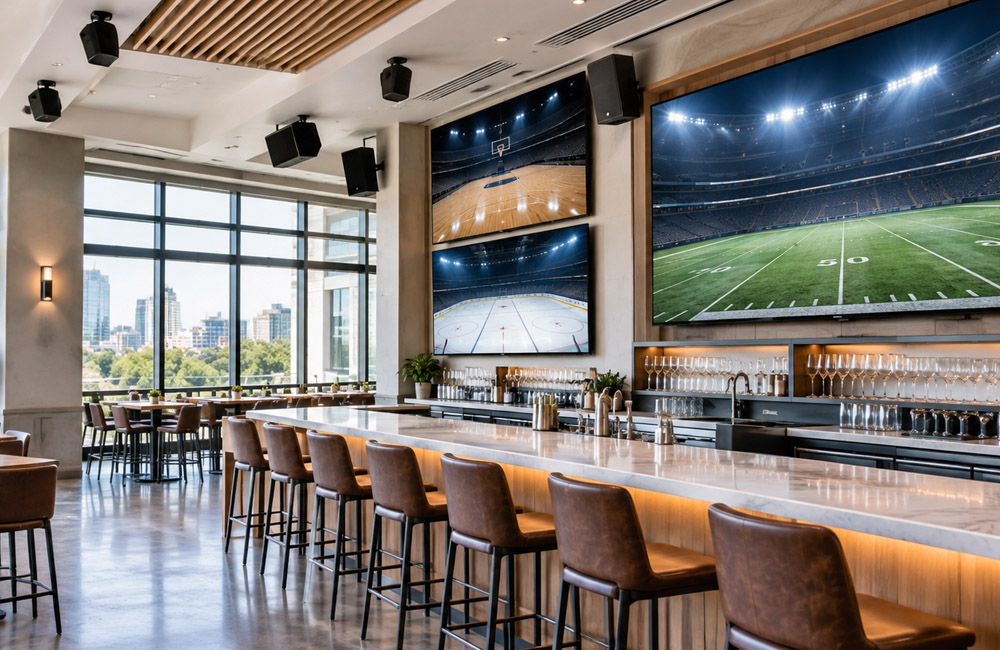
Ask the provider to walk the room with you and map bar stools and booths separately rather than relying only on a floor plan. Viewing height and distance can change considerably between those positions, and a screen that looks perfect from the bar may cause neck strain from a low booth. They should discuss mounting height, tilt and the way glare from doors and windows changes after dark. The goal is a clear view without forcing guests to turn their heads sharply or stare through other customers, and achieving that takes measurements rather than guesses.
Push them on accessible seating as well. Those tables are often tucked near the entry or placed off to the side. Guests seated there ordered the same food and paid the same cover. They deserve the same clear view of the main game as everyone else. A designer who overlooks those seats is likely to miss other practical details.
Question 3: what panels are you quoting and how will they hold up in our light?
Sports bars are usually bright environments. Daylight spills in early, while house lights often stay up late into the evening. Consumer sets can wash out quickly in that mix, and they may not be designed for long operating days, seven days a week. Ask for the brightness rating in nits for each display type included in the quote. Ask which panel grade they use for commercial rooms and why they selected it for your venue’s light levels and expected operating hours.
You don’t need to become an engineer to assess the answers. You need specifications that can be compared across bids, because when one proposal is much cheaper, the panel specification often helps explain why. If a provider can’t give you the rating or insists that a TV is a TV, take that as a warning sign. A commercial label alone does not settle the choice. Compare brightness, rated operating hours, ventilation requirements and warranty coverage for commercial use. Ask the provider to explain how each proposed model meets those requirements in your room.
Make the room sound right
Audio deserves the same planning attention as video. Guests need to hear the main game where it matters without losing the ability to hold a conversation in quieter areas. Ask the provider how the design balances those competing needs.
Loud is not clear.
Question 4: how will you zone audio and tame echo?
Ask how many audio zones are included and what each zone is intended to do. You may want game sound near the main wall and background music near the entry and dining side. The bar itself could need a separate mix so bartenders can hear customers calling orders. If everything runs from one volume knob, the venue has noise rather than useful audio zones.
Then ask how the design will address echo. High ceilings and hard surfaces can look great but sound awful when the room fills up. Commentary turns to mush, staff start shouting and guests respond by shouting even louder. A credible plan should cover speaker placement and direction, along with some basic treatment to reduce reflections where needed. It should not depend on simply turning up the volume, because extra volume cannot fix a room that reflects sound in every direction.
Plan signal flow that can grow with the room
Cheap installations may work on opening day but struggle to accommodate screen seven or a patio feed the following summer without disruptive changes.
Question 5: how does video reach each screen and what happens when we add more?
Ask whether the provider plans to distribute video over HDBaseT or IP video and why that approach suits your build. When correctly specified and installed, both can carry clean 4K feeds across a bar without depending on a collection of long HDMI runs. The key consideration is the backbone behind the rack. A properly engineered sports bar av system should be able to grow from a handful of screens to a venue-wide layout without ceilings being torn open, with suitable spare ports and cable paths reserved for future TVs.
Ask what adding a patio or two more booth screens would require in labor and parts. If the answer involves rewiring the entire venue, the original design leaves too little room for growth. You want a head-end rack with expansion space and a wiring map that can be handed to any qualified technician. Ask which future resolutions and formats the proposed cabling can support. Spare pathways are valuable, but the provider should identify any upgrade that would require new cable rather than just different endpoint equipment.
Keep game-day operation simple for staff
Your system will often be operated by a bartender managing a full well and a line at the door. The control setup needs to reflect that day-to-day reality.
Question 6: who runs this during a rush and how fast can they switch it?
Request a demonstration designed around your staff’s needs rather than the installer’s familiarity with the system. Can a new hire switch the sound from one fight feed to baseball in under 30 seconds? Can that person put one major game on every screen with a single press? If the process requires several remotes and a manual, it is unlikely to happen smoothly on a Friday night when tickets are piling up.
Good control is boring, and that is exactly what a busy bar needs. One touch panel behind the bar with clear labels such as Main Wall and Patio can work well. Staff should not have to navigate nested menus or remember cryptic input numbers. They should be able to learn the controls in one training shift and then use them without stopping to think. Ask about lockouts too, so guests and new hires cannot wander into settings and accidentally kill the main feed.
Question 7: will our network handle streams, POS and guest Wi-Fi at once?
This question quickly distinguishes experienced venue designers from basic TV installers. Game streams may share the same network as your POS. Guest Wi-Fi can place heavy demands on that network during busy periods, while digital signs may also rely on it. A provider who does not ask about the combined load is making assumptions rather than developing an informed design.
Ask for a network check before the screen quote is finalized. The provider should examine your switches, available bandwidth and the way traffic is prioritized when every service is active. If POS performance slows while the back bar streams four games, you lose money while creating extra problems for staff. You need appropriately managed equipment and a plan for peak hours, rather than a vague hope that the internet connection holds up.
If the provider shrugs and says the internet is fine, move on. That confidence can disappear on the first playoff weekend.
Lock in support and real costs
Bids may cover different scopes, making headline prices difficult to compare. Put equipment, content, training and support costs on paper before making a decision.
Question 8: what happens when something fails at 8 p.m. on Saturday?
Bars make much of their money at night and on weekends. A support plan limited to weekdays does not match the hours when your system matters most. Ask for game-day weekend support in writing, including clear response times and remote dial-in before a technician is sent to the venue. You need to know who will answer and what that person can fix remotely while a full room is waiting.
Also ask about spare components and replacement procedures. Do they keep a compatible spare extender or receiver for your system on the shelf? Can they replace a failed source quickly and restore the main wall before halftime? You do not need a complete second rack sitting in storage. You need a workable plan that protects the screens responsible for keeping guests engaged when the room is busiest.
Question 9: what will this cost over five years, not just on install day?
Ask for a five-year cost view presented on one sheet. Hardware is only the starting point. Content subscriptions and service agreements have their own renewal terms. Displays may eventually need replacement, bandwidth requirements can change as streams are added, and maintenance visits add to operating costs. A basic installation bid can hide those lines. A clear ownership view shows them, allowing you to compare complete systems instead of focusing only on day-one prices.
Use that sheet to compare competing bids on equal terms. One provider may initially look expensive until you see that licensing and service are included. Another may appear cheap until repairs, missing services and early equipment replacements are added. Ask for hospitality references too. You want to speak with a sports bar or restaurant they have worked on, rather than hearing only about offices, and you should ask how they managed kitchens and late-night support calls. That history indicates whether they can work effectively around cooks, customers and crowded service periods.
Choose the provider who asks about your seats and your Saturdays. Installing the TVs is the straightforward part. Keeping them running cleanly for five seasons is the real job.