Basic Information
| Field | Details |
|---|---|
| Full Name | Claire Merritt Ruth (born Clara Mae Merritt) |
| Birth | September 11, 1900 |
| Birthplace | Near Athens, Clarke County, Georgia |
| Death | October 25, 1976 (age 76), New York City |
| Parents | James Monroe Merritt; Carrie Lou Riley (Merritt) |
| First Marriage | Frank Bishop Hodgson (m. March 17, 1915; d. February 16, 1921) |
| Child | Julia Ruth Stevens (b. July 7, 1916; d. March 9, 2019), later adopted by Babe Ruth |
| Second Marriage | Babe Ruth (George Herman Ruth) (m. April 17, 1929; d. August 16, 1948) |
| Stepchild | Dorothy Ruth Pirone (b. June 7, 1921; d. May 18, 1989), adopted by Claire |
| Residences | Athens, GA; Rye, NY; Upper West Side, NYC (Riverside Drive) |
| Early Occupations | Model (for artist Howard Chandler Christy); Broadway dancer |
| Media Appearances | Fancy Curves (1932); Go to Bat for the Babe (1951); The Steve Allen Plymouth Show (1956) |
| Notable Work | Co-author, The Babe and I (1959) with Bill Slocum |
| Key Contributions | Stabilizing Babe Ruth’s life and finances; stewarding his legacy; supporting youth baseball |
| Resting Place | Gate of Heaven Cemetery, Hawthorne, NY (beside Babe Ruth) |
From Banks County Roots to Broadway Lights
Claire Merritt Ruth’s story begins in a rural corner of Northeast Georgia, where family ties threaded through Clarke and Banks counties like the roots of a long-lived oak. Born in 1900, she grew up in a large Southern household shaped by the steady presence of her parents, James and Carrie. At 15, she married Frank Bishop Hodgson in Athens. Widowhood arrived early: Hodgson died in 1921, leaving Claire with a young daughter, Julia, and the resolve to reinvent herself.
Around 1920, she stepped onto New York’s stage—literally and figuratively. She worked as a model for famed illustrator Howard Chandler Christy and danced in Broadway musicals, riding the electric pulse of a metropolis that thrived on spectacle. Behind that shine was grit: a young mother navigating show business while learning its rhythms, its risks, and its opportunities.
A Marriage That Calmed a Thunderstorm: Life with Babe Ruth
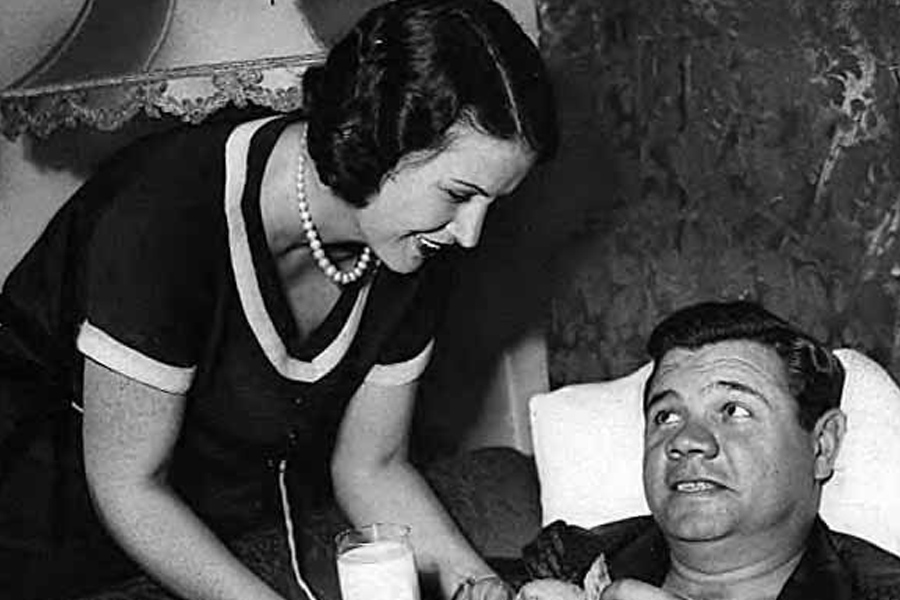
Claire met Babe Ruth in 1923, while he was estranged from his first wife, Helen Woodford. After Helen’s death in January 1929, Claire and Babe married on April 17, 1929, in a quiet ceremony designed to avoid crowds. Their union became one of those rare partnerships where a steady hand can tame a force of nature. Babe’s appetites—food, drink, spending—were the stuff of legend; Claire was the ballast. She curbed excess, tracked expenses, and instilled a routine that helped extend his playing vitality into the mid-1930s and secured their future.
Together they formed a blended family: Babe adopted Julia; Claire adopted Dorothy. In Rye and later on Riverside Drive, family life revolved around baseball’s rhythms—off-season dinners, clubhouse anecdotes, summer road trips—and the daily work of being recognizable in public without losing the private tenderness of home.
Not everything was smooth. A comment by Lou Gehrig’s mother comparing Dorothy’s clothes to Julia’s sparked a bitter rift between the Ruths and Gehrigs in the mid-1930s. Pride and proximity did the rest. It took until 1939—Gehrig’s farewell at Yankee Stadium—for a public reconciliation. Claire later took responsibility for her role in the feud, a reminder that even among icons, small slights can cast long shadows.
Family Ties: Georgia Kin, Daughters, and Grandchildren
Family, for Claire, was a constellation that stretched from Banks County cousins to New England winters in Conway, New Hampshire. Her kin included the Rylee family of Banks County and, by family lore, a connection to slugger Johnny Mize. She carried the memory of Georgia long after the skyscrapers replaced pine trees on her horizon.
| Name | Relation | Life Dates | Notes |
|---|---|---|---|
| James Monroe Merritt | Father | — | Georgia roots; large family network |
| Carrie Lou Riley (Merritt) | Mother | — | Stabilizing presence in early life |
| Frank Bishop Hodgson | First Husband | d. Feb 16, 1921 | Athens hotel man; married Claire at 15 |
| Babe Ruth | Second Husband | 1895–1948 | Baseball icon; married Claire Apr 17, 1929 |
| Julia Ruth Stevens | Daughter | Jul 7, 1916 – Mar 9, 2019 | A lifelong baseball devotee; lived to age 102 |
| Dorothy Ruth Pirone | Stepdaughter | Jun 7, 1921 – May 18, 1989 | Authored a memoir about her parentage |
| Tom Stevens | Grandson | — | Visited Georgia relatives; helped dispel family myths |
| Johnny Mize | Cousin (family connection) | 1913–1993 | Hall of Fame slugger; Georgia native |
Career, Media, and Legacy Work
Claire’s show-business career remained modest—modeling gigs, choruses in musicals, the occasional short film—yet it set the stage for her later role as a public steward of Babe’s memory. After Babe’s death in 1948, she became the keeper of the flame: unveiling monuments, attending ceremonies, writing articles, and, in 1959, co-authoring The Babe and I with Bill Slocum. She granted permission for youth baseball programs to adopt the Babe Ruth League name in 1953, tying America’s pastime to the next generation.
Her media appearances were often tethered to Babe’s legend: the short Fancy Curves (1932), the television spot Go to Bat for the Babe (1951), and The Steve Allen Plymouth Show (1956). In 1948, her cinematic portrayal by Claire Trevor in The Babe Ruth Story helped cement a cultural image—glamour tinged with devotion, fame tempered by steadiness.
She wasn’t shy about civic life either, assisting in the 1952 Eisenhower campaign and appearing at political events into the early 1970s. The image endured: a poised widow in a memorabilia-lined apartment, a living archive of baseball’s golden age.
Money and Home: Stability in the Spotlight
Claire’s influence wasn’t only emotional—it was practical. She tracked spending, weighed offers, and opted for prudence over spectacle. That discipline mattered, especially in the years after Babe’s playing days. As a widow from 1948 onward, she lived comfortably on Riverside Drive, surrounded by artifacts that turned her apartment into a museum of memories. The home—valued around $1.6 million—became part sanctuary, part salon, a place where baseball history felt tangible.
In 2025, renewed attention followed the apartment’s sale; a high-profile bid drew headlines when a co-op board reportedly turned it down. The episode echoed the old theater of New York real estate, where stories sometimes matter as much as square footage.
Key Dates Timeline
| Year | Event | Details |
|---|---|---|
| 1900 | Birth | Sep 11, Athens/Clarke County, GA |
| 1915 | First Marriage | Mar 17, married Frank B. Hodgson at 15 |
| 1916 | Julia Born | Jul 7, Athens, GA |
| 1921 | Widowhood | Feb 16, Hodgson dies |
| 1920–1923 | New York Move | Modeling for Christy; Broadway dancing; meets Babe (1923) |
| 1929 | Second Marriage | Apr 17, married Babe Ruth after Helen’s Jan death |
| 1930s | Family Life | Adopts Dorothy; blended family in Rye, NY |
| Mid-1930s | Gehrig Rift | Sparked by a remark; reconciliation at 1939 Lou Gehrig Day |
| 1948 | Babe’s Death | Aug 16; Claire becomes primary keeper of his legacy |
| 1953 | Youth Baseball | Babe Ruth League name adopted with her permission |
| 1956–1959 | Media & Book | Steve Allen Show (1956); The Babe and I published (1959) |
| 1961 | Record Falls | Roger Maris hits 61 HR, surpassing Babe’s single-season mark |
| 1974 | Record Falls | Hank Aaron surpasses Babe’s career HR total |
| 1976 | Claire’s Death | Oct 25, age 76; buried beside Babe |
Recent Mentions and Cultural Echoes (2025)
The year 2025 brought fresh spotlights. A Georgia-focused profile celebrated Claire as a “homegrown hero,” linking her Banks County heritage to her steadying role in Babe Ruth’s life and noting the family tie to Johnny Mize. Reports about the Riverside Drive apartment resurfaced, including a high-profile bid rejected by a co-op board in mid-summer.
Across social platforms, archival images flickered: a January clip of Babe signing a 1932 contract with Claire present; a May photograph of the couple surrounded by autograph seekers; August posts of Claire alongside Babe and Hank Greenberg. On YouTube, historical pieces revisited her Georgia roots, the 1929 wedding, and early 1930s game footage featuring a brief interview—fragments that, when woven together, create a patchwork quilt of memory.
FAQ
Who was Claire Merritt Ruth?
She was the second wife of Babe Ruth and a Georgia-born model and Broadway dancer who became a key steward of his legacy.
When was she born and when did she die?
She was born on September 11, 1900, and died on October 25, 1976.
Did Claire have children?
Yes—her daughter Julia Ruth Stevens (born 1916), whom Babe later adopted; Claire also adopted Babe’s daughter, Dorothy.
How did she influence Babe Ruth’s life?
She curbed his excesses, instilled routine, and managed finances, helping stabilize his career and their home.
Was she related to Johnny Mize?
Yes, family connections link Claire to Hall of Famer Johnny Mize through their Georgia roots.
What happened with Lou Gehrig’s family?
A comment from Gehrig’s mother sparked a rift; Babe and Gehrig publicly reconciled in 1939, and Claire later accepted responsibility for the feud.
What did she do after Babe’s death?
She preserved his memory through public appearances, writing, and support for youth baseball, including the Babe Ruth Leagues.
Where is she buried?
She rests beside Babe Ruth at Gate of Heaven Cemetery in Hawthorne, New York.
Did she appear in films or TV?
Yes—among them Fancy Curves (1932), Go to Bat for the Babe (1951), and The Steve Allen Plymouth Show (1956).
What book did she co-author?
She co-wrote The Babe and I (1959) with Bill Slocum.