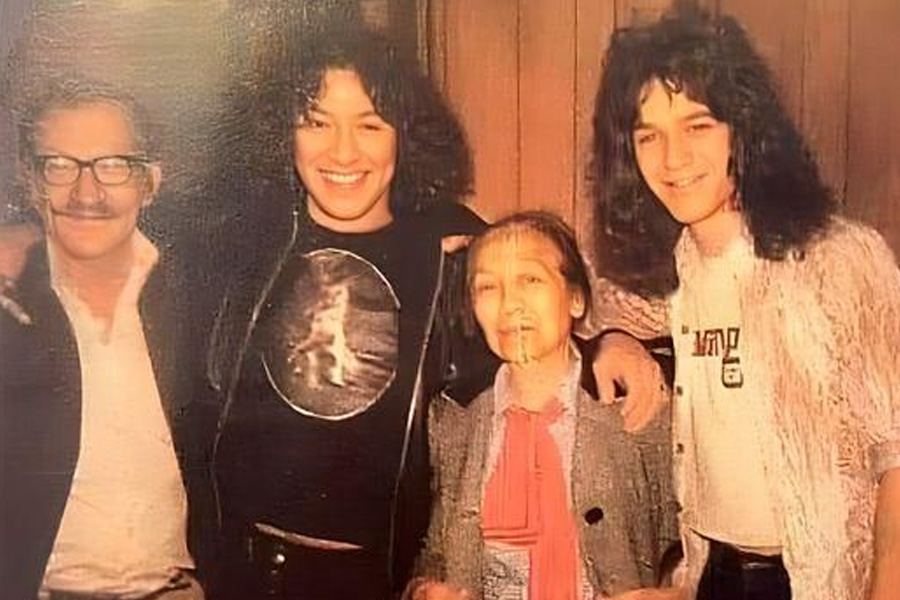
Basic Information
| Field | Details |
|---|---|
| Full Name | Eugenia Van Halen (née van Beers) |
| Birth | 1914, Rangkasbitung, Lebak, Bantam, Netherlands Indies (now Indonesia) |
| Heritage | Indo-European (Dutch, Italian, Indonesian) |
| Parents | Frans van Beers; Eugenie Mafficioli del Castelletto |
| Spouse | Jan Van Halen (1921–1986), Dutch jazz musician; married August 1950 |
| Children | Alex Van Halen (b. May 8, 1953); Eddie Van Halen (Jan 26, 1955–Oct 6, 2020) |
| Grandchildren | Aric Van Halen (b. Oct 6, 1989); Malcolm Van Halen (b. Aug 1, 1999); Wolfgang Van Halen (b. Mar 16, 1991) |
| Major Residences | Amsterdam; Nijmegen (59 Rozemarijnstraat); Pasadena (1881 Las Lunas Street) |
| Immigration to U.S. | February 22, 1962, by boat to New York; train to Pasadena, California |
| Occupations | Homemaker; maid in California |
| Death | August 4, 2005, Beverly Hills, California (aged 91) |
A Life Forged at the Crossroads
Eugenia Van Halen’s story begins in 1914 in Rangkasbitung, a town cradled in the lush landscape of Indonesia during Dutch colonial rule. Of Indo-European heritage, she embodied a bridge between worlds—Dutch and Italian ancestry through her parents, and deep Indonesian roots through birth and upbringing. That intersection of cultures shaped her sense of self and taught her resilience early, a resilience that would later anchor a family destined for global musical fame.
Her path crossed with Jan Van Halen in Indonesia. Jan was a Dutch musician with a clarinet, saxophone, and piano at his command, and a post with the Dutch Air Force that had taken him far from home. They married in August 1950, a partnership that balanced music, migration, and a stubborn faith in better days.
Marriage, Music, and Moving
The early 1950s were a test. Eugenia and Jan faced ugly societal pressures—racism and suspicion targeted their mixed-race union—especially in the Netherlands. They moved repeatedly, carving out a home where they could. By 1953 the family was in Amsterdam, where their first son, Alexander Arthur “Alex,” was born on May 8. Two years later, on January 26, 1955, their second son, Edward Lodewijk “Eddie,” arrived. A later move took them to Nijmegen, with an address on Rozemarijnstraat (No. 59) that would become one of the family’s formative stops.
Within the Van Halen home, music was both a language and a compass. Jan’s jazz records and instruments filled rooms with possibilities. Yet Eugenia—tiny but tough—kept the rudder steady. She believed in discipline and classical training, insisting her boys learn piano and technique before chasing volume and swagger. It was the discipline that later gave Eddie’s guitar a classical precision and Alex’s drums a stern backbone.
Immigration and the Lean Years
On February 22, 1962, the Van Halen family boarded a ship to the United States. They arrived in New York and took a train west, finding their way to Pasadena, California. The family settled at 1881 Las Lunas Street, carrying little more than grit and an immigrant’s hope. Money was scarce—by some accounts, only about $15 in hand. Jan picked up janitorial work and played gigs. Eugenia worked as a maid, a quiet act of sacrifice to keep the household afloat.
These were lean years, measured not in dollars but in dedication. The boys practiced music obsessively; their mother’s strict schedules and unbending expectations became scaffolding for ambition. The seeds of a world-class rock band were sown on humble floors, in cramped rooms, at a modest address in Pasadena.
Raising Alex and Eddie: Classical Roots, Rock Wings
Eugenia’s parenting style could be stern. She favored classical music and structure, bristling at the idea of rock as a career path for her sons. Over time, she softened. What began as disapproval shifted toward cautious support as she saw Alex and Eddie’s drive harden into craft. The conservatory-like practice enforced in childhood sharpened their edge. Eddie’s tapping technique, the daring engine of Van Halen’s sound, carried echoes of scales and exercises learned because his mother insisted.
Debates persist over whether she fully embraced her sons’ rock-star identities. What’s clear is that she helped forge the discipline behind the chaos and added ballast to the ship even when the winds screamed.
Family Timeline
| Year | Event | Details |
|---|---|---|
| 1914 | Birth | Rangkasbitung, Indonesia |
| 1950 | Marriage | Married Jan Van Halen in Indonesia |
| 1953 | First Child | Alex Van Halen born in Amsterdam (May 8) |
| 1955 | Second Child | Eddie Van Halen born in Amsterdam (Jan 26) |
| Late 1950s | Move | Relocated to Nijmegen (59 Rozemarijnstraat) |
| 1962 | Immigration | Sailed to New York (Feb 22); moved to Pasadena (1881 Las Lunas Street) |
| 1960s–1970s | Lean Years | Eugenia works as a maid; Jan works as a custodian and musician |
| 1986 | Loss | Jan Van Halen dies |
| 1989 | Grandchild | Aric Van Halen born (Oct 6) |
| 1991 | Grandchild | Wolfgang Van Halen born (Mar 16) |
| 1999 | Grandchild | Malcolm Van Halen born (Aug 1) |
| 2005 | Passing | Eugenia dies in Beverly Hills (Aug 4) |
| 2020 | Son’s Passing | Eddie Van Halen dies (Oct 6) |
| 2024 | Memoir | Alex Van Halen publishes Brothers, reflecting on family and upbringing |
Family at a Glance
|
Member |
Birth–Death | Notes |
|---|---|---|
| Jan Van Halen | 1921–1986 | Dutch jazz musician (clarinet, saxophone, piano); married Eugenia (1950) |
| Alex Van Halen | b. May 8, 1953 | Van Halen co-founder and drummer; known for powerful style and band leadership |
| Eddie Van Halen | Jan 26, 1955–Oct 6, 2020 | Guitar innovator; architect of tapping technique; global rock icon |
| Wolfgang Van Halen | b. Mar 16, 1991 | Musician; Mammoth WVH; former Van Halen bassist |
| Aric Van Halen | b. Oct 6, 1989 | Track and field athlete; also creative pursuits |
| Malcolm Van Halen | b. Aug 1, 1999 | Maintains a private life; part of the family’s creative thread |
The Matriarch’s Quiet Strength
Eugenia didn’t seek the spotlight. She had no independent career that turned heads, no public net worth to tally. Her achievements were domestic yet monumental: keeping the family intact, teaching discipline, and shouldering the weight of immigration and prejudice. In the household ledger of influence, her entries were in ink—firm, indelible.
She embodied the immigrant’s paradox: invisible in public, unforgettable in private. Without her, the story of Van Halen would lose its keel. With her, the family ship held steady through rough seas—poverty, relocations, and the punishing friction of cultural change.
Legacy and Recent Mentions
Eugenia’s legacy lives in the music and in the family narratives that echo across decades. In 2024, Alex Van Halen’s memoir, Brothers, revisited the family’s journey: the racism they endured, the discipline of their youth, and the grinding ascent from Pasadena garages to stadiums worldwide. Social media posts in 2025 highlighted Eugenia’s Indonesian origins, her Indo-European identity, and the immigrant tale behind a quintessentially American rock band.
She remains unentangled by controversy. Discussions persist about her early resistance to rock and whether pride blossomed fully as her sons conquered stages. The debates, however, only underline her paradox—both protective and demanding, skeptical yet supportive in the end.
FAQ
Where was Eugenia Van Halen born?
She was born in 1914 in Rangkasbitung, Indonesia, during Dutch colonial rule.
What was her heritage?
She was Indo-European, with Dutch, Italian, and Indonesian ancestry.
Whom did she marry?
She married Dutch musician Jan Van Halen in August 1950.
When did the family move to the United States?
They immigrated on February 22, 1962, arriving in New York and settling in Pasadena, California.
What role did she play in her sons’ musical upbringing?
She enforced classical training and discipline, initially disapproving of rock before softening over time.
Did Eugenia have a public career?
No; she focused on homemaking and worked as a maid to support the family after immigration.
Who are her grandchildren?
Aric (1989), Malcolm (1999), and Wolfgang (1991).
When did Eugenia pass away?
She died on August 4, 2005, in Beverly Hills, California.