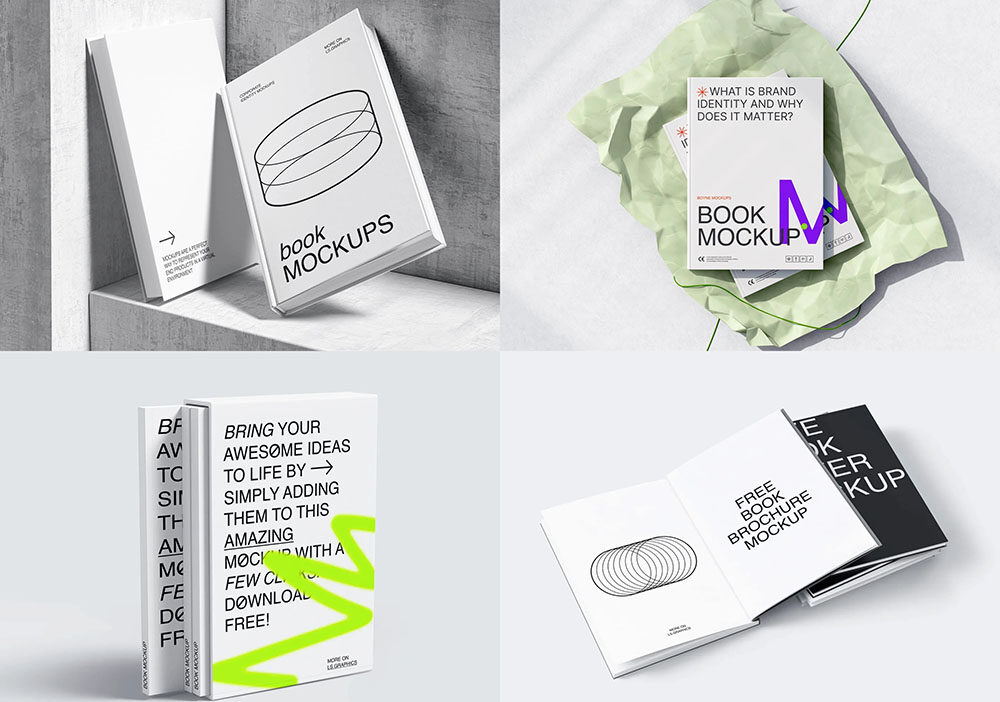
You’ve written the book. You’ve bled onto those pages, revised until your eyes crossed, and finally hit “publish.” Now comes the part nobody warned you about: making people actually stop scrolling long enough to notice it exists.
Static images aren’t cutting it anymore. Feeds are crowded, attention spans are brutally short, and the difference between a post that gets 12 likes and one that goes semi-viral often comes down to one thing — motion.
Why Animation Changes Everything
Human brains are wired to detect movement. It’s evolutionary — our ancestors needed to notice the rustling bush before the predator lunged. Social media algorithms exploit this instinct mercilessly.
When a Book mockup rotates gently on screen, pages fanning open like a slow exhale, the eye locks onto it automatically. It’s not a gimmick — it’s neuroscience working in your favor.
Studies from HubSpot and Sprout Social consistently show that animated content outperforms static images across all major platforms. The 300% engagement figure isn’t plucked from thin air — it reflects documented patterns in how animated visuals drive saves, shares, and comments versus flat product photography.
The Mechanics Behind the Numbers
What specifically happens when animation enters your book marketing?
- Dwell time increases — animated posts keep viewers watching 2–3 seconds longer on average, which signals quality content to platform algorithms and expands organic reach
- Save rates climb — readers save animated mockups to return to them, a behavior Instagram and Pinterest reward heavily with distribution boosts
- Story re-watches multiply — a looping animated mockup placed in Stories generates significantly more replays than a static cover image
These aren’t vanity metrics. Saves and replays feed directly into algorithmic distribution, meaning your content reaches people who’ve never heard of you.
Real-World Examples: Book Mockups in Practice
Let’s talk about what this looks like when actual creators use animation strategically.
Independent authors launching on Amazon have replaced static cover screenshots with animated Book mockup visuals showing covers rotating under cinematic lighting. When the same post was tested in both formats, the animated version consistently generated more profile visits and link clicks within the first 24 hours — the window that matters most algorithmically.
Small publishers embed looping animated mockups inside email newsletters as GIFs. The subtle motion of pages turning or a cover catching light mid-rotation makes subscribers pause rather than scroll past — directly improving click-to-open rates on launch day campaigns.
BookTok creators build announcement videos around a single animated mockup, holding the shot for 3–5 seconds before cutting. That stillness-with-motion technique exploits TikTok’s watch-time metric, pushing the video into broader recommendation feeds organically.
Bookstagram accounts A/B test static flat lays against animated versions of identical compositions. The animated posts reliably accumulate more saves — the metric Instagram weights most heavily when deciding which posts to surface in Explore.
Course creators promoting digital workbooks use animated book mockups to simulate a physical product reveal, creating an “unboxing” feeling for something that exists only as a PDF — which measurably increases perceived value and conversion on landing pages.
Book Mockups on ls.graphics
ls.graphics offers a professional-grade mockup library built for creators who take visual presentation seriously.
Their book mockups stand out for ultra-realistic rendering that makes digital files look genuinely tactile — lighting, shadow, and paper texture all behave as physics would demand. Files arrive with organized, clearly labeled layers, so swapping your cover artwork takes minutes, not an afternoon.
The collection spans many different angles and orientations, from dramatic low perspectives to clean overhead flat lays. Color styles and stylish minimalistic compositions make it easy to match any brand aesthetic. The Edit Online feature lets you customize directly in the browser without opening Photoshop. And a large number of free scenes are available to explore before committing — a genuinely rare offer at this quality level.
Conclusion
The gap between authors and creators who grow audiences and those who stay invisible is increasingly a visual gap. Animated book mockups aren’t decoration — they’re strategic tools that work with platform algorithms, human psychology, and scroll behavior simultaneously.
The investment is small. The return, when done consistently, compounds. Start with quality assets, keep compositions clean, let motion do its quiet, powerful work.
For mockups that match the seriousness of your work, ls.graphics is the place to start.