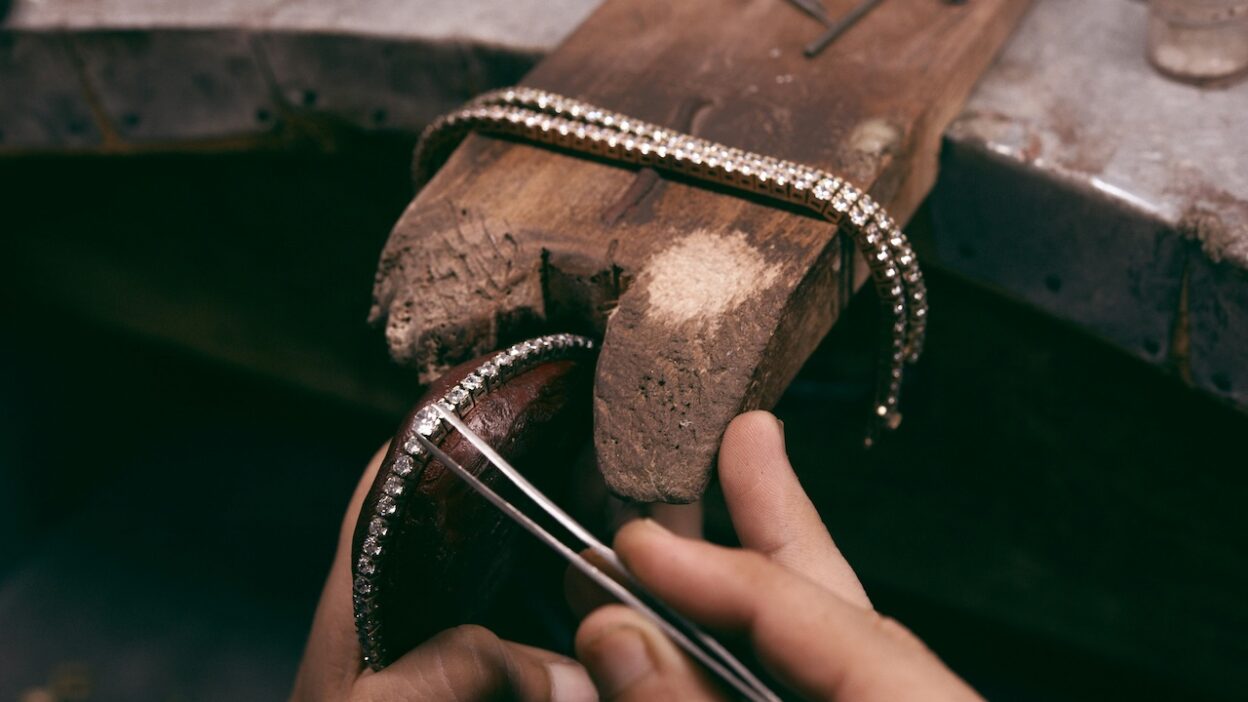
The high jewelry sector is hiring, and wages are competitive, but the craftspeople who can fill the most technically demanding roles are not available in sufficient numbers. Stone setters are not a bottleneck anyone discusses loudly, yet they remain the binding constraint on high jewelry volume.
How rising demand, aging artisans, and the technical demands of gem setting are creating a structural talent gap in luxury production
The global luxury goods market has expanded steadily, and high jewelry has followed that curve. Auction records fall each season, new maisons enter the segment, and established houses scale production upward. The labor market, however, has not kept pace. The artisans who set the stones at the heart of these pieces are aging out of the workforce faster than new talent arrives.
The widening gap between high jewelry demand and the hands to make it
LVMH, the world’s largest luxury group, has projected a shortfall of around 22,000 workers across its workforce. Roughly a third of those positions require craftspeople rather than managerial or commercial staff. To address this, the group scaled its Métiers d’Excellence apprenticeship program from 180 trainees in 2018 to approximately 700. Around 80 percent of those who complete the program are hired directly by LVMH brands.
These are reported internal figures from LVMH, not independent projections, but they illustrate the scale at which a single group is operating to close its own supply gap. The problem is structural. Craft skills in jewelry making and gemstone setting were historically transmitted through long workshop apprenticeships, where a junior setter spent years alongside a senior one. That model has contracted significantly as workshop sizes shrink and senior setters guard their production time.
What the LVMH figures suggest, and what smaller workshops confirm informally, is that demand at the high end is outpacing the pool of qualified setters by a meaningful margin. Industry associations have flagged this shift across Europe, though quantifying it remains difficult. Craft employment data tends to aggregate across metalwork trades rather than isolating stone setting as a distinct category.
Why stone setting is one of the hardest skills to build
Stone setting demands a level of mastery that covers gem setting, diamond setting, and pavé work, each requiring distinct combinations of manual dexterity, optical training, and precision judgment. The difficulty compounds at the high jewelry level, where a single misplaced millimeter can crack a stone worth more than the setter’s annual salary. Rome’s Gerardi Setting School, a professional stone setting training institution, specializes in exactly this formation, offering structured programs built around the trinocular method. The Gerardi Setting School trains students from multiple countries in the full technical range demanded by international luxury maisons.
The training path reflects this difficulty. Precision in setting is developed through repetition over years, not months. The most demanding techniques, including micro pavé and microscope-assisted work, require a practitioner to recalibrate nearly every physical habit developed at the bench. A workshop cannot replace a departing senior setter in a season; the incoming practitioner will take years to reach full capability.
Stone setting is not one technique but a family of methods, and each has its own learning curve. Bezel and channel work differ fundamentally from pavé and griffe. A setter who is fluent in one category may spend additional years developing the next. That breadth is part of why the skill takes so long to build, and why the shortage compounds itself as senior practitioners leave the workforce.
How luxury maisons are racing to train a new generation
The response from the largest players has moved beyond internal apprenticeships. Several major houses have begun opening or funding training structures that are at least partially accessible to the public. According to National Jeweler, Bulgari has roughly doubled the size of its Valenza manufacture and plans to bring on more than 500 craftspeople by 2029. As part of that expansion, the brand opened Scuola Bulgari, described as its first jewelry training school open to the public.
That move is significant. It represents a calculated effort to expand the external talent pipeline rather than compete purely for a fixed pool of already-trained setters. Other houses are watching, and when a maison of Bulgari’s standing builds a school, it signals that internal upskilling alone is no longer sufficient to meet production targets.
The shift reflects a broader acknowledgment that the sector has a training responsibility it cannot defer indefinitely. The timelines of institutional education and luxury production cycles are misaligned. Maisons that need setters within a couple of years cannot rely on programs whose graduates will arrive only years later.
What the shortage means for anyone entering the craft
The supply shortfall has reshaped the economics of the craft for those entering it. Entry-level demand at well-run workshops is genuine, and the ceiling for skilled practitioners has risen as senior setters become scarcer. The technical complexity of the work insulates it from the displacement patterns affecting more routine production tasks.
The conditions that make the shortage difficult to solve are the same conditions that make the skill worth acquiring. Stone setting resists shortcuts, resists remote work, and resists being broken into simpler sub-tasks and distributed across lower-skill labor. A trained setter is not easily substitutable, and the major buyers of that skill are the houses most willing to invest in retaining it. That combination is rare in contemporary manufacturing.
The craft also rewards sustained commitment differently from many technical trades. Competence builds in stages that are unevenly spaced, with long plateaus followed by step changes in capability. For those willing to work through those plateaus, the professional position at the end of the process is more durable, and more valued, than the entry point suggests.