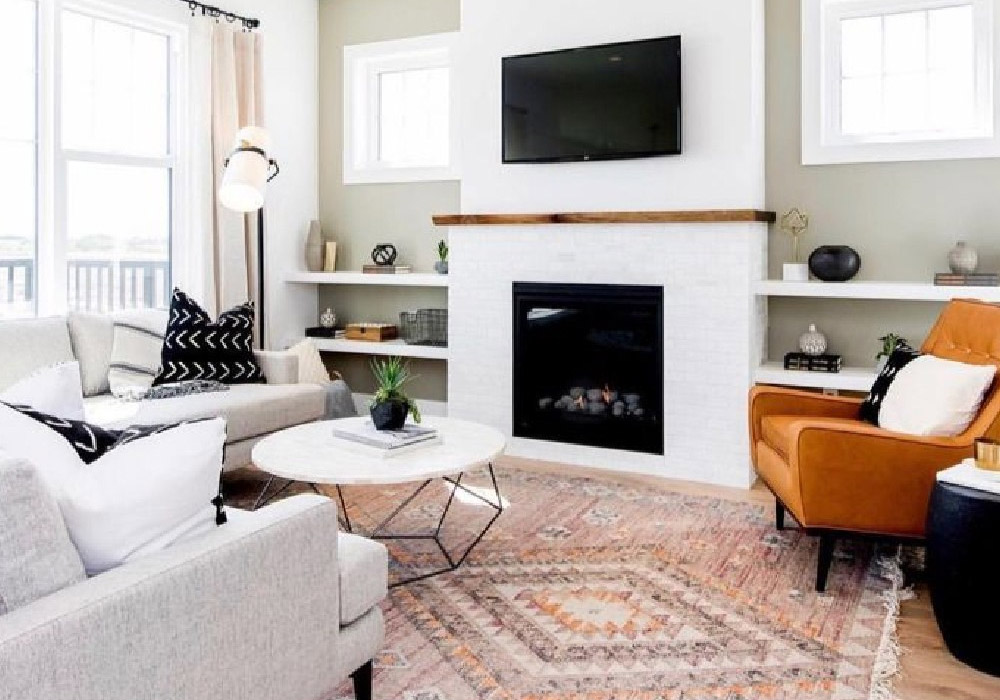
A living room can look bright and still feel uncomfortable. Light may fall in the wrong places, create glare near the sofa, or leave a favorite reading chair in shadow. These seven common mistakes explain why more brightness isn’t always the answer and how a few targeted changes can help.
1. Relying on one ceiling light
A single overhead fixture flattens everything below it. Faces get harsh shadows while corners stay dim, yet the center of the room feels flooded with brightness that no one enjoys for long. Recessed lights or a lone flush mount can do the same thing when they are the only source in a large space.
Start with a lighting plan built around layers that each do one job. Ambient light handles general movement and sets the base level for the evening. Task light supports reading and close work at the seats people actually use each night, where overhead light alone often leaves shadows. Accent light then brings out art and texture so walls don’t disappear after dark. Each layer can switch separately.
There’s no need to buy everything at once.
2. Mixing bulb colors across fixtures
Walk into some living rooms and one lamp glows warm while another throws cold blue-white light across the rug. That mismatch makes sofas and wood tones look off, even when the furniture is well chosen and the paint color is settled. The eye notices the clash first.
Look for 2700-3000K on the box and use that range for every bulb in the room. That span reads as soft white with a warmth that suits relaxing in the evening without looking too yellow. Check the label for lumens as well, because lumens indicate brightness more clearly than wattage when choosing LEDs and help avoid bulbs that feel too dim or too bright.
3. Skipping task light where people sit
Overhead light rarely reaches a book without a shadow from your head and shoulders. Reading can feel tiring in rooms with no lamp near the chairs, even when the ceiling looks bright. A bright corner can still fail readers.
Place a floor lamp or table lamp beside or slightly behind the reading chair. Test it while seated with a book open: light should reach the page without your head or hand casting a shadow. An adjustable shade helps direct the beam, while a shielded bulb keeps brightness out of your eyes. Pair it with a warm LED bulb that renders color well and suits the lamp’s controls.
4. Buying the wrong size fixture and hanging it wrong
Scale can matter more than style. A tiny pendant lost on a high ceiling has little presence, while an oversized floor lamp crowds a small nook and blocks sight lines across the room. Tape the outline on the floor or mock it up with cardboard before drilling holes in the ceiling.
Pendants need both size and height to work over a coffee table or seating zone. Choose the position around the furniture layout, leaving clear sight lines from every seat and enough headroom wherever people stand or walk. A mock-up helps reveal obstructions before installation. When comparing proportions and finishes for that kind of focal piece, browse the Lustria lighting store with the room’s dimensions and furniture layout in mind.
5. Leaving the room stuck at one brightness
Many living rooms have only on and off. That’s fine for cleaning, but less comfortable for movies and quiet conversation when full brightness feels harsh and flat.
There’s no reason to live with that limit.
Compatible dimmer switches or app-controlled smart bulbs offer more control without adding more fixtures. Set brighter levels for games or cleaning and lower levels for watching a movie. Match conventional LED bulbs to the dimmer manufacturer’s compatibility list; mismatched combinations can flicker or buzz. For smart bulbs, follow the manufacturer’s control recommendations rather than assuming they work with an existing wall dimmer.
6. Letting bare bulbs cause glare
Exposed bulbs photograph well but can be uncomfortable to sit near. Clear glass and open pendants throw light directly into the eyes, which can mean squinting through long evenings spent on the sofa. Shades and diffusers screen the light source.
Choose frosted glass or fabric shades with a deep fit so the bright source isn’t visible from nearby seats. Keep table lamp shades positioned so the bulb doesn’t peek out below the rim when viewed from a low chair. Indirect wall sconces can bounce light off walls for soft fill without adding floor clutter in tight seating areas.
7. Buying fixtures for looks alone
A lamp should suit the room and the way it will be used. Check that the base feels stable, the switch is easy to reach, and the shade directs light where needed. Bulb color quality deserves attention alongside the frame and finish.
Look for solid joints and clean finishes that hold up to daily use. Then check the bulb’s Color Rendering Index, or CRI, which indicates how faithfully it shows colors compared with a reference light source. Higher scores can help fabrics and paint look more natural. Test a bulb beside the actual upholstery before buying a full set.
Good living room light starts with distinct layers in one consistent color. Add a way to adjust brightness for different activities, and the room becomes easier to use throughout the evening.