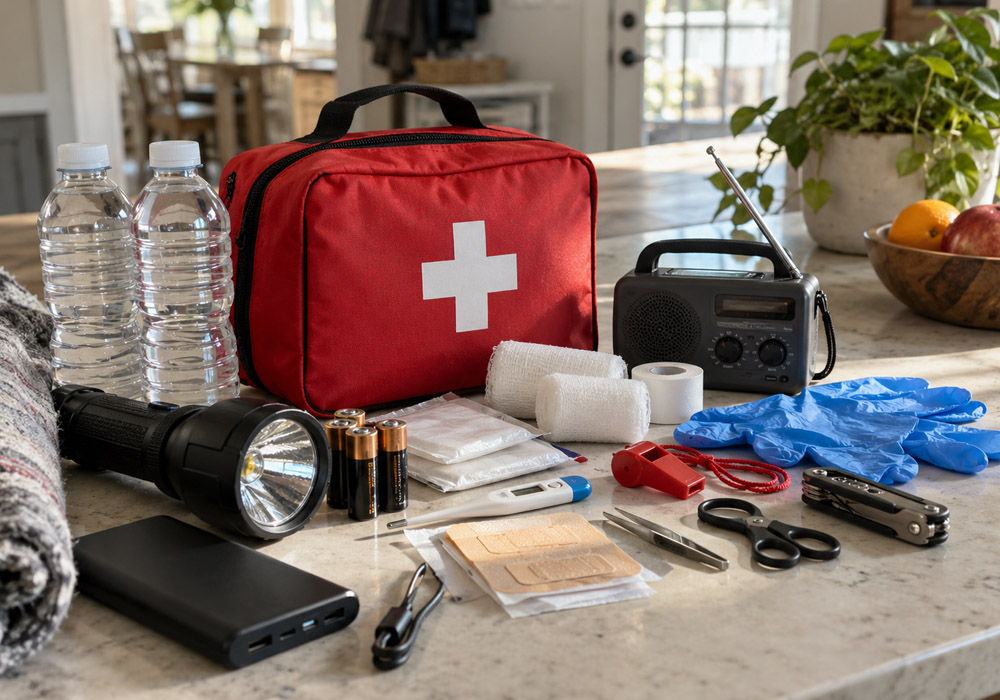
Accidents don’t announce themselves. A kitchen slip, a backyard fall, a sudden allergic reaction, all of these happen in the seconds when you’re least prepared, and the gap between the incident and professional medical help is exactly where your own readiness matters most. While a fully stocked medicine cabinet is a good start, the modern approach to home safety has moved well beyond adhesive bandages and antiseptic wipes. If you’ve been reading this site’s health section for a while, you know how often we talk about the importance of being proactive rather than reactive, and that same logic applies to the gear you keep on hand. The tools below cover bleeding control, wound care, monitoring, and even documentation, because being ready means having the right equipment and knowing how to use it. Think of this as a practical checklist for households that take preparedness seriously, especially if you’re the type of person who also cares about the finer details of health and wellness, like your smile or your skin, and you want that same level of attention applied to your safety net.
1. The QuikClot Advanced Clotting Gauze
Severe bleeding is the number one preventable cause of death in trauma situations, and standard gauze just doesn’t cut it when an artery gets nicked. QuikClot’s Advanced Clotting Gauze is impregnated with kaolin, a mineral that triggers your body’s natural clotting cascade almost instantly. You press it directly into the wound and hold, and it works even when blood is pooling fast. The FDA has cleared this type of dressing for over-the-counter use, which means you don’t need a prescription to keep it in your kitchen drawer. Pair it with a proper tourniquet and you’ve got a solid response for the worst-case scenarios. For everyday cuts and scrapes, you still need regular gauze, but this is the heavy artillery you hope you never need.
2. The SAM XT Extremity Tourniquet
Tourniquets used to be a last resort, a tool that medical professionals whispered about because of the risk of tissue damage. That thinking has changed completely. The military’s experience in recent conflicts showed that early, aggressive tourniquet use saves limbs and lives, and the SAM XT is one of the most user-friendly designs on the market. It has a windlass rod that you twist to tighten, a strap that locks in place, and a buckle that works one-handed, which matters if your other arm is injured. The American Red Cross now includes tourniquet training in its standard first aid courses, so there’s no excuse for not knowing how to apply one. Keep it in your car, your kitchen, and your garage, because bleeding control is time-sensitive and every second counts.
3. The Braun ThermoScan 7 Ear Thermometer
Fever is often the first sign of infection, and guessing at a temperature with a hand on the forehead is not a diagnostic strategy. The Braun ThermoScan 7 uses infrared technology to read the temperature of the eardrum, which reflects your core body temperature more accurately than armpit or forehead readings. It’s the brand that pediatricians overwhelmingly recommend, and its pre-warmed tip ensures that the probe itself doesn’t cool down the ear canal and skew the reading. You’ll use this hundreds of times over the life of your family, and the accuracy matters when you’re deciding whether to call the doctor or ride it out. It’s a purchase that pays for itself in peace of mind alone.
4. The Philips HeartStart Home AED
This one is a big investment, but consider the math. Cardiac arrest outside of a hospital has a survival rate under 10 percent, and that number drops by roughly 10 percent for every minute that passes without defibrillation. An automated external defibrillator like the Philips HeartStart speaks to you in plain English, walks you through pad placement, and analyzes the heart rhythm before it delivers a shock. It won’t let you shock someone who doesn’t need it, so it’s safe for untrained users. If you or anyone in your household has a history of heart issues, this is the single most valuable item on this list. The American Heart Association maintains detailed guidance on AED placement in homes, and their statistics on survival rates are sobering enough to justify the cost.
5. The ResQPOD Impedance Threshold Device
CPR saves lives, but the quality of that CPR varies wildly depending on who’s performing it and how tired they get. The ResQPOD is a small valve that attaches to a CPR mask or bag-valve mask, and it creates a slight vacuum in the chest during the recoil phase of compressions. That vacuum pulls more blood back into the heart, which means the next compression pushes more oxygenated blood to the brain. Studies published in the medical journal JAMA have shown measurable improvements in survival rates when this device is used during resuscitation. It’s not a standalone tool; it’s an enhancement to standard CPR, and it’s cheap enough that every well-stocked first aid kit should have one. You still need proper training, but this gadget makes your efforts more effective.
6. The NightSight LED Headlamp
Think about every emergency you’ve ever read about that happened after dark. Power outages, car breakdowns, searching for a dropped medication, all of these are miserable with a flashlight held between your teeth. A proper headlamp frees both hands for the actual work, and the NightSight model has a red light mode that preserves your night vision while still letting you see what you’re doing. It’s waterproof, it takes standard AAA batteries, and its strap fits comfortably over a helmet or a hood. You’ll also use it for camping, home repairs, and late-night dog walks, so it’s not a single-use item that sits in a drawer gathering dust. The utility per dollar on this thing is absurd.
7. The TraumaShears 7.5 Inch Bandage Scissors
You cannot cut through a pair of jeans with regular scissors, and in a trauma scenario, you might need to expose a wound that’s covered by thick fabric. Trauma shears have a blunt tip that slides under clothing without stabbing the skin, and their angled blades are strong enough to cut through denim, leather, and even a belt. The 7.5 inch size is the sweet spot for hand size and leverage. They’re also invaluable for cutting medical tape, opening packaging, and trimming gauze, so they earn their place in every single first aid kit you own. A good pair will outlast you, and they cost less than a movie ticket.
8. The Oura Ring Gen 3 for Health Monitoring
This one is a bit of a curveball, but hear out the logic. The Oura Ring tracks your resting heart rate, body temperature, and blood oxygen levels continuously, and it builds a baseline of your personal norms over weeks and months. When something is off, whether it’s the early stage of an infection, stress, or overtraining, your metrics will deviate from that baseline, and the app flags it. This kind of passive monitoring gives you a head start on illness, which is exactly what you want when your family depends on you to be the one who notices things first. It’s not a medical device, so don’t treat it as a diagnostic tool, but it’s a very effective early warning system that runs silently on your finger.
9. The 3M Micropore Surgical Tape
Dressings fall off, bandages slide, and gauze shifts when you move, and the culprit is almost always cheap adhesive tape. 3M Micropore is the paper tape that hospitals use, and it breathes, stretches slightly, and removes cleanly without pulling out arm hair. It holds dressings firmly in place even during a full day of movement, and it tears easily by hand so you don’t need scissors in the moment. It also works for splinting a finger, securing an ice pack, and labeling medication bottles. This is one of those boring essentials that you don’t think about until you need it, and then you’re amazed that you ever tried to get by without it.
10. The Emergency Preparedness Manual from FEMA
Gear is meaningless without a plan, and the Federal Emergency Management Agency publishes a free, downloadable manual that walks you through building a family emergency plan, stocking supplies, and handling specific scenarios like fires, floods, and earthquakes. The FEMA website has resources for every region of the country, and their guidance is written in plain language that doesn’t assume you have any prior training. Print it out, put it in a binder, and run through the drills with your household twice a year. You don’t need a basement bunker or a full stockpile of canned goods to be prepared; you need a documented plan and the tools to execute it. That’s the whole ballgame, and the manual is the starting point.
When you get serious about your health, you start small, with flossing more regularly, booking that appointment with a Cosmetic Dentist White Rock recommends, and paying attention to your daily habits. Emergency preparedness follows the same trajectory. You start with the basics, then you layer in the equipment that handles the situations you actually fear, and before long you’re the person who’s ready when everyone else is scrambling.