
Foundations of Employment and Consumer Law in Defamation Claims
Defamation law serves as a critical mechanism for protecting an individual’s or entity’s reputation from false and damaging statements. At its core, defamation is classified as a prima facie tort, meaning that a plaintiff must prove specific elements to establish a valid claim. These elements generally center on false assertions of fact that cause harm to reputation, and the plaintiff must meet a particular standard of proof. The legal framework aims to strike a delicate balance between safeguarding free speech and providing recourse for those whose reputations have been unjustly tarnished.
Essential Elements Under Employment and Consumer Law
To successfully pursue a defamation claim, a plaintiff must typically prove four or five essential elements, depending on the jurisdiction and specific circumstances. These elements are:
- A False Statement Purporting to Be Fact: The statement must be presented as an assertion of fact, not merely an opinion. Crucially, this statement must be false. Truth, as we will discuss, is an absolute defense to defamation.
- Publication to a Third Person: The defamatory statement must be communicated, either orally or in writing, to at least one person other than the plaintiff. This “publication” can occur through various mediums, including traditional media, private conversations, or, increasingly, digital platforms.
- Fault Amounting to at Least Negligence: The defendant must have acted with a certain level of culpability. For private individuals, this typically means acting with negligence—failing to exercise reasonable care in ascertaining the truth of the statement. For public officials and public figures, a higher standard of “actual malice” is required, meaning the statement was made with knowledge of its falsity or with reckless disregard for the truth.
- Harm Caused to Reputation (Damages): The false statement must have caused actual injury to the plaintiff’s reputation. This can manifest as economic losses, emotional distress, or damage to one’s standing in the community.
In some jurisdictions, a fifth element, “of and concerning the plaintiff,” is explicitly stated, meaning the statement must clearly identify or be reasonably understood to refer to the plaintiff.
The severity of the harm and the need to prove it can vary significantly based on whether the statement falls into the category of “defamation per se” or “defamation per quod.”
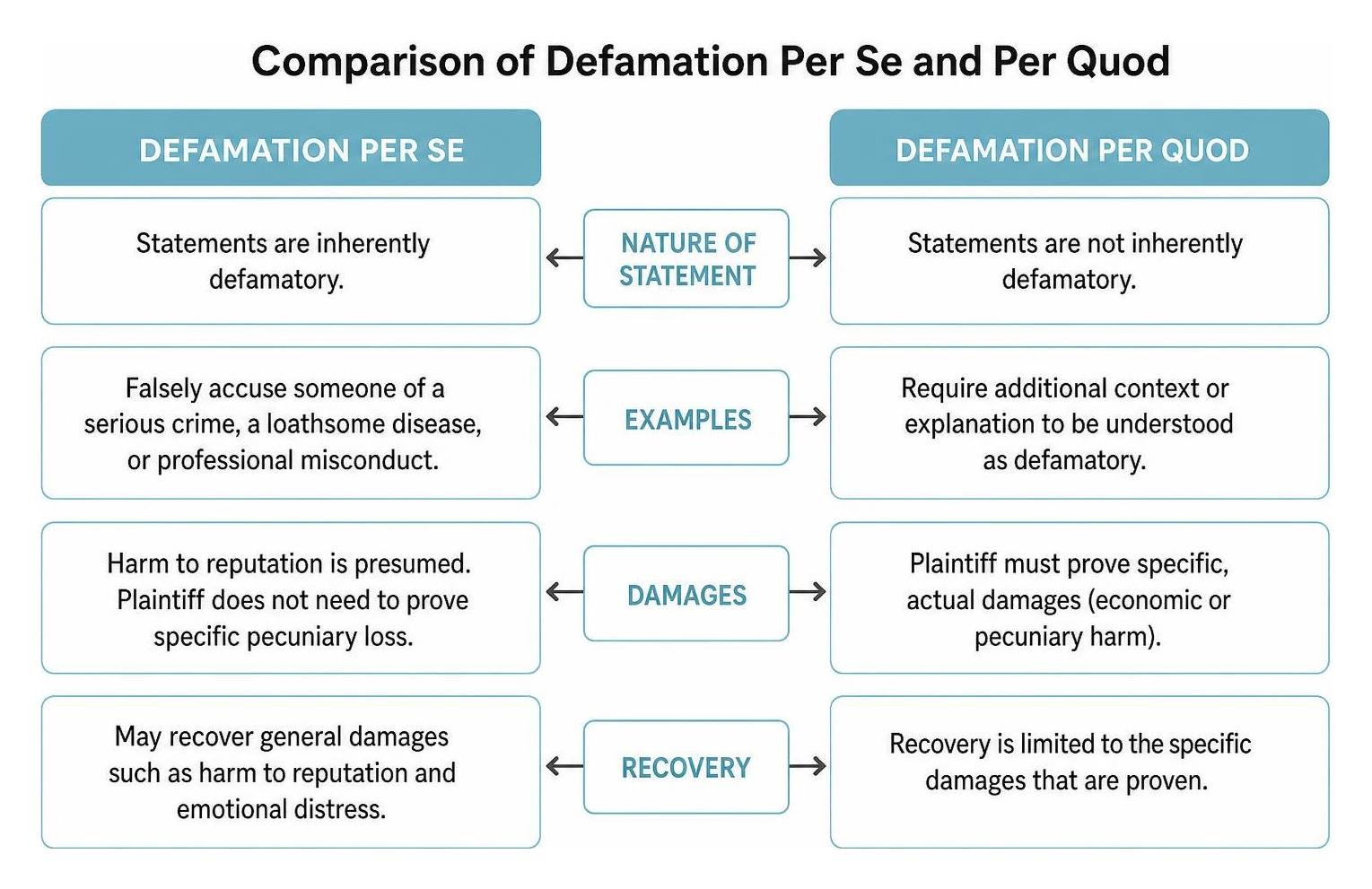
Defamation per se refers to statements that are inherently defamatory and presumed to cause harm, such such as falsely accusing someone of a serious crime, a loathsome disease, or professional misconduct. In these cases, plaintiffs may not need to prove specific pecuniary loss. For instance, some states treat accusations of committing a crime or a corrupt act as outright defamatory per se. Conversely, defamation per quod requires the plaintiff to prove specific, actual damages resulting from the defamatory statement, often involving demonstrable economic or pecuniary harm. This distinction significantly impacts a plaintiff’s case, particularly regarding the burden of proof for damages.
Fact Versus Opinion in Consumer Reviews and Evaluations
A critical aspect of defamation law, particularly in the realm of consumer reviews and evaluations, is the distinction between statements of fact and statements of opinion. Only statements purporting to be factual can be considered defamatory. Pure opinions, rhetorical hyperbole, or statements that cannot be objectively verified as true or false are generally protected under the First Amendment.
However, the line between fact and opinion can be blurry. A statement phrased as an opinion can still be actionable if it implies undisclosed false facts. For example, saying “In my opinion, that doctor is incompetent” might be protected. But saying “In my opinion, that doctor is incompetent because she regularly misdiagnoses patients” could be defamatory if the implication of regular misdiagnosis is false and presented as an underlying fact. Courts will consider the context, phrasing, and whether a reasonable person would interpret the statement as asserting a verifiable fact.
This distinction is particularly relevant for review platforms and in cases of commercial disparagement. Businesses and individuals often rely on online reviews, and false factual claims can severely impact their reputation and livelihood. While platforms often have policies regarding content, the legal burden for proving defamation still rests on the plaintiff to demonstrate that the statement was a false assertion of fact, not merely a subjective viewpoint. Actionable steps for individuals often involve determining whether the statement in question is expressed as an actionable fact or a protected opinion before proceeding with legal action.
Workplace Defamation, Retaliation, and Worker Protections
The workplace, with its inherent dynamics of communication, evaluation, and professional reputation, presents a fertile ground for defamation claims. Employer communications, workplace gossip, performance discipline, and reference checks can all become sources of potentially defamatory statements, impacting an individual’s career trajectory and professional standing.
Defamatory Statements in Job References and Performance Reviews
One of the most common arenas for workplace defamation involves job references and performance reviews. Employers walk a fine line when providing information about current or former employees. While they generally have a legitimate interest in sharing accurate information, false or misleading statements can lead to significant legal repercussions.
The concept of “blacklisting”—where an employer intentionally provides negative or false information to prevent a former employee from securing new employment—is explicitly addressed in some state laws. For instance, under California Labor Code Section 1050, individuals found guilty of such defamation may be liable for “triple damages.” This statute aims to protect employees from malicious interference with their ability to find work.
In these contexts, the defense of “qualified privilege” often arises. This privilege protects employers who make statements without malice, in good faith, and to individuals with a legitimate interest in the information (e.g., prospective employers). However, this privilege can be lost if the statement is made with actual malice, excessive publication, or knowledge of its falsity. Therefore, employers must verify statements against objective facts before publication to avoid negligence or reckless disregard. For those navigating complex employment issues, including potential defamation, understanding the nuances of these protections is crucial, especially when seeking workplace discrimination representation.
Compelled Self-Defamation and Wrongful Termination
A unique and often complex area of workplace defamation is “compelled self-defamation,” also known as compelled self-publication. This doctrine applies when an employer makes a defamatory statement to an employee, and it is foreseeable that the employee will be compelled to repeat that statement to a third party, such as a prospective employer during a job interview. In such cases, the employer can be held liable for the employee’s “self-publication” of the defamatory statement.
For example, if an employee is terminated for allegedly stealing company property (a false accusation) and is then asked by a prospective employer why they left their last job, they might feel compelled to repeat the employer’s defamatory reason. If it was foreseeable that the employee would have to explain their termination, the original employer could be liable.
This concept often arises in wrongful termination cases, where the grounds for termination are false and defamatory. It challenges the traditional publication requirement by recognizing that, in certain circumstances, the employee’s own repetition of the statement can satisfy the element of publication, extending employer liability. While at-will employment is the default in many states, exceptions exist, and false, defamatory statements surrounding termination can create significant employer liability, especially when employees are forced to repeat these statements on job applications.
Constitutional Standards, Digital Media, and Platform Liability
The landscape of defamation law in the United States is profoundly shaped by the First Amendment, which protects freedom of speech and the press. This constitutional overlay introduces unique standards, particularly concerning public figures, and presents complex challenges in the digital age, where information spreads rapidly across various platforms.
Public Figures Versus Private Individuals Across Employment and Consumer Law
The U.S. Supreme Court has established different legal standards for defamation claims based on the plaintiff’s status: whether they are a public official, a public figure, or a private individual. This distinction emerged from landmark cases such as New York Times Co. v. Sullivan (1964) and Gertz v. Robert Welch, Inc. (1974).
In New York Times Co. v. Sullivan, the Supreme Court held that public officials must prove “actual malice” to win a defamation claim related to their official conduct. This means they must demonstrate, by “clear and convincing evidence,” that the defamatory statement was made with knowledge that it was false or with reckless disregard of whether it was false or not. This higher burden of proof was established to foster robust public debate and prevent public officials from using libel laws to suppress criticism. The jury in the original Sullivan case had awarded the plaintiff $500,000 in damages, a stark contrast to the maximum $500 fine under Alabama’s criminal libel statute at the time, highlighting the potential chilling effect on free speech.
This “actual malice” standard was later extended to “public figures,” which include “all-purpose public figures” (individuals who have achieved pervasive fame or notoriety) and “limited-purpose public figures” (individuals who voluntarily inject themselves or are drawn into a particular public controversy).
For “private individuals,” the standard is generally lower. They typically only need to prove that the defendant acted with “negligence”—meaning the defendant failed to exercise reasonable care in ascertaining the truth of the statement before publication. This differentiation ensures that while private citizens have stronger protections for their reputations, public discourse on matters of public concern remains largely uninhibited.
Social Media Defamation and Section 230 Immunity
The rise of digital media, particularly social media, has introduced unprecedented complexities to defamation law. What constitutes “publication” has expanded to include posts, shares, comments, and even likes on platforms like Facebook, X (formerly Twitter), Instagram, and TikTok. The speed and reach of online content mean that defamatory statements can spread globally in moments, causing rapid and widespread reputational damage.
A significant legal development in this area is Section 230 of the Communications Decency Act (CDA). This federal statute generally provides immunity to “interactive computer services” (which include social media platforms, forums, and websites that host user-generated content) from liability for content posted by their users. The rationale behind Section 230 is to encourage platforms to moderate content without fear of being held liable for every user-generated post.
However, this immunity is not absolute. Platforms can lose Section 230 protection if they actively participate in creating or materially altering the defamatory content. The “republication rule” generally holds that anyone who repeats or republishes a defamatory statement is also liable, but Section 230 carves out an exception for platforms acting merely as hosts. This creates a challenging environment for individuals seeking to remove defamatory content online, as the platform itself is often shielded, leaving the plaintiff to pursue the original poster.

The format of online content also poses questions: does a defamatory video on TikTok constitute libel (written/permanent) or slander (spoken)? Courts are continually grappling with these modern digital dynamics, striving to apply traditional defamation principles to a rapidly evolving technological landscape.
Key Legal Defenses, Privileges, and Retraction Statutes
Even when a statement might appear defamatory, several robust legal defenses and privileges can shield a defendant from liability or significantly mitigate damages. These liability shields are crucial for protecting free speech and ensuring that individuals and media organizations can engage in public discourse without undue fear of litigation.
Absolute and Qualified Privileges
Legal privileges offer protection from defamation claims under specific circumstances, even if the statements made are false and harmful. There are two main types:
Absolute Privilege: This provides complete immunity from defamation lawsuits, regardless of whether the statement was made with malice or knowledge of its falsity. Absolute privilege typically applies to statements made in certain official contexts deemed essential for the functioning of government and justice. Examples include:
Statements made by participants in judicial proceedings (e.g., judges, lawyers, witnesses, jurors) during the course of a trial or hearing.
Statements made by legislators during legislative debates or proceedings.
Statements made by high-ranking executive officials in the course of their official duties.
Truth is recognized as a complete defense against all defamation claims, but absolute privilege goes a step further, shielding statements even if they are false.
Qualified Privilege (or Conditional Privilege): This offers protection for statements made in good faith and without malice, where the speaker has a legal, moral, or social duty to make the statement, and the recipient has a corresponding interest in receiving it. This privilege is “qualified” because it can be defeated if the plaintiff proves that the statement was made with actual malice, excessive publication, or a reckless disregard for the truth. Common examples include:
Statements made during employment investigations or performance appraisals.
Reference checks provided by former employers.
Statements made to law enforcement during an investigation.
Communications between individuals who share a “common interest,” such as members of a professional organization or homeowners’ association.
These privileges are vital for ensuring that certain essential communications can occur freely without the constant threat of defamation lawsuits.
Truth, Substantial Truth, and Retraction Demands
The most powerful and common defense against a defamation claim is truth. If a defendant can prove that the statement in question is true, it cannot be defamatory, regardless of how damaging it might be to the plaintiff’s reputation. The burden of proving falsity generally rests with the plaintiff, especially in cases involving public figures or matters of public concern.
Related to truth is the doctrine of substantial truth. This defense holds that even if a statement contains minor factual inaccuracies, it is not defamatory if the “gist” or “sting” of the statement is true. Courts recognize that minor errors do not fundamentally alter the overall truthfulness of a communication.
Furthermore, many states have retraction statutes that allow defendants to limit their potential liability or damages by promptly publishing a retraction or correction of a defamatory statement. These statutes often specify requirements for the retraction, such as its prominence and timing.
Statutory mitigation steps often include:
- Prompt Correction: Issuing a retraction or correction notice quickly after discovering an error.
- Equal Prominence: Publishing the retraction with the same prominence as the original defamatory statement.
- Specific Content: The retraction must clearly acknowledge the falsity or inaccuracy of the original statement.
- Damage Limitation: In many states, a proper retraction can limit recoverable damages to “special damages” (actual monetary losses, such as lost wages), precluding the recovery of general damages (e.g., emotional distress) or punitive damages.
Publishers can reduce potential defamation damages in select states by issuing a formal retraction or redaction. This mechanism provides an incentive for defendants to correct errors and for plaintiffs to seek remediation without necessarily resorting to full litigation for all types of damages.
Frequently Asked Questions About Defamation in the Workplace
Navigating defamation claims in the workplace can be particularly challenging due to the sensitive nature of employment relationships and professional reputations. Here, we address some frequently asked questions to clarify common scenarios and legal thresholds.
Can a former employer give a false reference that prevents new employment?
Yes, a former employer can be held liable for giving a false and defamatory reference that prevents a former employee from obtaining new employment. This falls under the umbrella of misrepresentation and, in some cases, can be considered “blacklisting.” As discussed, California Labor Code Section 1050 specifically prohibits employers from making misrepresentations that prevent or attempt to prevent a former employee from securing new employment.
To succeed in such a claim, the plaintiff would typically need to prove:
- The employer made a false statement of fact.
- The statement was communicated to a prospective employer (publication).
- The employer acted with the requisite fault (e.g., malice or negligence, depending on the jurisdiction and the nature of the statement).
- The false statement caused actual harm, such as the loss of a job offer or other economic damages.
Such actions can also give rise to claims of intentional interference with prospective economic advantage, where the employer’s malicious actions directly caused the employee to lose a potential job opportunity. The potential for “triple damages” under statutes like California Labor Code 1050 provides a strong deterrent against such malicious practices.
What is the difference between defamation per se and defamation per quod?
The distinction between defamation per se and defamation per quod is crucial because it affects the plaintiff’s burden of proving damages:
- Defamation per se: These are statements considered so inherently damaging to one’s reputation that harm is presumed, and the plaintiff typically does not need to prove specific actual damages (pecuniary loss). Categories often include false accusations of:
- Committing a serious crime.
- Having a loathsome or contagious disease (e.g., certain sexually transmitted infections).
- Professional misconduct or incompetence (trade disparagement).
- Serious sexual misconduct.
- For example, falsely stating that an accountant embezzled funds would likely be defamation per se because it directly impugns their professional integrity.
- Defamation per quod: These are statements that are not obviously defamatory on their face and require additional facts or context (an “inducement”) to understand their defamatory meaning. For per quod claims, the plaintiff must plead and prove “special damages,” meaning specific, quantifiable pecuniary loss directly resulting from the defamatory statement. General allegations of emotional distress or lowered social standing are usually insufficient. For instance, an oral accusation of immoral conduct may not be actionable per se unless it imputes an indictable crime involving moral turpitude or directly causes proven pecuniary damage, as highlighted in historical cases like Pollard v. Lyon (1875).
Understanding this distinction is vital for both plaintiffs and defendants, as it dictates the pleading standards and the types of evidence required to prove a claim.
How do retraction statutes affect potential damages in defamation suits?
Retraction statutes, present in nearly every U.S. state, play a significant role in limiting the potential damages recoverable in defamation lawsuits. These laws encourage the prompt correction of factual errors and provide a mechanism for defendants to mitigate their liability.
Typically, if a defendant publishes a timely and conspicuous retraction or correction of a defamatory statement, they may be shielded from certain types of damages, such as punitive damages (designed to punish the defendant) and general damages (for emotional distress, humiliation, etc.). In many states, including California, a proper retraction can limit a plaintiff’s recovery to only “special damages,” which are specific, quantifiable economic losses (e.g., lost income, medical bills directly attributable to the defamation).
The effectiveness of a retraction often depends on:
- Timeliness: The retraction must be published within a specified statutory deadline after the plaintiff’s demand or discovery of the error.
- Prominence: It must be published with the same or similar prominence as the original defamatory statement.
- Content: It must clearly and unambiguously retract or correct the false statement.
These statutes serve to balance the plaintiff’s right to clear their name with the defendant’s right to correct errors without facing excessive financial penalties, promoting prompt remediation and reducing the likelihood of protracted litigation.
Conclusion
Our reputation is a fragile yet invaluable asset, profoundly impacting our personal lives, professional careers, and public standing. Understanding the intricate legal framework surrounding defamatory statements is not merely an academic exercise; it is an essential aspect of safeguarding our rights in an increasingly interconnected world.
From the foundational elements of false statements and publication to the nuanced standards of fault for public figures versus private individuals, defamation law provides a critical mechanism for redress. The complexities introduced by workplace dynamics, such as job references and compelled self-defamation, alongside the challenges of digital media and platform immunity, underscore the need for vigilance and informed action.
We have explored the vital defenses of truth and privilege, as well as the role of retraction statutes in mitigating damages. This knowledge empowers individuals to protect their reputational integrity and pursue appropriate legal remedies when false assertions cause harm. By understanding these principles, we can better navigate the legal landscape, ensuring statutory compliance and advocating for prompt remediation when our reputations are at stake.