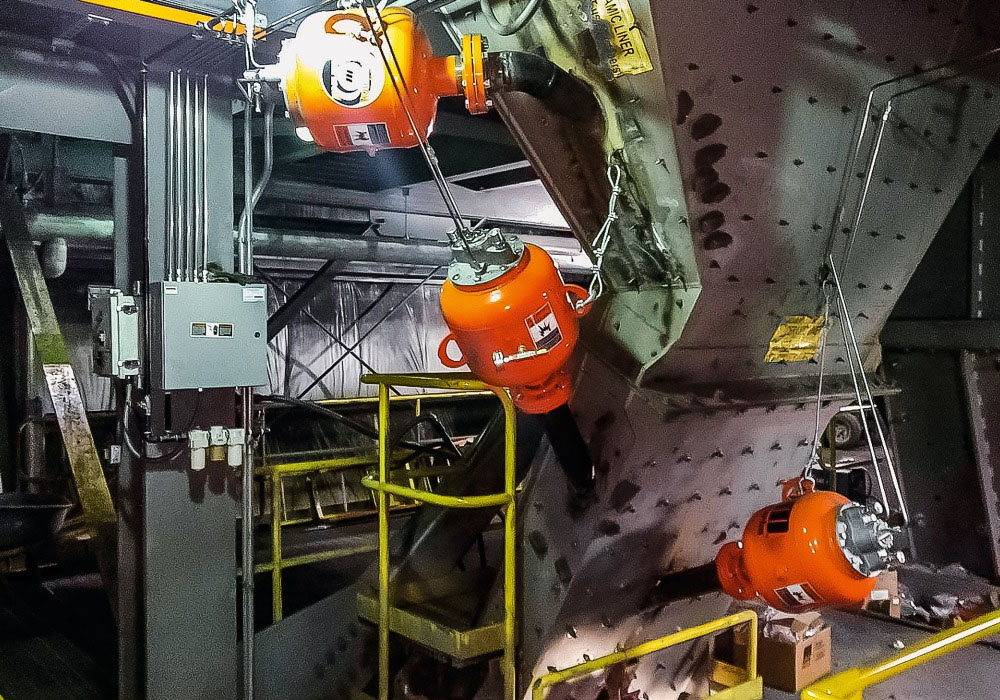
Air cannons don’t fail because the idea is wrong. They fail because plants treat them as hammers rather than working parts of a flow system. The same pattern is seen in mining circuits, where a blocked bin stops the entire crusher train.
Design errors lock in weak blasts and dead zones before the plant even starts. Operating errors then waste the remaining power through poor timing and low air quality. Fix both sides and flow performance becomes far more consistent.
This piece covers eight mistakes that are seen in ROM bins and transfer chutes. The first four happen on paper, while the last four happen on shift. Each one reduces the force that reaches the material.
Mistake 1: sizing on pressure and ignoring stored air
Many specifications list pressure first and stop there. A 100-psi rating sounds strong, so buyers assume two units with the same rating will hit with the same force. They don’t.
Stored energy sits in the receiver tank volume, not only in the gauge reading. Pressure sets the punch per litre, while tank volume determines how many litres expand into the hopper. The quick-release discharge valve controls how fast that charge escapes, with port diameter acting as the choke point for peak blast force.
When units have been pulled apart, they look equal on paper but have very different ports inside. One had a wide bore that dumped its tank in a sharp crack. The other used a smaller bore that throttled the same tank into a long sigh. Compare two models with the same pressure rating but different tank volumes and valve bores, and the larger assembly may fracture a settled arch while the smaller one only dusts the surface.
Pressure alone is not enough for selection. Ask for output tied to tank size and port bore at your working pressure. Check duty against sticky ore rather than clean gravel. If a vendor won’t share tank volume and valve bore, you don’t have enough information to choose properly.
Mistake 2: aiming at the wall instead of the bridge anchor
Every bin has a point where flow stops. In most hoppers, it is the convergence zone where the sloped walls meet the outlet throat. An arch anchors on both sides at this point, which is where bridging usually starts.
Crews often bolt nozzles wherever access is easy. They aim straight at the wall face or high above the outlet because a free flange is already there. That blast stirs loose material while leaving the anchor untouched.
Pressure alone tells you almost nothing about whether the blast will reach the problem area.
Check the material’s angle of repose and watch where lumps lock during discharge. Place the nozzle so it drives under that ledge at 15 to 30 degrees below horizontal towards the outlet, rather than at the flat wall. The pulse needs to shear the foot of the arch so the span above it can no longer hold.
When the nozzle points too high or sits square to the wall, the shock wave spreads across steel and loose fines. Meanwhile, the compacted shoulder that holds the bridge remains intact and continues to build.
Mistake 3: spacing cannons too far apart
One cannon can’t sweep an entire bin. Each blast clears a limited footprint around the nozzle, often called the effective cleaning radius, and material outside that circle does not move. Space the units beyond that reach and strips remain where fines can settle and pack.
Over time, those strips form a lining. Layer by layer, damp fines and clay-rich ore press against the wall until they stop responding to nearby blasts. Flow narrows into a central channel while dead material remains on the sides, creating the classic ratholing that cannons are intended to collapse.
Adding pressure would not solve it. The practical fix was another nozzle connected to the same header and aimed at the dead shoulder.
Don’t set spacing by guesswork. Map the effective radius for your ore and overlap the coverage at the outlet transition. Adding a nozzle during installation is cheaper than chipping out a live bin with hand tools while the crusher train waits.
Mistake 4: firing all cannons at once
Hitting every button together feels powerful. In practice, simultaneous discharge dumps the header and lowers pressure at every nozzle. The resulting shared pulse may pack fines more tightly rather than shearing the arch.
Loose material compacts when hit from all sides. A blast that should fracture the bridge can instead force the shoulder into a denser plug, requiring even more force on the next attempt. The system burns a full charge of air and leaves behind a harder blockage.
A bottom-up sequence fixes this issue without additional equipment. In a multi-cannon installation, each air cannon should be triggered in a bottom-up sequence so freed material has a clear path downwards.
Clearing the lower arch first removes the support beneath the material. The load above then falls into the open void instead of locking into a stronger span across the hopper.
Start with the lowest nozzle at the outlet throat. That shot clears the throat and restores a void before the next unit above fires into the newly opened space, with the sequence continuing upwards step by step. Once the foot of the blockage is gone, gravity does much of the remaining work.
PLC timing makes the process repeatable. Set delays that allow material to drop between shots and tank pressure to recover before the next discharge. Manual gang firing cannot maintain the same rhythm and often drifts back towards all-at-once firing under pressure.
Mistake 5: starving the cannon with a small feed line
A cannon is only as ready as its refill allows. After each blast, the receiver must recharge through the feed line, and refill time depends on the line diameter and real airflow at the hopper. The compressor nameplate in a distant room does not show what reaches the unit.
Industry professionals have seen long runs and shared headers take away flow. A 25-mm line that looks adequate on a sketch can leave a large tank only half charged when the timer calls for the next shot. The gauge at the compressor may still read full. The gauge at the tank shows what the cannon actually has available.
Sticky ore in mining crusher feed bins won’t wait for a slow recharge. It needs full-energy shots on a tight cycle, and delayed refilling turns a strong design into a weak puff that merely dents the arch.
The operating cost matters as well. Compressed air accounts for roughly 10% of industrial electricity use (Compressed Air Challenge), so leaky couplings and undersized lines waste power at the same time as a blocked chute stops production.
Size lines for the actual CFM required at the point of use. Keep runs short and straight where the installation allows it. Measure refill time at the tank after installation instead of relying only on figures taken during compressor commissioning.
Mistake 6: waiting for a blockage instead of firing on time
Most crews fire when flow stops. The bin hangs up, the belt runs empty and someone presses the manual button. It feels logical, but this approach asks the most from the system at the worst point.
Once fines sift into voids and moisture wicks through contact points, the span gains strength quickly. It can need several times more force to break than the same material required while it was still moving. This jump can be measured on sticky ores that set like concrete after a weekend shutdown.
Proactive cycles are more effective than reactive blasts. Short timed shots during normal flow prevent shoulders from locking and help keep the outlet throat open. They use less air per shot while avoiding the dead stop that idles downstream equipment.
There is no single timer setting for every ore. Start with frequent light cycles, then tune them to throughput and moisture conditions. Watch the discharge stream and adjust the sequence until the dip that warns of a new bridge no longer appears.
Mistake 7: letting wet air and worn seals bleed off power
Mine air is hard on valves. Heat and moisture travel through the lines before condensation collects inside tanks and valve bodies. That water rusts steel and damages seals until the valve sticks or leaks during the firing cycle, causing a soft shot that crews may mistake for low compressor output.
A leaking valve never builds a full charge. The system fires late or fires softly, and crews blame the pressure settings even though wet air is the underlying fault. Dryers and automatic drains directly affect whether full force reaches the nozzle.
Piston seals and gauges have a finite service life in dusty, high-vibration conditions. Once they begin to pass, force fades a little further with each cycle. A unit that worked last quarter may not deliver the same impact this quarter if nobody checks its condition.
Plants can chase pressure problems for weeks when a five-minute drain check would have identified the cause of repeated misfires. Put air preparation and inspection on a schedule. Log tank pressure after refill and monitor it for drift. Isolation remains essential: any hands-on inspection must be completed by trained staff under site lockout/tagout rules, with the air isolated and stored pressure safely released before the receiver is opened.
Mistake 8: using cannons to cover bad hopper geometry
This is the error behind many of the others. Some hoppers will never flow cleanly, regardless of how many cannons are bolted on. Steep mass-flow walls behave very differently from shallow funnel-flow pockets, and cannons cannot rewrite the underlying geometry.
A funnel-flow bin with a narrow outlet and flat shoulders will continue to form a stable arch. The outlet spans too wide for the material’s angle of repose. Fines lock early, so each blast clears a temporary hole that soon closes again. Increasing the air supply will not change the span.
Circuits have been audited where the timers and nozzles were correct, yet ROM bins still hung up during every shift. The walls held material in a steep pipe while the centre emptied, after which the pipe collapsed and slammed the feeder. If the outlet is too small for the ore’s cohesion and the wall angle retains dead material at the sides, each blast punches a short-lived hole that closes as flow resumes.
Treat cannons as flow aids rather than complete cures. If hang-ups return on schedule despite good air and correct timing, have the hopper angles and outlet size reviewed. A steel correction carries a one-off cost. Masking the geometry problem with compressed air costs the plant every day.
Cannons work when the surrounding system works with them. Get sizing, placement, air supply and timing right, and bridging remains a manageable flow issue instead of becoming a shift-stopping blockage.