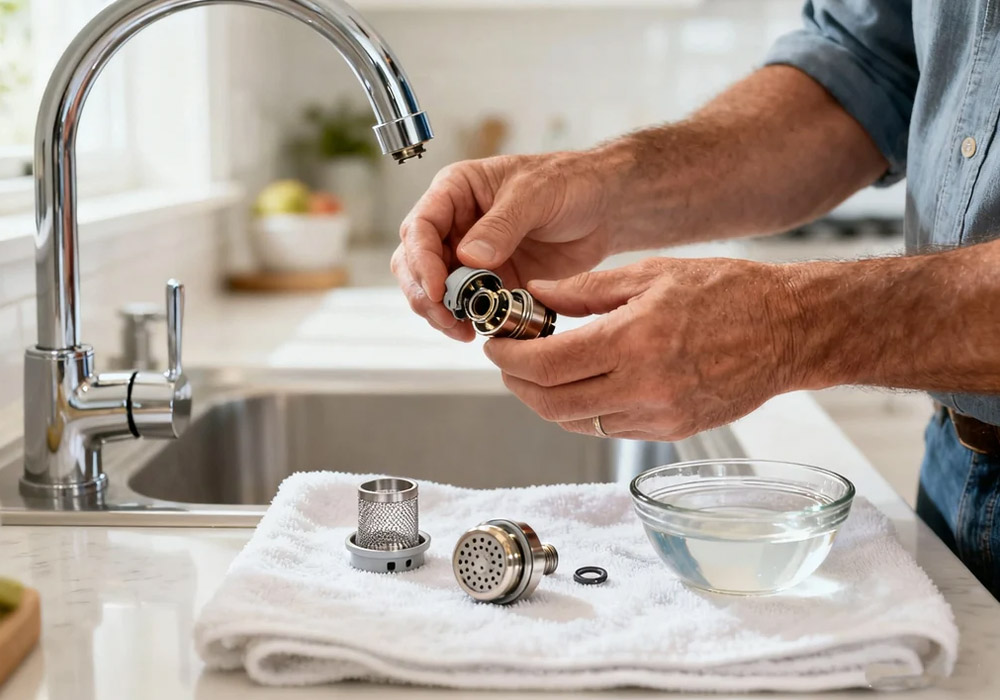
Two neighbors swapped the same model of pull-down faucet on the same Saturday. One finished before her coffee went cold. The other was still crouched under the cabinet at dinner, flashlight in her teeth, muttering about a nut that would not budge. Same faucet, same afternoon, wildly different results, which tells you the real question is not how long does it take to replace a faucet but what kind of faucet swap you happen to be running. Before you block out your weekend, figure out which of those two afternoons is yours.
I spent most of my twenties renting, which means I did a lot of swapping faucets I did not pay for on sinks I did not own. Cheap ones go fast. Nice ones with a sprayer and a soap dispenser are a whole other animal. If you want a technician’s typical range in a normal kitchen, a licensed plumber usually wraps the job in 30 to 60 minutes, while a first timer can expect a few hours. A service page laying out how long does it take to replace a faucet puts the same spread on record: an hour or less with a pro, a couple of hours or more on your own. Both numbers are honest. Both assume the plumbing underneath cooperates.
The two things that set your clock
Everything that stretches a faucet job traces back to two factors. How tangled the old setup is, and how much extra work the new one demands.
Removal is where most DIY projects go sideways. A faucet installed fifteen years ago has had a decade and a half to fuse together. Mineral scale, dried putty, and rust all lock those mounting nuts in place. Tighten too hard with the wrong tool and you can crack the sink or round off the nut entirely, and then a simple swap turns into a cut-and-replace job.
Installation depends on what you bought. A basic single-handle faucet drops onto the existing holes. Add a soap dispenser, a side sprayer, or a wider escutcheon plate, and you are routing hoses, sealing extra openings, and shifting supply lines to fit. Wall-mounted faucets raise it again, because now the work happens inside the wall.
What the water itself is doing to your hardware
Hard water does not just spot your glasses. It leaves mineral deposits that build up on the moving parts of a faucet and inside the supply lines, and over time those deposits stiffen valves and clog aerators. According to the Department of Energy, hard water is common across large parts of the country and puts extra wear on the appliances and fixtures it touches. So if you have replaced two faucets in five years instead of one, the water may be doing more damage than the fixture ever did. That matters for your schedule because a calcified connection is the slowest thing you will ever try to loosen.
How long each kind of swap actually takes
| Scenario | Typical time | What slows it down
|
| Pro swap, standard sink | 30 to 60 minutes | Almost nothing, they carry the right tools and adapters |
| First DIY attempt | 2 to 4 hours | Slow shutoff valves and a stubborn old mounting nut |
| Adding a sprayer or dispenser | Adds 30 to 60 minutes | New holes, extra hose routing, re-sealing |
| Wall-mounted faucet | Half a day or more | Opening the wall, relocating supply lines |
| Corroded or seized fittings | Double your estimate | Cutting out old pipe and rebuilding the connection |
Notice the table has no single answer. Anyone who promises you one is selling something.
A 20 Minute Pre Flight Check Most Homeowners Skip
Do this before you buy a faucet or book anyone. It costs you almost nothing and it saves Saturdays.
- Shut off both supply valves under the sink and open the faucet. If the water keeps running, the valve is stuck and you need the main shutoff instead. Find that main valve now, not at 9 p.m.
- Take a photo of the underside of the sink with your phone flash on. Count the holes you can see. Three holes usually means you can keep a sprayer. One hole limits you to a single-handle setup.
- Measure the distance between the wall and the center of the sink. Deep sinks with shallow countertops leave no room for some faucet bases.
- Look at your existing supply lines. Braided lines with a little flex are friendly. Rigid copper lines soldered straight into the wall are not, and if you have those, plan on a plumber.
- Check the age of the shutoff valves. Valves older than about twenty years often fail the first time anyone turns them, and they fail by leaking onto your cabinet floor.
That list takes a few minutes and it tells you more than any product review will. I would genuinely spend twenty minutes on it over picking between two faucets I cannot tell apart.
What the hardware itself reveals about your time budget
You can read a faucet box like a schedule. Single-handle, deck-mounted, standard finish: that is a fast job. Soap dispenser included: you are drilling. Pull-down with a weighted hose: fine, but that weight can snag on other lines under the cabinet, and you will spend time untangling it. Any box that mentions a separate sprayer means more connections, which means more spots to check for drips after you turn the water back on.
The finish matters too. Chrome is forgiving and cheap to replace. Brushed nickel and matte black show fewer spots but cost more, so a mistake is more expensive. The Hunker home improvement guides cover fixture and finish selection in detail for anyone who wants to match an existing kitchen rather than start over. My own rule: if the faucet is more than forty percent of the cost of a pro install, hire the pro and keep your afternoon.
The honest time estimate to give your household
Here is the version I would give anyone standing in a hardware aisle. If you have a standard sink, a working shutoff, and a faucet that matches your existing holes, plan on two hours and be pleasantly surprised. If any of those three things is missing, plan on half a day and have a plumber’s number ready. If you are paying someone, an hour is realistic and you should not feel bad about it.
Add a margin of one hour to whatever you decide. Leaks show up after the water is back on, not before, and you will want time to tighten a connection and run the faucet again. Almost nobody budgets for that second look.
The best prepared homeowner is the one who checked the shutoff valve weeks ago and knows exactly which afternoon is free.
So pull out your phone, crawl under the sink, and take that photo. The answer to how long your faucet replacement takes is already hiding under there, and it always shows up before the wrench does.