Most Loudoun County homeowners love their mature trees. The shade, the privacy, and the curb appeal are half the reason people buy out here in the first place. Few people think about what those same trees are doing underground, often directly above the water and waste systems that keep a house running.
The collision usually stays invisible for years. Then one winter morning, a toilet won’t flush, a basement drain gurgles, or a patch of lawn suddenly turns spongy. By the time the symptoms show up, roots have often been working their way into a pipe or drain field for a long time.
This post breaks down which trees cause the most trouble, how far roots really travel, the warning signs to watch for, and why timing an inspection correctly can save you thousands.
Why Roots and Underground Systems Don’t Mix
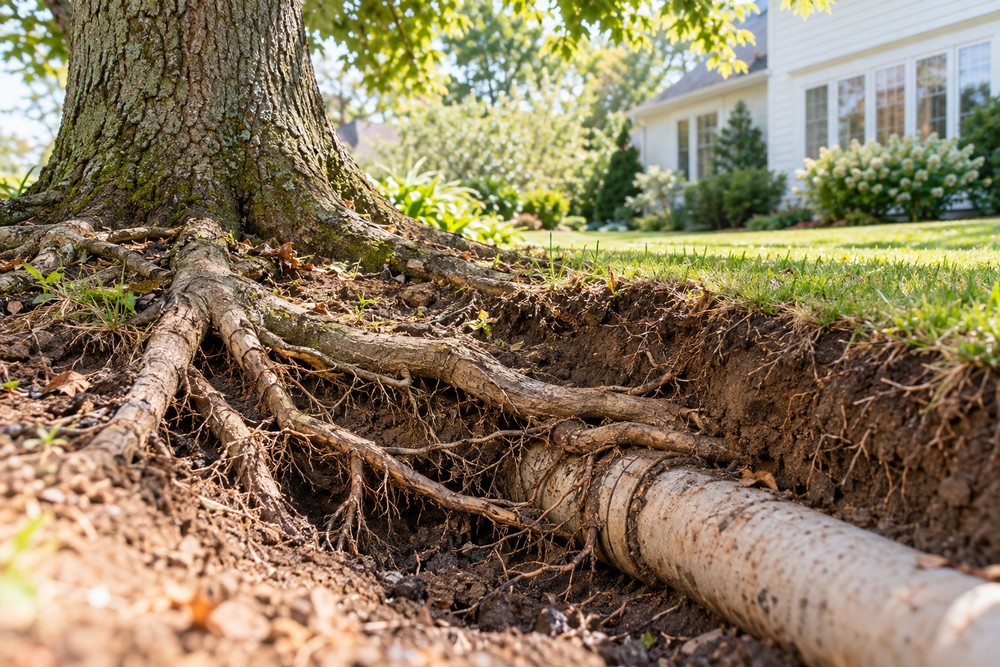
Tree roots are opportunists. They aren’t deliberately “seeking out” your sewer line, but they relentlessly chase two things: water and oxygen. A drain field, a leaking joint, or a condensation-covered pipe is essentially a buffet.
Once a feeder root finds a hairline crack or a loose seal, it pushes in, thickens, and keeps growing. What started as a thread can become a woody mass that blocks flow entirely.
Older properties are especially vulnerable. Clay tile and cast-iron lines installed decades ago develop gaps at every joint, and roots take hold there.
Species With the Most Aggressive Root Systems
Not every tree is a threat, but a handful are repeat offenders in this region. If any of these are growing near your lines, pay closer attention.
- Willows – Famous for chasing moisture. A single willow can dominate a wide underground area.
- Silver maples – Fast-growing with shallow, spreading roots that lift sidewalks and invade pipes.
- Poplars and cottonwoods – Thirsty, aggressive, and often planted too close to structures.
- American elms – Broad root spread that can reach well beyond the trunk.
- Some oaks – Slower, but powerful enough to crush older pipe over time.
Fruit and ornamental trees are generally lower risk, but “low risk” is “no risk” when a tree sits directly over a line.
How Far Roots Actually Travel
Here’s what surprises people: roots aren’t confined to the area under the canopy.
As a rule of thumb, a tree’s roots can extend two to three times the width of its canopy. The most active feeder roots often sit in the top 12 to 18 inches of soil, right where shallow utility lines live.
So a tree whose branches stop ten feet from your drain field may still have roots sitting on top of it. Judging risk by the canopy alone is one of the most common mistakes homeowners make.
When Removal or Root Pruning Makes Sense
You don’t have to cut down every tree near a line. The right response depends on the species, the tree’s health, its distance from the system, and how much damage is already underway.
A few general guidelines:
- Root pruning can work when a tree is otherwise healthy and valuable, and the conflict is localized. Cutting and installing a root barrier can redirect future growth.
- Removal becomes the honest answer when an aggressive species sits directly over a drain field, when the trunk is close enough that pruning would destabilize the tree, or when repeated backups keep happening in the same spot.
- Monitoring is reasonable for lower-risk species at a safe distance, paired with periodic inspections.
This is where professional judgment matters. An experienced arborist can assess whether a tree can be saved without sacrificing the system beneath it, and whether pruning will actually solve the problem or delay it. Before making a call near a drain field, have an Ashburn, VA tree service company evaluate the species, root direction, and the tree’s overall condition instead of guessing.
Cutting the wrong tree wastes money. Keeping the wrong tree costs even more.
Warning Signs Roots Have Reached Your Lines
The early signs are easy to dismiss because they come and go. Learning to read them is what separates a cheap fix from a major one.
Slow or Gurgling Drains
If sinks, tubs, or toilets drain slowly across multiple fixtures, not just one, that points to a main line problem rather than a local clog. Gurgling sounds as water goes down suggest air trapped behind a partial blockage.
Recurring Backups
A clog you snake out that returns a few weeks later is a classic root signature. Roots grow back. A mechanical clog usually doesn’t.
Soggy or Unusually Green Patches
When a line or drain field is compromised, moisture and nutrients leak into the soil. Watch for:
- Spongy ground that stays wet with no rain
- A strip of grass that’s greener or grows faster than the rest
- Faint odors near the yard or tank area
Fluctuating Toilet Levels
Water levels that rise and fall on their own can indicate intermittent blockage from roots shifting in the line.
None of these guarantees root intrusion on its own. Together, or if they recur, they’re a strong signal to have the system checked.
Why a Fall Inspection Beats a Winter Emergency
Timing is the quiet factor that determines how expensive this problem gets.
During dry late-summer and fall conditions, roots actively push toward any available moisture, so intrusions are often easiest to detect, and the ground is easier to work. Soil is drier, access is simpler, and crews aren’t fighting saturated conditions.
Winter flips all of that. Wet, heavy, sometimes frozen ground slows excavation, makes it messier, and costs more. A backup during a cold, rainy stretch is also simply a worse experience: harder to diagnose, harder to repair, and more likely to cause interior damage while you wait.
Scheduling a camera inspection and any needed pumping in the fall lets you catch a developing intrusion before the weather turns it into an emergency. Many septic service providers in Loudoun County, VA will run a line camera, check the tank, and flag root activity before winter sets in, when repairs are cheapest to handle.
Mistakes Homeowners Make
A few patterns show up again and again:
- Planting first, mapping never. Putting a new tree in without knowing where the lines and field sit.
- Judging by the canopy. Assuming roots stop where the branches do.
- Snaking repeatedly instead of inspecting. Treating the symptom while the cause keeps growing.
- Waiting out the symptoms. Hoping a slow drain resolves itself.
- Separating the two problems. Treating the tree and the system as unrelated when they’re clearly connected.
Bringing It Together
Trees and underground systems compete for the same real estate, and most homeowners don’t notice until something fails. The good news is that the conflict is predictable.
Know which species are aggressive. Respect how far roots actually travel. Watch for slow drains, recurring backups, and soggy ground. And handle inspections in the fall, before wet winter conditions raise the stakes.
A little attention now, on both the tree and the tank, keeps a manageable situation from turning into a muddy, expensive surprise.