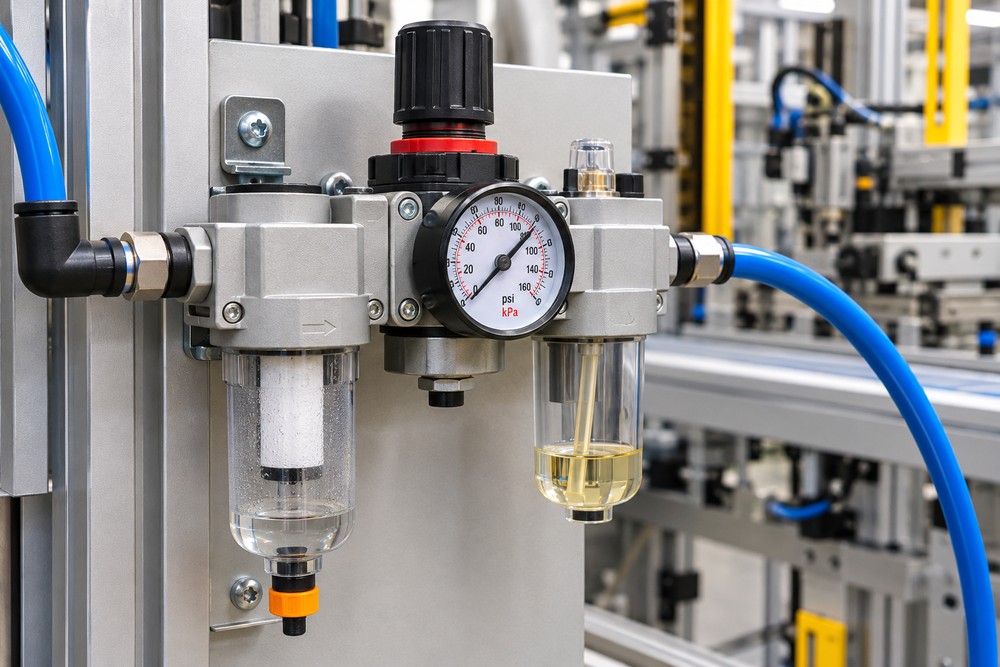
Compressed air supports many industrial operations, from operating pneumatic cylinders and control valves to powering automated assembly equipment. However, the air supplied by a compressor is not necessarily suitable for every downstream application without additional treatment.
Moisture, airborne particles, and variations in operating pressure can affect how pneumatic equipment performs. These conditions make air preparation an important consideration when designing machinery or maintaining existing production systems.
Pneumatic air preparation components help address these requirements at or near the equipment being supplied. Filters remove specified contaminants, regulators control downstream pressure, and lubricators provide oil mist where additional lubrication is required.
Selecting the appropriate equipment begins with understanding the conditions of the compressed air supply and the requirements of the machinery using it.
Understanding Compressed Air Quality at the Point of Use
Compressed air can contain contaminants originating from the surrounding environment, the compression process, or the distribution system.
Common concerns include solid particles, moisture, and oil contamination. Their presence and concentration depend on factors such as compressor type, upstream treatment, piping conditions, and operating environment.
Although a facility may have centralized filtration and drying equipment, certain machines require additional treatment closer to the point of use.
This distinction is important. Plant-level compressed air treatment addresses broader distribution requirements, while local air preparation helps match supply conditions to individual pneumatic applications.
For example, a pneumatic actuator operating in a general assembly area may have different air quality requirements from a sensitive pneumatic control device.
Manufacturers should review the air quality specifications provided by downstream equipment manufacturers rather than assume that one filtration arrangement is suitable for every application.
Compressed air quality should also be evaluated under actual operating conditions, including changes in demand and environmental temperature.
How Filtration and Pressure Regulation Support Equipment Operation
Compressed air filtration is commonly used to reduce contamination before air reaches valves, cylinders, and other pneumatic components.
General-purpose particulate filters are designed to capture particles and separate certain liquid contaminants within their specified operating limits.
More specialized filtration may be necessary where finer particles or oil aerosols must be removed.
Filter selection depends on the type of contamination being addressed, the required filtration rating, and the volume of air passing through the assembly.
A filter’s nominal or rated removal capability should not be interpreted as a guarantee that every contaminant will be eliminated. Manufacturers should review published filtration specifications and applicable equipment requirements.
Moisture management also requires attention. Some filters can separate liquid water, but they do not replace compressed air dryers when controlling water vapour or pressure dew point is necessary.
Pressure regulation serves a different purpose.
Pneumatic pressure regulators reduce and control downstream pressure within their specified operating range. This helps supply equipment at an appropriate pressure despite variations in upstream conditions, provided sufficient inlet pressure and flow capacity are available.
A regulator that is improperly sized may experience excessive pressure drop when equipment demand increases.
For this reason, engineers should consider both the required operating pressure and the expected flow rate rather than selecting a regulator based only on connection size.
When Lubrication Is Necessary and When It Is Not
Lubricators introduce controlled quantities of lubricant into compressed air to support equipment designed for oil-mist lubrication.
However, additional air-line lubrication is not always necessary.
Many modern pneumatic valves and cylinders are designed to operate with factory-applied lubrication and do not require continuous oil introduction during normal service.
Adding lubrication where it is not specified may create maintenance complications or introduce oil into parts of the system that are intended to remain free of added lubricant.
The appropriate approach is to review the manufacturer’s requirements for each downstream component.
Where lubrication is required, technicians should confirm the recommended lubricant, delivery method, and operating conditions.
Combined filter regulator lubricators, commonly called FRL assemblies, can bring several air preparation functions into one arrangement. However, a filter-regulator combination without a lubricator may be more appropriate for equipment designed to operate without added air-line oil.
Machine builders should also consider whether different equipment branches require separate air preparation arrangements.
A single lubrication approach may not suit every pneumatic component connected to the same compressed air supply.
Selecting Components for Flow, Pressure, and Installation Conditions
Practical component selection requires more than identifying the correct filtration or regulation function.
Flow capacity is especially important because air preparation equipment creates resistance to airflow. Filters, regulators, and connecting components must support the expected demand without causing unacceptable pressure losses.
Engineers should examine normal consumption, peak demand, and equipment duty cycles when reviewing component specifications.
Other important considerations include operating pressure range, filtration rating, connection size, temperature limits, and compatibility with the compressed air conditions.
Connection size alone does not establish flow capacity. Two components with similar ports may have different internal flow characteristics and pressure-drop performance.
Installation requirements also influence selection. Maintenance personnel need access to filter bowls, drainage mechanisms, regulator adjustments, and pressure gauges.
A unit installed in a confined or obstructed location may be difficult to inspect or service.
For Canadian manufacturers evaluating these requirements, Canada Pneumatics Inc. offers air preparation components for pneumatic systems as part of its industrial pneumatic product range.
Supplier product information can help engineering and procurement teams compare component configurations against application requirements. Final selection should be based on technical specifications and compatibility with the intended equipment.
In Ontario manufacturing facilities, seasonal temperature changes and variations in plant conditions may also influence moisture management and installation decisions.
Components exposed to colder environments require particular attention to condensation and applicable temperature limitations.
Building Air Preparation Checks Into Maintenance Planning
Pneumatic system maintenance should include regular inspection of air preparation assemblies rather than focusing only on downstream actuators and valves.
A filter containing accumulated liquid or excessive contamination may restrict airflow or indicate that upstream treatment needs attention.
Maintenance teams should inspect filter elements, bowls, drains, pressure gauges, and regulator settings according to manufacturer recommendations and plant procedures.
Drainage arrangements deserve particular consideration. Manual drains require scheduled attention, while automatic drains should be checked for correct operation.
Filter replacement intervals should reflect operating conditions, contamination levels, and the manufacturer’s maintenance guidance.
When troubleshooting slow actuator movement, inconsistent equipment response, or pressure-related problems, technicians should examine the air preparation assembly as part of the diagnostic process.
Pressure readings taken under actual operating demand may reveal conditions that are not apparent when machinery is idle.
Technicians should also check for leakage, damaged connections, restricted elements, and unauthorized changes to regulator settings.
Before opening filters or disconnecting air preparation equipment, compressed air must be safely isolated, depressurized, and checked for stored energy.
Effective industrial air preparation is ultimately an application-specific decision. The appropriate combination of filtration, pressure regulation, and lubrication depends on what the downstream equipment requires.
By matching component specifications to actual operating conditions and maintaining accessible inspection procedures, manufacturers can establish a more consistent approach to compressed air quality and pneumatic equipment maintenance.