Why Drain Trouble Builds Quietly
Like home veins, drainage systems transport away anything you’d rather forget. They work silently for years. Trouble rarely begins abruptly. It grows. A debris snag becomes a stubborn stopper. A grain-by-grain hairline crack widens. Grit is caught like a fishing net when a joint moves a few millimeters. Minor details may reveal a meandering story beneath your feet.
The key is understanding how these subtle clues connect to specific underground conditions, explain Spartan Property Management experts. Once you can read the signs, you can read the system.
How Minor Symptoms Escalate
Early drain symptoms often show up as everyday annoyances. Water lingers in the shower. The kitchen sink burps after a wash cycle. An occasional whiff of something unpleasant drifts up from a floor drain. On their own, any one of these can be easy to dismiss. Together, they sketch a pattern.
- When several fixtures drain sluggishly at the same time, the bottleneck is usually past the branch lines in the main run.
- When the same fixture misbehaves repeatedly, there is often a local structural issue that briefly clears under pressure, then traps debris again.
- When symptoms migrate around the house, it can indicate an evolving blockage traveling through the system, or a collapsing section that intermittently shifts.
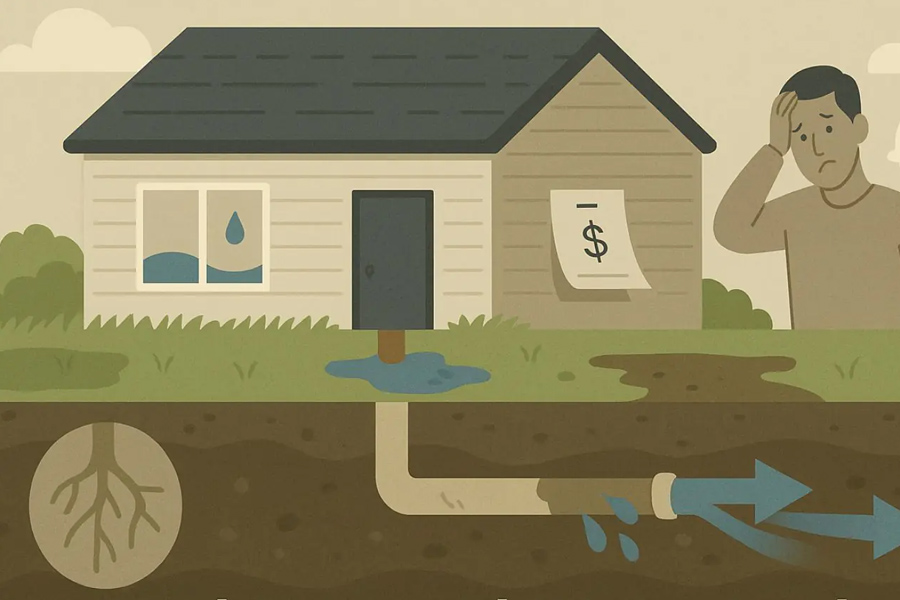
Small signals lead to larger ones. Damp patches appear on walls or paving. Soil softens along a suspected pipe path. An outdoor inspection chamber shows high water that lingers after use. The story moves from nuisance to risk.
The Physics Inside a Struggling Drain
Think of wastewater flow like traffic through a tunnel. It needs a clear path, a stable slope, and uninterrupted air to move freely. When any of these change, the system speaks up.
- Restricted flow creates negative pressures. That is the gurgle you hear as air is dragged through traps.
- Misaligned joints form shelves that catch solids. Each passing flush adds another fragment to the ledge.
- Cracks invite roots. Roots follow moisture, then thicken and braid, turning a round pipe into a twig-filled sieve.
- Collapses change the gradient. Standing water collects behind the low point, then surges when the pressure peaks and briefly forces a path.
Odors are a chemistry lesson in slow motion. Organic residues decay and release gases. In a healthy, vented, free flowing system, those gases leave with the water. In a struggling system, they look for the shortest exit, which is often a sink or shower you just used.
What A Camera Survey Actually Reveals
A modern drain inspection uses a push rod or crawler camera with LED lighting and distance counters. The technician feeds the camera into an accessible point and maps what the eye cannot see.
On screen, the mundane becomes clear:
- Ovality from soil pressure that flattened a section.
- Inverted joints where the downstream pipe sits higher than the upstream, creating a lip.
- Fractures that weep and pull in surrounding fines, undermining the bedding.
- Root curtains at joints that let water pass slowly while catching fiber and grease.
Video makes the invisible measurable. You get footage with timestamps and distances from the access point, notes on pipe materials and diameters, and a plan for targeted repair rather than guesswork.
Damage Patterns You Can Infer From Surface Clues
Surface clues can be read like footprints.
- Soft lawn strips or depressions that trace a straight line often mirror a leaking run that has washed away fines beneath the turf.
- Repeated blockages in wet weather can point to groundwater infiltration through cracks that carry silt into the system.
- Damp patches on lower interior walls might trace to damaged gullies or lateral connections where water escapes and wicks through masonry.
- A cleanout or inspection chamber that repeatedly shows standing water after use usually means the restriction lies downstream of that point.
None of these confirm the exact defect. They do help you decide where to look first and how urgent the situation is becoming.
Risks Of Waiting Too Long
Water perseveres. If allowed to roam, it will locate soil, brick, and concrete weaknesses. Minimal leaks develop voids. Void becomes settled. Doors stick. Plaster has cracks. Pavers tilt and pond. A modest service call becomes a multi-trade structural issue. Calling CCTV drain survey specialists early can prevent these severe problems. They can find tiny leaks and cracks before any major damage occurs, which saves you time and money.
The financial impact grows in steps. Clearing a blockage is a quick visit. Locating and lining a cracked section is a planned repair. Stabilizing subsidence and rebuilding affected areas is a project that steals both time and sleep. Acting on the early signs is not alarmist. It is disciplined.
Repair Paths After A Diagnosis
Once the camera tells the truth, the remedy tends to fall into a few categories.
- Cleaning and recovery. High pressure jetting and mechanical cutting remove grease caps, roots, and loose debris. This solves flow but does not address deeper defects.
- Structural lining. A resin-impregnated liner is inverted or pulled into the defective section, then cured to form a new pipe within the old. This is useful for cracks, root entry at joints, and short runs with limited access.
- Sectional patching. Targeted patches reinforce specific defects without lining an entire length.
- Open cut replacement. Necessary when a pipe has collapsed, changed alignment severely, or when connections need rebuilding.
- Ancillary fixes. Rebuilding gullies, correcting backfalls, improving ventilation, and installing backwater valves where appropriate.
The right choice is dictated by the defect, location, and access. A good inspection report aligns the evidence with the repair logic so each pound or dollar works where it counts.
What To Expect On Inspection Day
Basic flow checks, accessible chamber inspections, and fixture notes start a normal examination. After choosing entry spots, the technician feeds the camera through each run. Live video and comments are shown. Distance counters locate flaws at access points. If safe, jetting can eliminate barriers so the camera can view.
Afterward you receive a documented report that includes video files, still images of key findings, measurements, and a clear summary of conditions by run. Good providers also map the layout as discovered so future work can be planned without guesswork.
Cost Factors That Surprise Homeowners
Inspection and repair costs vary for reasons that are not always obvious at first glance.
- Access dictates effort. A straight run from an external chamber is quick. A buried or obstructed access point can add time.
- Materials matter. Old clay with mortar joints behaves differently from PVC or pitch fiber, and repair methods vary accordingly.
- Depth and surroundings drive complexity. Pipes under lawns are simpler than those under extensions, driveways, or mature trees.
- Water table conditions can complicate work. In high groundwater areas, infiltration during repair can require additional control measures.
Viewing costs through the lens of risk helps. Paying for clear diagnosis avoids repeated callouts that never address the cause. Choosing the right repair once is cheaper than choosing the quick repair twice.
FAQ
What exactly is a CCTV drain survey and how long does it take?
CCTV drain surveys record your drainage pipes with a waterproof camera. Operator guides camera from access points, documents flaws, and counts distances to each finding. The process takes one to three hours for a typical home with accessible runs, plus time to create the report and footage.
Are gurgling sounds always a sign of a blockage?
Not always, but always indicating airflow disruption or constriction. Partially blocked venting, undersized venting, or misaligned joints can cause gurgling. If many fixtures gurgle or start unexpectedly after years of calm operation, investigate.
Can tree roots be removed without digging up the garden?
Yes. Mechanical cutting and high pressure jetting can clear roots from inside the pipe, and structural liners can seal the entry points at joints to prevent regrowth. Excavation is usually reserved for collapsed sections, severely displaced joints, or where connections must be rebuilt.
Will a home insurance policy cover a collapsed drain?
Policy and jurisdiction affect coverage. Many plans cover immediate damage to home subsurface pipes but not ongoing degradation. Camera surveys give proof for insurers. Before repairs begin, your insurer and policy paperwork can explain.
How often should older drains be inspected?
A baseline survey is recommended for homes with original or unknown drainage when symptoms arise or after a purchase. The risk profile can guide recurrent checks after remediation. A few-year checkups are recommended for root-prone clay systems, whereas modern PVC systems may only need care when symptoms appear.