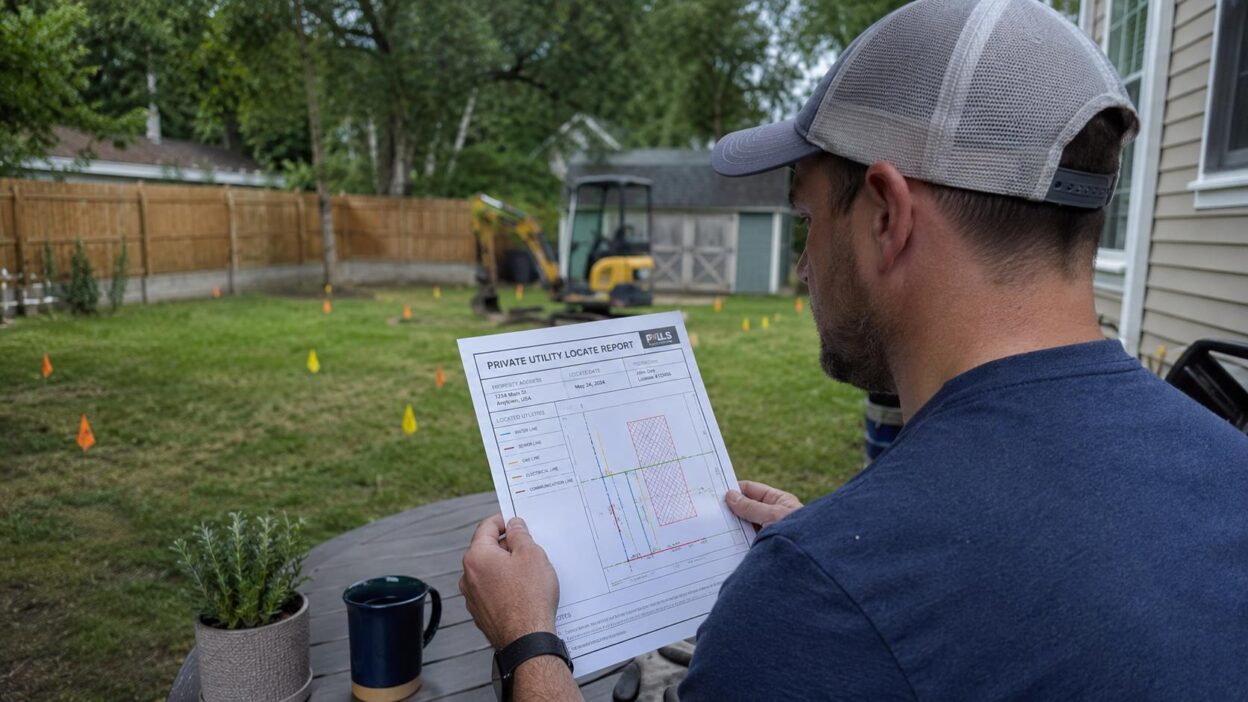
Planning a new deck, a pool, or a fence line feels like the easy part. Picking the tile, choosing the fence style, deciding where the pergola goes – that’s the fun work. What most homeowners don’t think about is what’s sitting a foot or two under the grass they’re about to dig up. Every spring, tens of millions of people start digging on their own property without giving it a second thought.
That gap in thinking is exactly where expensive mistakes happen. A single afternoon of digging can hit an irrigation line, a low-voltage cable, or worse, a gas line – and the homeowner is often the one left holding the bill.
Why Homeowners Overlook Private Utility Locating
Most people assume that calling 811 before a project means they’re covered. It’s an easy assumption to make, and it’s wrong in a way that catches a lot of people off guard. The 811 system exists to mark public utility lines, the ones owned and maintained by utility companies, and it does that job well. But it stops at a specific point: the property line or the meter, depending on the utility.
Everything past that point, the irrigation lines a previous owner installed, the low-voltage wiring for landscape lighting, the private water or sewer line running to a detached garage, is the homeowner’s responsibility to locate. Nobody mails you a map of it. Nobody flags it automatically. That’s the reason services exist for a private utility locator near me, which handles exactly the part of the property that 811 doesn’t touch.
This isn’t a rare edge case. Underground utility strikes happen between 400,000 and 800,000 times a year in the United States, or roughly one to two every minute, according to damage-prevention research compiled by Geoff Zeiss and Dr. Sakura Shinoaki. A meaningful share of those strikes happen on residential property, where nobody thought to check what was buried before the shovel went in.
The Gap Between 811 and Your Property Line
It helps to understand why this gap exists at all. Federal rules under OSHA’s excavation standard (29 CFR 1926.651) require that utility locations be established before excavation begins, but that requirement is aimed primarily at contractors and jobsites, not homeowners doing weekend projects. The public 811 system was built to protect the utility company’s own infrastructure, the lines that run from the street to your meter. Once utility ownership transfers to you at that point, so does the locating responsibility.
This isn’t a theoretical problem. In Colorado, state labor officials recorded 198 underground utility facility damages in 2024, and failure to notify 811 accounted for 21 percent of them, a share that has held steady since 2018. That consistency matters. It means this isn’t a one-off reporting quirk, it’s a structural gap that keeps causing the same kind of damage year after year, according to the Colorado Department of Labor and Employment’s 2026 Dig Safely Month announcement.
Homeowners planning additions, in particular, run into this gap. A property line survey from years ago won’t show a sprinkler system installed five years later, or a low-voltage line an electrician ran to a shed. The physical property and the paperwork drift apart over time, and most people don’t realize how far apart they’ve drifted until a shovel hits something it shouldn’t.
The same principle applies even if you’re starting from scratch rather than renovating. People planning a new home often assume an empty lot means there’s little risk beneath the surface, but existing utility connections, abandoned service lines, drainage systems, or neighboring infrastructure can still affect excavation and foundation work. Identifying what’s already underground before construction begins helps builders avoid costly surprises, keeps projects on schedule, and makes it easier to plan utility connections as the home takes shape.
What a Private Utility Locate Involves
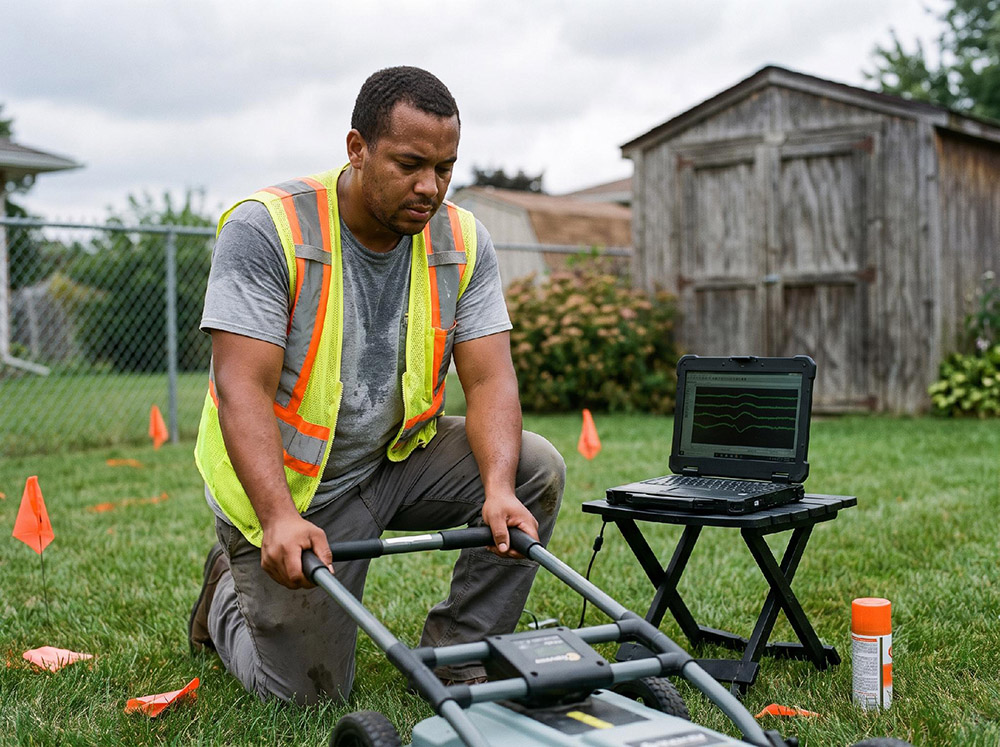
A private locate follows a fairly consistent process regardless of who performs it. A technician walks the site first, noting sprinkler heads, meter boxes, and any visible signs of buried infrastructure. From there, they typically use two complementary methods: electromagnetic (EM) locating, which traces conductive lines like metal pipe and cable, and ground-penetrating radar (GPR), which can pick up non-conductive materials such as PVC irrigation pipe or fiber conduit that EM equipment would miss entirely.
Once the lines are traced, the technician marks them with flags or spray paint using the same color code contractors use nationally: red for electric, yellow for gas, blue for water, and so on. A written report usually follows, documenting what was found and where, which is worth keeping on file if you ever sell the property or bring in another contractor later.
If you’re planning a backyard renovation that involves any digging deeper than a few inches, this step should happen before the trencher or the excavator ever touches the yard. It’s a few hundred dollars and an afternoon of waiting, which is a small price against the alternative.
The Real Cost of Skipping This Step
The financial argument for locating private utilities isn’t abstract. The Common Ground Alliance’s most recent DIRT Report analyzed nearly 197,000 unique utility damage reports from 2024 alone, and estimates that excavation-related damage costs the country roughly $30 billion a year in societal costs, covering repairs, service outages, injuries, and project delays.
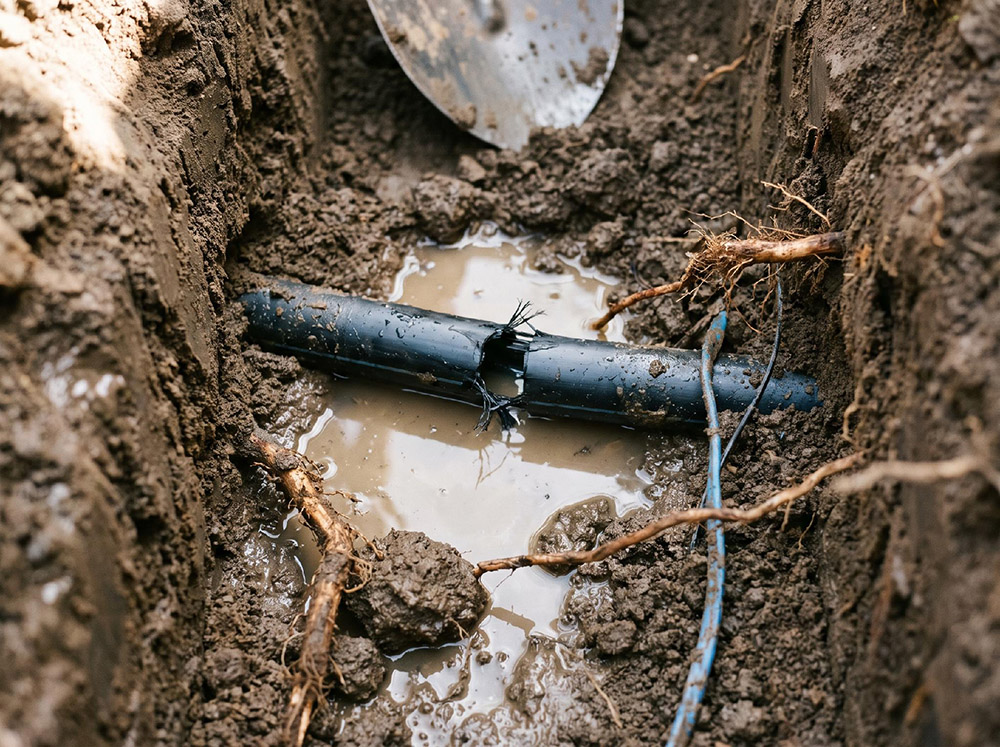
On a homeowner’s project, the consequences show up in smaller but still painful ways. A severed irrigation line means a soggy yard and a repair bill. A nicked gas line means an evacuation, a fire department visit, and a delayed project while the utility company repairs the line. A cut electrical or data cable can knock out service to your own home or, in dense neighborhoods, a neighbor’s home too, opening up liability questions nobody wants to deal with mid-renovation.
There’s also the safety angle that doesn’t show up on an invoice. Trenching and excavation carry real risk on their own, which is why federal standards exist around trench protection in the first place. Adding an unmarked utility line into that mix only raises the stakes.
None of this is meant to scare anyone off backyard projects. It’s meant to point out that a locate is cheap insurance against a much larger repair bill, and against losing a week of your renovation timeline to an unplanned utility repair.
When to Call a Private Locator
Certain projects call for a private locate almost every time: pool installations, deck footings that go below frost line, solar panel ground mounts, additions with new foundations, fence post holes in older yards, and any irrigation system work. Many of these improvements are ultimately about creating a better space for outdoor gatherings, making it all the more important to avoid unnecessary delays or damage before the project even gets started. Basically, if a project involves digging deeper than a shovel’s depth of topsoil, it’s worth the call.
The industry itself is scaling to meet this kind of demand. The global underground utility mapping market grew from an estimated $1.26 billion in 2025 to roughly $1.4 billion in 2026, growth that market analysts partly attribute to rising excavation-damage incidents pushing more property owners toward better locating technology, according to a 2026 market report from GII Research. That’s not a niche industry propping itself up. It’s a response to a real and growing need.
It also pays to think about timing relative to the rest of your project. More than 60 million Americans planned to dig on their own property this past spring, according to a national 811 public-awareness campaign, and a lot of that digging is tied to home upgrades.
A Small Step That Prevents Big Mistakes
811 does its job well, but it was never designed to cover the parts of your property that belong to you. The gap between where public utility marking ends and where your project actually breaks ground is exactly where a private locate earns its cost.
Whether you’re planning a pool, an addition, or a fence line that hasn’t been touched in years, a locate takes an afternoon and a modest fee. Skipping it risks your timeline, your budget, and in the worst cases, your safety, since a severed water or irrigation line rarely stays contained to just the trench you dug.
The homeowners who get this right treat the locate the same way they treat a permit: a non-negotiable step before the real work starts, not a box to check only if something feels off.