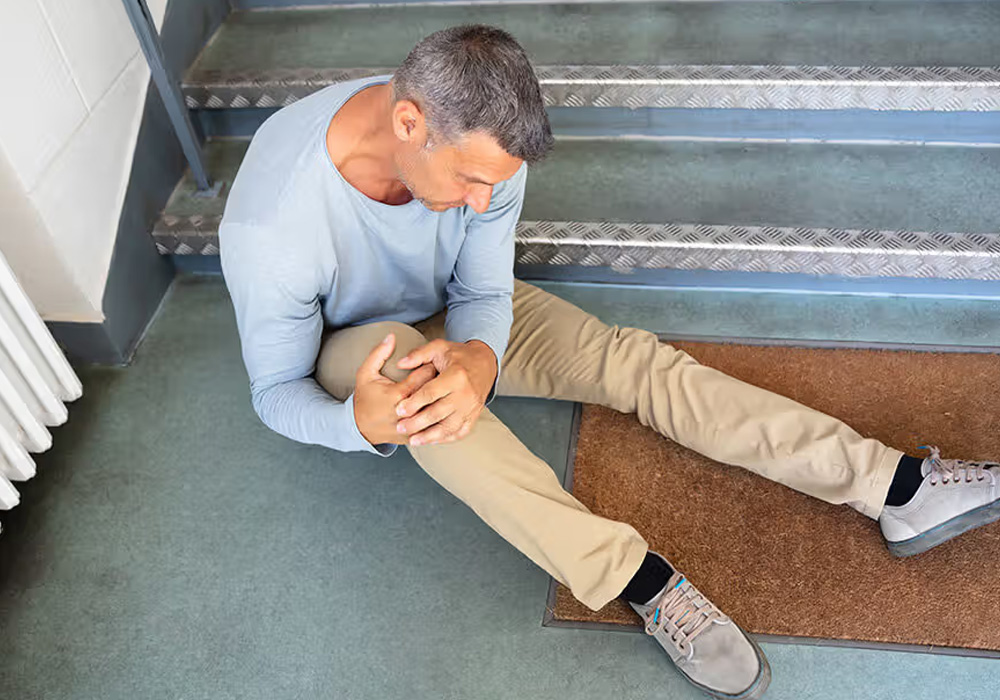
Stairs are so familiar that most people stop thinking of them as a risk factor at all. They’ve been navigated thousands of times without incident, so the assumption builds quietly that they’ll continue to be navigated thousands more. What changes that assumption is rarely a dramatic health event. It’s usually something smaller: a slightly off step in dim light, a momentary distraction, a patch of socks on a polished surface. The falls that happen on stairs in residential properties are rarely the result of obvious negligence. They’re almost always the result of familiar conditions meeting a brief lapse in conditions that had always been fine before.
The Numbers Behind the Risk
Stair-related falls are among the most common causes of injury-related emergency room visits for adults over 65, and the injury rates climb significantly with age. What makes these statistics more than just an abstract public health concern is the proportion that happen in the home, in familiar settings, on stairs that the person had navigated routinely without issue.
This pattern is worth understanding because it directly challenges the common assumption that familiarity with a staircase reduces the risk. In many cases, familiarity produces exactly the opposite effect: it reduces vigilance at precisely the moments when conditions are different from the norm.
Why Familiarity With Stairs Doesn’t Reduce the Risk the Way People Expect
The mental model most people carry about stair safety focuses on obvious risk factors: stairs that are too steep, poorly lit, without handrails, or clearly in poor condition. Addressing those factors does reduce risk. But the majority of stair falls don’t happen on objectively dangerous stairs. They happen on perfectly ordinary stairs under perfectly ordinary conditions, because the human nervous system is remarkably good at automating routine tasks and remarkably susceptible to small disruptions of those routines.
A person who has walked down the same staircase ten thousand times isn’t thinking consciously about each step. The movement is largely automatic. That automation is efficient and effective under stable conditions. It becomes a liability when something small changes: a slightly different footwear, a momentary distraction from a sound or a phone notification, a brief period of dizziness, an object on a step that wasn’t there yesterday. The automatic execution of the movement doesn’t leave room to adjust quickly for the unexpected.
How Physical Changes Shift the Risk Over Time
The baseline risk from stairs doesn’t stay constant as a person ages. Several physical changes that develop gradually over time each independently increase the risk that a familiar staircase presents.
Balance and Vestibular Function
The vestibular system that governs balance becomes less reliable with age, and the changes are gradual enough that many people don’t notice them directly. The result is that the small postural corrections that happen automatically during stair navigation become less precise, and the margin for error on each step narrows in ways that aren’t visible in a routine daily context.
Vision Changes
Depth perception and contrast sensitivity both decline with age, and both play roles in accurately perceiving stair edges and negotiating steps confidently. Changes in either can make the edge of a step less clearly defined, particularly in lower light conditions, without the person having any clear sense that their visual assessment of the stairs has changed.
Medication Effects
A significant proportion of older adults take medications that affect balance, blood pressure, or alertness, and the effects are often strongest at certain times of day, during periods of dietary change, or when medications are adjusted. A staircase that was managed confidently before a medication change can become genuinely risky after one, sometimes without any obvious warning.
What Workarounds Actually Address and What They Don’t
The most common responses to stair risk in a multi-level home are handrail additions, better lighting, and non-slip treads. These are genuinely helpful interventions and worth implementing. What they share is that they improve the conditions around the stairs without removing the stairs from the navigation path.
A person whose balance or strength has changed significantly still has to navigate every step every time they need to move between floors, regardless of how well-lit and well-equipped the staircase is. The improved conditions reduce the risk per trip. They don’t reduce the number of trips, and they don’t address the underlying vulnerability that comes from having to rely on a physical capability that may be declining.
What Permanent Vertical Access Actually Changes
Removing stairs from the necessary daily navigation path removes the accumulated risk of all the trips that would otherwise have been made on them. For someone who moves between floors multiple times daily, the risk isn’t just from any single trip. It’s from the sum of all the trips, multiplied by the probability that any one of them occurs under slightly off conditions.
For families in the area looking at an elevator for homes in Reno, NV, the conversation about fall risk is often what finally makes the timeline concrete. The decision to add a lift isn’t typically made after a fall has already happened. But many families reflect afterward that the warning signs were present well before the event that finally prompted action, and that acting earlier would have been worth it.
Conclusion
Stairs become a greater risk factor than most people expect, more gradually than is easy to notice, and under conditions that feel entirely familiar right up until they aren’t. Addressing that risk structurally, by changing what daily navigation between floors requires, is what produces genuine long-term safety rather than a reduced version of the same risk.