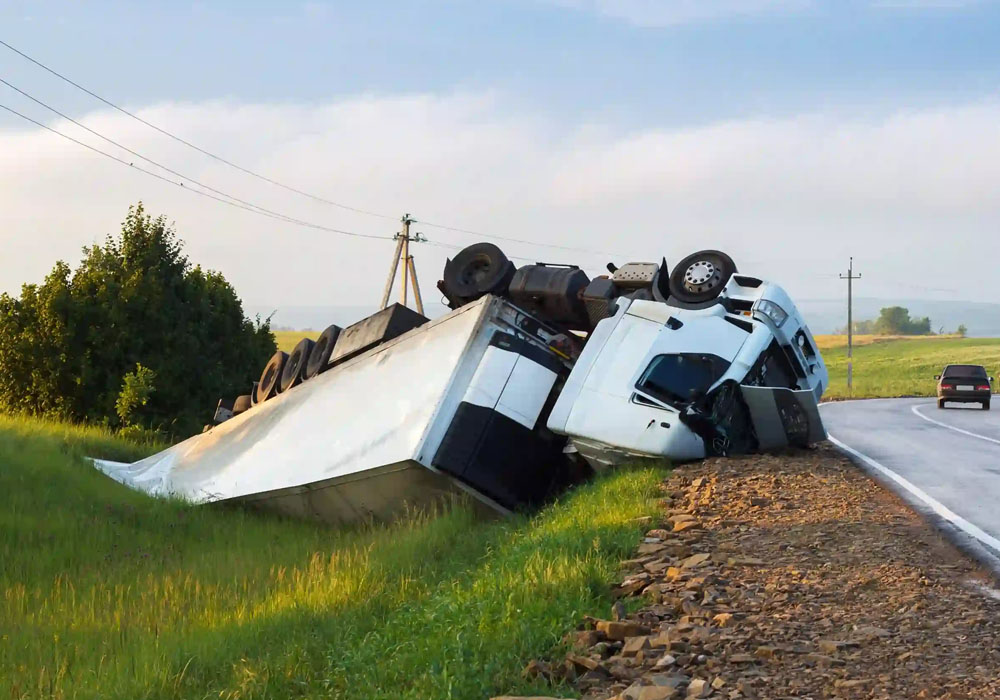
Commercial truck accidents are not merely larger versions of car crashes. They are corporate litigation events hidden behind the guise of a traffic accident, and the liability and insurance issues are almost always more complex than in a motor vehicle collision involving two private individuals.
When an 18-wheeler collides with a smaller passenger vehicle, two or more large companies, through their insurance carriers, are immediately and simultaneously at risk for substantial losses. Trucking companies, shippers, brokers, freight forwarders, and manufacturers are also potentially at risk for significant punitive damages, as it’s invariably proven in court or they’re more compelled to settle when they’ve put cost-cutting over safety.
Why commercial trucking cases are categorically different
Car accident cases usually have two sides, one insurance policy, and a simple negligence analysis. Trucking cases have six defendants before you even get out of the gate and often require penetrating multiple layers of insurance in a hunt just to recover enough to cover your client’s medical bills. You’ve got another three parties whose cheap insurance policy won’t even make a dent in the damages they’ve caused. Then, where the collision report leaves off, the litigation begins. You can bet that the GPS data stored in that truck is programmed to write over itself every seven days.
The first 72 hours determine what evidence survives
Trucking companies aren’t legally required to preserve digital data indefinitely. Electronic Logging Devices, which automatically record a driver’s hours of service and location data, can be overwritten. The Electronic Control Module – often called the truck’s black box – captures pre-crash telemetry including vehicle speed, braking behavior, and engine RPM in the seconds before impact. That data doesn’t stay there forever.
A spoliation letter is the tool that changes this equation. It’s a formal legal notice sent to the trucking company demanding immediate preservation of all evidence – digital, physical, and paper – related to the vehicle and driver involved in the crash. Courts take spoliation seriously. When a company receives that letter and destroys evidence anyway, the consequences can be severe, including adverse inference instructions that allow a jury to assume the destroyed evidence would have been unfavorable to the defendant.
The window for sending this letter effectively is narrow. ELD and ECM data, driver qualification files, maintenance records, drug and alcohol test results, inspection logs – all of it needs to be locked down before routine data purging takes it off the table. This is one of the clearest areas where early legal involvement after a serious truck accident pays off directly.
Direct liability vs. vicarious liability against the carrier
There are two main legal theories to hold a motor carrier responsible, and they operate independently of each other.
Vicarious liability, or respondeat superior, is based on the carrier being the employer, and holding the carrier responsible for the negligent acts of a driver because that driver was an employee acting within the scope of employment when those acts occurred. In other words, if the driver runs a red light, the company shares liability for that act. This is the easier of the two theories to understand.
Direct liability is a separate claim against the carrier for the carrier’s conduct. Negligent hiring, negligent training, and negligent retention all fall in this bucket. If a carrier hires a driver with a history of safety violations, or retains a driver after similar warnings, the company faces direct liability for that decision independent of anything the driver did in the specific crash. Pre-trip driver vehicle inspection reports, known as DVIRs, can indicate a pattern of mechanical problems being overlooked that lead to crashes. Driver qualification files can show what the carrier knew about prior violations. Both play into the direct liability picture.
The importance of keeping the two theories separate is that they support each other. A case that might be thin on vicarious liability can still be strong on direct liability, and vice versa.
Freight brokers, shippers, and supply chain liability
The liability web extends beyond the truck and its owner. Third-party logistics companies and freight brokers coordinate cargo movement between shippers and carriers. When a broker knowingly selects an unsafe carrier – one with poor safety ratings, unresolved violations, or inadequate insurance – that broker may face liability for the consequences.
Shippers can also be drawn in when their delivery demands created pressure to violate safety laws. If a shipper imposed an impossible deadline that required a driver to exceed Hours of Service limits to make delivery, and that driver fell asleep at the wheel, the shipper’s role in creating that pressure is legally relevant. These aren’t theoretical claims – they’re pursued in serious truck accident litigation when the evidence supports them.
This layer of the analysis gets locally specific quickly. State courts handle negligent selection claims differently. Comparative fault rules – which determine how damages are reduced when the injured party bears some responsibility – vary by jurisdiction. Navigating these localized legal complexities is exactly why an experienced beaumont personal injury attorney who understands how local courts handle complex trucking litigation makes a concrete difference in outcomes, not just a procedural one.
When brake failures and tire blowouts point to a third party
Not all truck accidents are due to how the driver acted. Identified vehicle-related causes, including brake system failures and tire degradation, contributed to 10% of analyzed crashes, while driver-related causes made up 87% of the critical reasons. When mechanical failure leads or contributes to a crash, liability issues become more complex.
For example, if a motor carrier contracted out its fleet maintenance to a third-party vendor, and that vendor failed to find or properly fix a brake defect, there could be direct liability on the part of the vendor. The same holds if the carrier’s in-house maintenance team overlooked the issue. The maintenance logs and service records amount to key evidence. So would the pre-trip inspection reports completed by the driver prior to the crash – if reports encountered a problem that the carrier chose not to resolve, that’s direct evidence against the carrier.
It may come as no surprise that a vehicle’s manufacturer becomes involved when a defect stems from design or production and not maintenance. These cases require specialized investigations, but they’re far from unheard of in severe commercial truck litigation.
The insurance structure behind commercial trucking claims
Commercial trucks are not insured under one policy. FMCSA regulations stipulate that there must be minimum liability coverage amounts of between $750,000 and $5 million based on the type of freight. Aside from that primary coverage, most carriers also have excess and umbrella policies raising those coverage limits.
In a high-value injury suit, those layers become very important. A severe enough injury claim will utilize the entire primary policy and raise the question of whether the excess coverage “drops down” – and on what terms. Defense lawyers are typically very mindful of this as they go about shaping settlements that ensure the excess layers are never hit.
Plaintiffs and their attorneys must know the complete insurance structure from the outset to make certain that they are not offered a settlement that, while it seems large, is actually too low. Again, this is a difference between commercial truck cases structurally and other passenger vehicle cases. There is a lot more money, so the fight is a good deal nastier.
How accident reconstruction counters defense strategy
Trucking defense teams are not passive. They typically send their own investigators immediately, use comparative fault to place as much blame as possible on the passenger vehicle driver, and also dispute causation to muddy the waters regarding what led to the accident.
This is where an accident reconstruction specialist can level the playing field if not tip it in favor of the plaintiff. These experts use physics, laser scanning, crush damage analysis, tire marks, and ECM data to recreate the event and develop a sequence that can be presented to a jury. For example, a reconstructionist might reveal that the truck was driving over the speed limit when the ECM reported it was applying its brakes, or show that the pattern of skid marks indicates the driver never tried to stop.
Quick to argue comparative fault and cite the potential for reducing a damage award depending on the percentage of fault found depending on jurisdiction, a defense team will scour the evidence for anything they can use to back up that claim – dash cam video, traffic violations, cell records, witness testimony. A thorough reconstruction analysis that clearly establishes the sequence of events makes that much harder to do.
Putting it together
Cases involving accidents with commercial trucks can be won on the merits if the injury is severe enough and if the facts of the accident show that the trucker and/or his employer broke the rules and need to be held accountable. As lawyers, we can’t change the fact that a truck made an unsafe lane change, or failed to adequately apply its brakes, or had a tire with such worn treads as to be foreseeable that it would blow out. But we can take proven shortcuts around the evidence’s less-than-photographic memory. Rules require records. If we put a defendant on notice immediately after an accident, we may, in many cases, freeze records that would otherwise go astray within a month or two of a serious accident.