A bathroom renovation that looks stunning on day one but adds three minutes of cleaning time per room is a financial failure. For a 150-room property, that small increase can translate into thousands of hours in additional labor costs over the life of the design. Similarly, a design that chases a fleeting trend can accelerate a property’s next Property Improvement Plan (PIP) by years, turning a capital investment into a recurring expense. The game has changed from pure aesthetics to operational efficiency and long-term value.
The focus is shifting from simply meeting brand standards to actively reducing maintenance overhead and maximizing room availability. This requires a deeper look into material durability, ease of cleaning, and the total cost of ownership, not just the initial bid. Successful modern hotel bathroom renovations are now strategic projects that directly impact a property’s bottom line. The right choices can lower housekeeping costs and extend the renovation cycle, while the wrong ones create hidden operational drags that erode profitability for years.
Quick answer: A successful hotel bathroom renovation in today’s market prioritizes operational efficiency and durability over short-term design trends. Key considerations include the impact of material choices on housekeeping time, long-term maintenance costs, and how the design will hold up against the next five to seven years of guest expectations and brand standards.
What’s inside
- What Really Defines a “Modern” Hotel Bathroom?
- How Material Choices Secretly Drive Up Labor Costs
- The Smart Way to Approach ADA Compliance and Accessibility
- Future-Proofing Your Design to Extend the Renovation Cycle
- Key Questions to Ask a Contractor About Minimizing Downtime
- FAQ on Hotel Bathroom Renovations
────────────────────────────────────────
What Really Defines a “Modern” Hotel Bathroom?
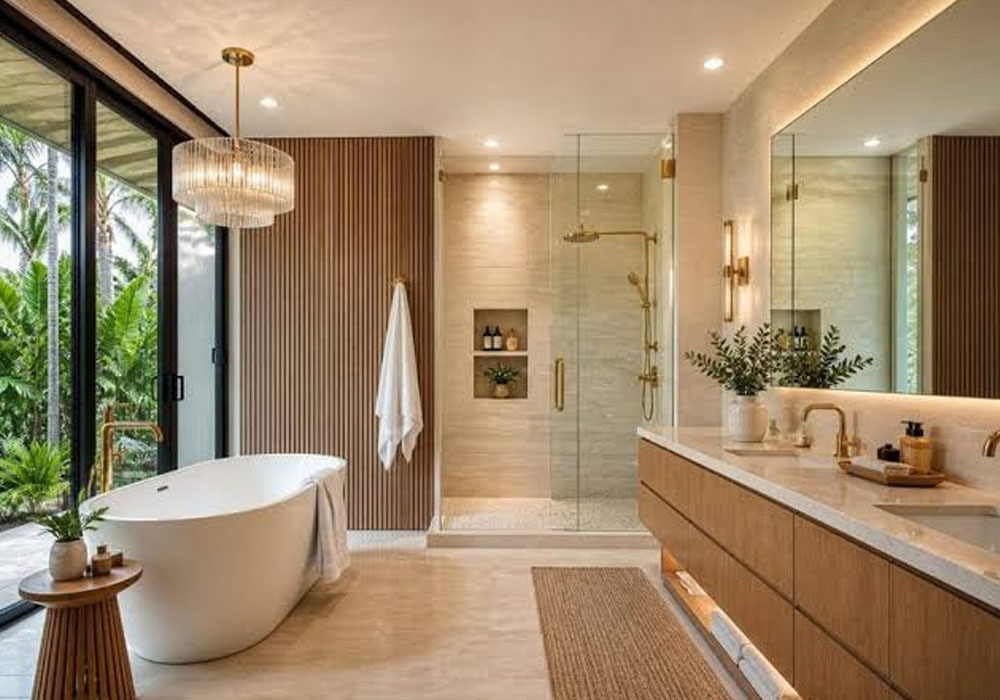
It’s less about a specific style and more about a strategic approach to guest experience and operational cost. A modern design anticipates guest needs for convenience, like integrated lighting and accessible power, while simultaneously reducing long-term maintenance for staff. It’s a balance between a high-end feel and the practical realities of durability, cleanability, and water efficiency. The focus has moved beyond aesthetics to performance over a 7 to 10 year lifecycle.
This shift means prioritizing non-porous, large-format materials that minimize grout lines and are resistant to mold and mildew. It involves selecting fixtures that are not only stylish but also have readily available parts and a track record of reliability in high-use commercial settings. For example, wall-hung toilets and vanities look sleek, but their primary operational benefit is making floors faster and easier to clean, which saves significant housekeeping time when multiplied across hundreds of rooms.
❝ Property owners might consider requesting a “cleanability audit” for proposed material palettes. This involves specifying cleaning chemicals and time-per-square-foot estimates for each surface. A lack of such detail may indicate a design-centric rather than operationally focused approach.
Ultimately, a modern bathroom is an asset that works for the property. It enhances the guest stay, commands a higher room rate, and reduces the operational drag on maintenance and housekeeping departments. It’s an investment in efficiency, not just a capital expenditure on new tile and faucets.
────────────────────────────────────────
How Do Material Choices Secretly Drive Up Labor Costs?
Material selections directly influence long-term operational expenses by dictating cleaning time, repair frequency, and the cost of replacement parts. A design that looks great at the grand opening can quickly become a financial drain if it wasn’t specified with the realities of daily housekeeping and maintenance in mind. The goal is to choose surfaces and fixtures that reduce the time and cost required to turn a room over.
The biggest hidden cost is often found in the grout lines. A standard 12×24 inch tile has significantly more grout per square foot than a 48×48 inch tile or a solid-surface wall panel. Each foot of grout is a potential failure point for cracking and a magnet for mold, requiring more intensive cleaning protocols. Shifting to non-porous surfaces like quartz for vanities eliminates the recurring need for sealing that natural stone requires, saving both labor and material costs annually.
Beyond surfaces, fixture selection is critical. While a residential faucet might look appealing, it is not engineered for the demands of a hotel. Commercial-grade fixtures are built for higher usage and often have readily available replacement parts. Furthermore, specifying water-efficient fixtures can lead to significant operational savings on utility bills. The U.S. Environmental Protection Agency’s WaterSense program provides a reliable standard for identifying toilets, faucets, and showerheads that meet rigorous criteria for both performance and efficiency.
Comparing Common Vanity and Wall Surfaces
| Material | Initial Cost | Cleanability | Durability & Repair |
| Quartz | High | Excellent (non-porous) | High; chips can be repaired |
| Granite | High | Good (requires sealing) | High; can stain if not sealed |
| Solid Surface | Medium-High | Excellent (seamless) | Excellent; scratches/burns repairable |
| Porcelain Tile | Medium | Fair (grout is a weak point) | High; single tile replacement is difficult |
| Cultured Marble | Low-Medium | Good (gel coat can scratch) | Fair; deep scratches are hard to fix |
❝ Before finalizing fixture selections, it can be beneficial to obtain model numbers for replacement cartridges and valves. This allows for confirmation of their cost and lead time from national suppliers, helping to avoid operational liabilities caused by extended room downtime due to unavailable parts.
Ultimately, every material choice should be evaluated against a total cost of ownership model. This includes the initial purchase and installation, but also the projected costs of cleaning, maintenance, repairs, and potential room downtime over a seven-to-ten year period.
────────────────────────────────────────
The Smart Way to Approach ADA Compliance and Accessibility
A smart approach treats accessibility as a design principle, not a legal checklist. While meeting the technical requirements is mandatory, the goal is to create a space that is equally functional and dignified for all guests without feeling clinical or separate. This means integrating accessibility features seamlessly into the overall modern aesthetic of the bathroom, enhancing the experience for every user.
The legal framework is the starting point. The U.S. Department of Justice’s 2010 ADA Standards for Accessible Design sets the minimum requirements for public accommodations. For example, a hotel with 101 to 150 guest rooms must provide at least five accessible rooms, with at least one featuring a roll-in shower. However, simply installing the required grab bars and ensuring a 60-inch turning radius is not enough. The challenge in a renovation is achieving this within the constraints of an existing structure, where plumbing stacks and load-bearing walls can make strict compliance difficult. In these documented cases, the standard allows for solutions that provide “equivalent facilitation,” but this requires careful planning and justification.
❝ A common mistake involves designing a standard bathroom first and then attempting to adapt it for accessibility, which often results in compromised layouts. An alternative approach is to design the accessible bathroom first; the solutions developed for clear floor space, intuitive controls, and easy-to-clean surfaces in such a room can frequently inform and improve the design for all standard rooms.
Furthermore, consider the operational impact. Are the grab bars located in a way that impedes housekeeping? Does the roll-in shower have proper drainage to prevent water from escaping into the main room, creating a slip hazard and potential water damage? Is the sink vanity designed to provide knee clearance without creating a difficult-to-clean area behind the plumbing? Thoughtful design addresses these issues, ensuring the room is not only compliant and usable for the guest but also efficient for staff to maintain. True accessibility enhances the property’s value by opening it to a wider market while reinforcing a brand image of inclusivity and thoughtful hospitality.
────────────────────────────────────────
Frequently Asked Questions About Hotel Bathroom Renovations
How long does a typical hotel bathroom renovation take per room? While the hands-on work inside a single room might span 7 to 14 days, this is not the most useful metric. A better measure is the contractor’s pace for completing entire floors or vertical stacks. An experienced team can often turn over a block of 10 to 20 rooms every few weeks by staggering trades, demolition, plumbing rough-in, waterproofing, tiling, and final fixture installation, in an efficient sequence.
What is the difference between a “soft” and “hard” renovation? A soft renovation is cosmetic, focusing on items like new paint, lighting fixtures, mirrors, shower curtains, and hardware. A hard renovation is a full gut, replacing everything down to the studs, including tile, vanities, toilets, showers, and often plumbing and electrical systems. While a soft refresh can provide a temporary lift, a hard renovation is necessary to fix underlying issues, improve operational efficiency, and meet new brand standards.
How can we minimize disruption during an occupied renovation? Effective containment is key. Renovation partners typically work in isolated blocks of rooms, sealing them off from guest-occupied areas. This includes using plastic barriers, dedicated service elevators, and negative air machines to control dust. The noisiest work, like demolition, should be restricted to a specific window of time (e.g., 10 a.m. to 4 p.m.) to avoid disturbing guests in the morning and evening.
How should we measure the return on investment (ROI) for this project? Look beyond the initial cost. The primary financial metrics to track are the post-renovation increases in Average Daily Rate (ADR) and Revenue Per Available Room (RevPAR). Property owners should also monitor guest satisfaction scores, specifically those related to room condition and cleanliness. A successful project also generates ROI through operational savings, such as reduced cleaning times and fewer maintenance calls for plumbing issues.
Are prefabricated bathroom pods a viable option for a renovation? Prefabricated pods can offer superior quality control and speed up a project timeline significantly, but they are primarily suited for new construction. The logistics of moving complete bathroom units into an existing building structure are often prohibitive. For most renovations, a traditional on-site build is more practical and cost-effective unless the project involves removing the building’s entire exterior facade.
────────────────────────────────────────
Conclusion
The evolution of hotel bathroom design reflects a shift from purely aesthetic considerations to a focus on operational efficiency and long-term value. Strategic material and fixture selections can significantly reduce ongoing labor costs for housekeeping and maintenance, transforming a capital expenditure into a compounding investment. Ultimately, a modern hotel bathroom is defined by its ability to perform flawlessly and contribute positively to a property’s bottom line through reduced operational drag. This perspective redefines excellence in hotel renovation, prioritizing durability and ease of maintenance alongside guest experience.
────────────────────────────────────────
About the author
This article was contributed by the team at Amerail, a hotel renovation contractor based in Erie, Pennsylvania. With over 40 years of experience, the company specializes in executing Property Improvement Plans (PIPs), brand conversions, and large-scale interior and exterior renovations for major hotel brands across the United States. They have completed more than 2,400 projects, focusing on value-engineered solutions that meet brand standards while minimizing operational disruption for hoteliers during construction.