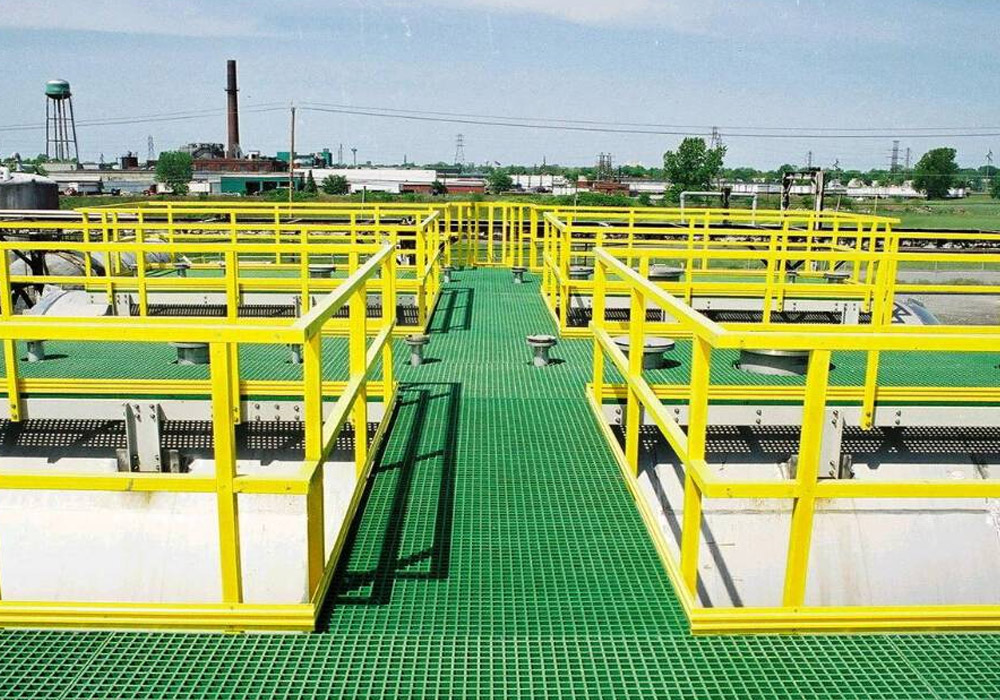
Fiberglass-reinforced plastic (FRP) grating often enters the conversation when corrosion makes steel walkways expensive to maintain. Yet choosing it involves more than swapping one panel for another. Strength, surface texture, resin chemistry, and support layout all affect whether the finished installation suits the facility.
For engineers, maintenance managers, and purchasing teams, the most useful response to common FRP myths is a closer look at the specification. These five misconceptions highlight what belongs in that review.
Myth 1: FRP cannot carry industrial walkway loads
The word “plastic” can suggest a lightweight product with little structural capacity. FRP, however, combines glass reinforcement with a resin matrix. Its suitability for a walkway depends on the particular grating and how it is supported, not on the material name alone.
Molded and pultruded grating have different structural characteristics. Square-mesh molded panels can distribute loads in two directions, while pultruded panels have primary load-bearing bars that must run in the intended span direction. Pultruded products can offer greater stiffness for applications that need it, but that does not make every pultruded panel suitable for every load.
Use the manufacturer’s load/span tables for the exact product. Review concentrated loads as well as distributed loads, and check deflection limits alongside strength. Equipment wheels, openings, and unsupported edges require attention beyond a basic pedestrian loading assumption.
An existing steel support layout is not automatically suitable for FRP. The panel, supports, and fastening details need to work as a system.
Myth 2: Fire-retardant FRP is fireproof
Neither dismissing all FRP as a fire hazard nor treating a fire-retardant label as blanket approval gives a project team enough information.
Some FRP products use fire-retardant resin formulations and carry surface-burning test results. ASTM E84, for example, evaluates flame-spread and smoke-development characteristics. Those results are not the same as a fire-resistance rating for a complete floor or wall assembly.
Ask for documentation covering the product being proposed, rather than relying on a general statement about a resin family. The project’s fire requirements must determine whether that product is appropriate for the location and use.
This distinction is especially important when purchasing teams compare apparently similar panels. A description such as “fire-retardant” is a starting point for reviewing performance, not a substitute for the relevant test results and project approval.
Myth 3: All FRP panels are interchangeable
Two panels with the same dimensions can differ in resin formulation, reinforcement, surface treatment, and load capacity. Matching the opening size and color does not establish an equivalent replacement.
Chemical compatibility deserves particular care. Resin selection depends on the substances present, their concentrations, exposure temperatures, and whether contact is continuous or occasional. A panel suitable for one wastewater area may not suit a different chemical process nearby.
Vinyl ester and polyester systems are common options, but neither label provides a universal compatibility guarantee. Review the manufacturer’s chemical-resistance guidance against actual operating conditions. Outdoor exposure also calls for attention to the product’s weathering provisions and maintenance recommendations.
Suppliers such as Fiberman offer both molded and pultruded grating. When comparing options, request product-specific information rather than assuming that panels within the same broad category perform alike. A bid comparison should identify the resin, panel geometry, surface, and supporting performance data.
Myth 4: A gritted surface eliminates slip risks
Surface texture can improve traction, but “slip-resistant” does not mean slip-proof. Footwear, contamination, cleaning practices, and surface wear all affect conditions underfoot.
FRP grating is available with different walking surfaces, including grit finishes. The useful question is how the proposed surface performs under conditions relevant to the facility, not whether it looks rough when new. Test results should be read with their methods and conditions in mind.
Drainage matters too. Open grating allows liquids to pass through, but deposits can still collect on the walking surface or obstruct openings. Grease, mud, and process residue need a cleaning plan.
Inspection remains necessary after installation. Worn surfaces, damaged panels, loose fasteners, and uneven transitions can undermine an otherwise suitable choice. Corrosion resistance does not remove those responsibilities.
Myth 5: FRP always costs more, or always saves money
Both claims oversimplify a site-specific decision. Purchase price is only one part of the comparison, and it should come from current quotes rather than an assumed price ranking between materials.
Compare equivalent load capacity, usable area, and installation requirements. Include support modifications, fasteners, fabrication, handling, and any disruption needed to complete the work.
Then consider maintenance over a realistic service period. In corrosive conditions, avoiding repeated steel coating repairs may favor FRP. In a less demanding environment, that advantage may be smaller. FRP still needs cleaning, inspection, and eventual repair or replacement when damaged or degraded.
A useful lifecycle estimate states its assumptions: expected exposure, inspection intervals, maintenance access, and downtime costs. Changing those assumptions can change the preferred material.
The strongest case for FRP is not that it wins every comparison. It is that a properly selected product can address specific operating problems. Define the loads and exposure first, review the supporting data, and compare complete installed systems. That turns a material debate into a practical engineering decision.