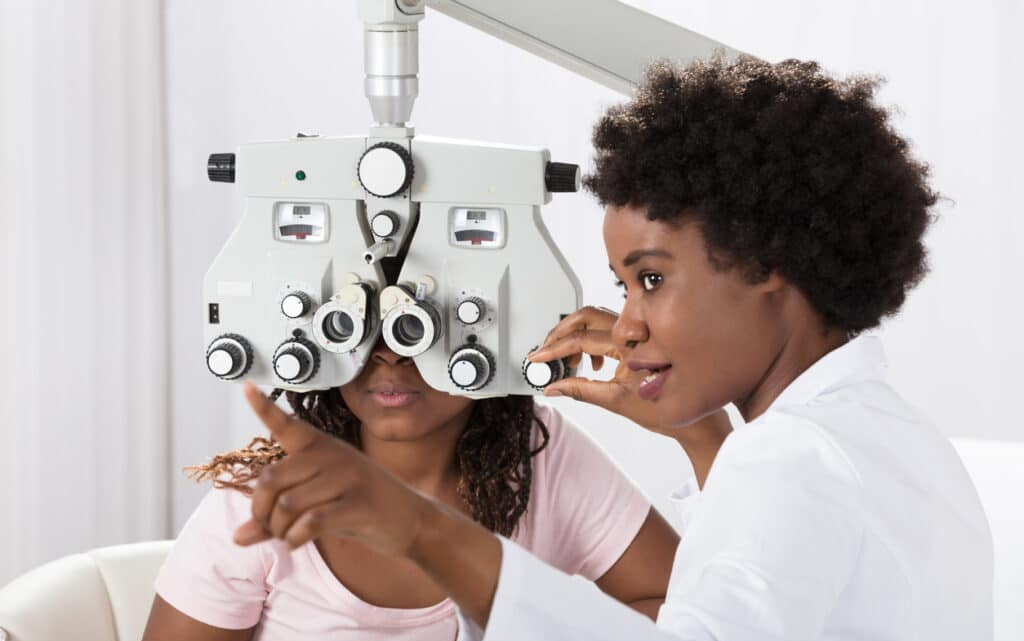
Searching for an eye exam near you is often triggered by something specific. Your vision has changed, your glasses prescription feels off, you are due for a contact lens renewal, or you have noticed something that was not there before. Whatever brought you to the search, understanding what a comprehensive eye exam actually involves and how to choose the right provider makes the experience more useful than a routine box to check.
Why Regular Eye Exams Matter Beyond Vision Correction
Most people think of an eye exam as a vision test. It is significantly more than that. A comprehensive eye exam evaluates the health of the entire visual system and the structures of the eye itself, not just how clearly you can read letters on a chart.
Several serious health conditions show early signs in the eye before they produce symptoms elsewhere in the body. Diabetes can be detected through changes in the blood vessels of the retina before a patient has received a formal diagnosis. High blood pressure produces visible changes in retinal vasculature. Certain neurological conditions, thyroid disorders, and autoimmune diseases all have ocular manifestations that a thorough eye exam can identify.
Within the eye itself, conditions like glaucoma, macular degeneration, and cataracts develop gradually and often without noticeable symptoms in their early stages. By the time vision changes become apparent, the condition may have progressed further than it would have if caught at a routine exam. Regular eye care is where early detection happens, and early detection is what makes the difference between conditions that are managed effectively and ones that cause irreversible damage. For example, to restore vision after extensive cataract development, the most common option is Cataract Surgery which involves a straightforward procedure to replace the cloudy lens with a clear artificial one. The recovery is typically fast, and most people see a major improvement in their sight shortly after.
How Often You Actually Need an Exam
The right frequency depends on your age, your visual history, and whether you have any risk factors for eye disease. General guidelines suggest that adults with no known risk factors and no vision correction needs benefit from a comprehensive exam every two years. Adults who wear glasses or contact lenses typically need annual exams to keep their prescription current and monitor any changes.
Risk factors that warrant more frequent monitoring include a family history of glaucoma or macular degeneration, diabetes, high blood pressure, a history of eye injury or surgery, and certain medications that can affect eye health over time. If any of these apply, an annual exam at minimum is the appropriate baseline, and your eye care provider may recommend more frequent monitoring depending on what they find.
Children need eye exams before starting school and regularly throughout their school years, as undetected vision problems directly affect learning and development in ways that are not always apparent without testing. Older adults benefit from annual exams as the risk of age-related eye conditions increases substantially after sixty.
What a Comprehensive Eye Exam Involves
A thorough exam covers considerably more ground than the vision chart most people picture. Your eye care provider will assess visual acuity at multiple distances, evaluate how your eyes work together, test your peripheral vision, measure intraocular pressure as a screen for glaucoma, and examine the internal structures of the eye including the retina, optic nerve, and blood vessels.
Dilation, where drops are used to widen the pupil and allow a clearer view of the back of the eye, is a standard part of a comprehensive exam and provides information about retinal health that cannot be gathered without it. Some practices also use imaging technology that photographs the retina in detail, creating a baseline record that makes changes easier to detect at future exams.
The prescription component, if you need vision correction, involves a refraction test that determines the lens power required to correct your vision. This is the part of the exam that determines your glasses or contact lens prescription and needs to be current for your lenses to actually correct your vision properly.
Pearle Vision makes it straightforward to find a provider and book an eye exam near me through their location finder, with licensed optometrists providing comprehensive eye care across a network of locations rather than a volume-focused retail experience.
Choosing the Right Provider
The quality of an eye exam depends significantly on the provider conducting it and the time and thoroughness they bring to the examination. A rushed exam that spends most of its time on the refraction and skips a thorough evaluation of eye health is not equivalent to a comprehensive exam that covers all the clinical ground it should.
When evaluating a provider, look for licensed optometrists or ophthalmologists rather than technician-led processes. Ask whether the exam includes dilation or retinal imaging. Check that the location has current diagnostic equipment rather than relying solely on older technology. A provider who spends time explaining what they are looking for and what they find is more likely to catch things that matter than one who moves through the appointment without engagement.
What to Bring and How to Prepare
Arriving at an eye exam with your current glasses or contact lenses allows the provider to assess your existing correction and compare it to what the exam reveals. Bringing a list of any medications you take is useful because several common medications have effects on vision and eye health that are relevant to the examination.
If you have had previous eye exams, records from prior providers give your current provider a baseline to compare against, which makes changes easier to identify and interpret. Being ready to describe any symptoms you have noticed, even ones that seem minor or intermittent, gives the provider context that improves the usefulness of the exam.
Eye care is one of those areas where the gap between doing it regularly and doing it only when something is obviously wrong determines outcomes in ways that are not apparent until a problem has already progressed. A comprehensive exam conducted by a thorough provider on a regular schedule is the most reliable way to stay ahead of conditions that are far easier to manage when caught early.