Your dishwasher racks came out chalky again. The ice machine is limping. And the espresso tech just told you your boiler is “mineralized,” which sounds expensive because it is. I’ve walked enough mechanical rooms in this city to say it plainly: most Los Angeles buildings are running harder water than their equipment was ever spec’d for, and nobody notices until something fails.
Here’s the thing about this city. We import roughly 85 percent of our water from the Sierra Nevada and the Colorado River, and that journey picks up minerals the whole way down. That’s why commercial water softener installation los angeles operators stay busy year round. It isn’t a plumbing emergency. It’s a slow math problem that shows up on your utility bill and your repair invoices at the same time. So let’s walk through what hardness actually does, how to tell whether your building has a problem, and what a sane fix looks like. You’ll leave with a diagnostic you can run this week.
What “Hard” Actually Means, Without the Chemistry Lecture
Hardness is dissolved calcium and magnesium. That’s the whole story. When those minerals ride along in your water and the water gets hot or evaporates, they drop out of solution and stick to whatever surface they touch. Pipe walls. Heat exchanger tubes. The inside of your combi oven.
The U.S. Geological Survey treats hardness as one of the most commonly measured water quality characteristics in the country, which tells you something: this is a baseline property of water, not a defect in your building. It varies by source, by season, and by how far your water traveled to get to you.
What counts as hard? The conventional scale runs from soft at the low end up past 180 milligrams per liter of calcium carbonate, which most water professionals call very hard. Los Angeles water tends to sit in the middle to upper range of that scale and shifts depending on which source is feeding your district that month. If you’re in a taller building with a rooftop tank and booster pumps, the number at your tap can drift from the number the utility reports.
Which brings me to my first real opinion: utility water quality reports are a starting point, not an answer. Test at the point of use.
The Scale Signal Check: A Five Minute Diagnostic
I use a simple framework with building managers called the Scale Signal Check. It has four signals, and if you get two or more, you’ve got a softener conversation to have. No lab kit required.
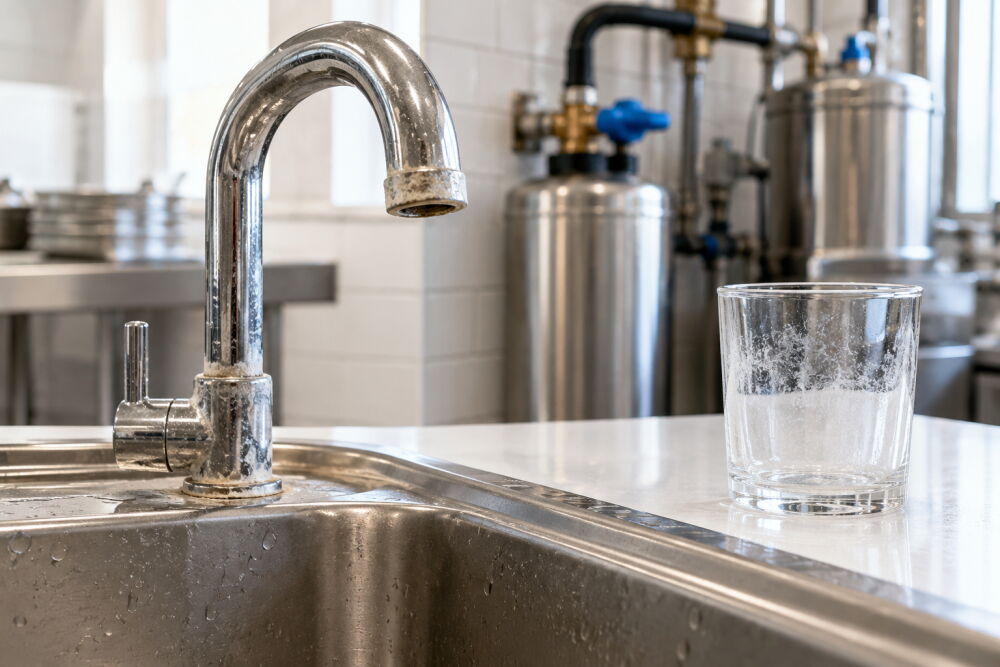
- The glass test. Fill a drinking glass, let it sit overnight, and look at it in morning light. A cloudy film that wipes away is hardness. A film that doesn’t wipe away is etching, which is a different problem.
- The hot water smell. Run hot water in a mop sink and smell it. Mineral-heavy hot water has a flat, chalky scent. It’s subtle, but you’ll catch it once you know it.
- The dishwasher rack. Pull a rack out and drag a dry finger across it. Grit means you’re depositing scale in a machine that costs more to replace than to protect.
- The water heater listen. Stand next to your water heater while it’s firing. Popping and rumbling is steam trapped under a scale layer on the burner surface. That’s a real one, and it costs you gas efficiency every single day.
Two signals means test the water properly. Three or four means you’re already paying for the problem, you just haven’t seen the invoice yet.
Why This Hits Los Angeles Kitchens and Laundries Hardest
High-volume food service is the brutal case. A commercial dishwasher running 200 racks a day is heating water constantly, and every heating cycle is a chance to deposit minerals. Same logic applies to laundry operations, health clubs, car washes, and any building with cooling towers.
The U.S. Environmental Protection Agency maintains drinking water regulations that set the standards utilities must meet, and hardness isn’t a regulated contaminant for health reasons. That’s worth saying out loud, because it’s why nobody from the utility is going to call you about it. Hard water isn’t a safety issue. It’s an equipment lifespan and operating cost issue, and that one is entirely yours to manage.
I’ll take a stance here that some vendors won’t like: you probably don’t need to soften every drop of water in your building. Irrigation, toilet flushing, and hose bibs don’t care. Softening the water that feeds boilers, dish machines, laundry, and any steam-generating equipment is where the payback lives. Treating the whole building is simpler to install and easier to explain, but it also means you’re buying salt to condition water that’s headed for a sidewalk.
Softener, Filtration, or Reverse Osmosis? Pick By Job
People mix these up constantly. They solve different problems, and the right answer usually involves two of them.
| System | What it removes | Best fit |
|---|---|---|
| Water softener | Calcium and magnesium | Boilers, dish machines, laundry, steam equipment |
| Carbon filtration | Chlorine, taste and odor compounds | Drinking water, coffee and beverage programs |
| Reverse osmosis | Most dissolved solids | Ice machines, espresso, lab and process water |
If your goal is protecting heat transfer surfaces, you want a softener. If your goal is making better coffee, you want filtration or RO after the softener, not instead of it. The ASHRAE standards community has spent decades documenting how water quality and treatment affect building mechanical systems, and the consistent finding is that scale on heat transfer surfaces costs energy. That’s not a sales pitch. It’s thermodynamics.
What Installation Actually Involves
The equipment is the easy part. The hard part is where it lives and how it’s maintained.
- Space and drainage. You need floor space, a drain that can handle backwash volume, and a power source. Retrofits in older downtown buildings often mean finding creative spots near the incoming line.
- Water pressure and flow rate. A softener sized for peak demand still has to deliver adequate pressure to the top floor. Under-sizing shows up as pressure complaints, not as soft water problems, which makes it confusing to diagnose later.
- Bypass and isolation. Always install bypass valves. When you need service, you don’t want to shut the building down.
- Salt delivery and consumables. This is the ongoing cost people forget to budget. Someone has to keep the brine tank full, and if you’re managing several properties, that logistics burden adds up fast.
Which is why I’d push most managers toward a service arrangement that covers installation, salt, and maintenance under one roof. Not because doing it yourself is impossible. Because the failure mode of a neglected softener is that it quietly stops working and you don’t find out until the scale is back.
Setting a Maintenance Rhythm That Survives a Busy Month
Softener systems are boring when they work and invisible when they don’t. Give yours a rhythm.
Check salt level weekly if you can, monthly at minimum. Test hardness at the outlet quarterly and log it somewhere you’ll actually look. Have the resin and control valve serviced annually. And keep one number handy: the hardness reading from the day the system was commissioned. That’s your baseline, and any drift off it is your early warning.
Budget-wise, treat softening as an equipment protection line item, not a utility. The savings show up as longer water heater life, lower gas use, fewer emergency service calls, and dish machines that finish their expected lifespan instead of dying at year four.
Start With the Glass Test Tonight
You don’t need a consultant to find out whether your building has a hardness issue. Fill a glass, let it sit, and look at it in the morning. Then check your water heater for popping, your dishwasher rack for grit, and your last twelve months of service invoices for anything with the word “descale” on it.
If two or more of those turned up something, you’re not guessing anymore. You have a documented problem with a known fix. The only question left is whether you deal with it this quarter or wait for the boiler to make the decision for you.