
Recovering Funeral Costs Through Personal Injury Claims
Few experiences are as devastating as losing a loved one unexpectedly, especially in a fatal accident. The emotional pain is immense, and often, families also face the sudden financial burden of funeral expenses.
We understand that navigating this difficult time while also seeking answers and financial relief can be overwhelming. This guide explores how families can claim for funeral costs after a fatal accident. We will look at various legal avenues, insurance options, and how personal injury claims can help.
Our goal is to shed light on who is responsible for these costs and what steps you can take to recover them. We aim to provide clear, actionable information during a challenging period.
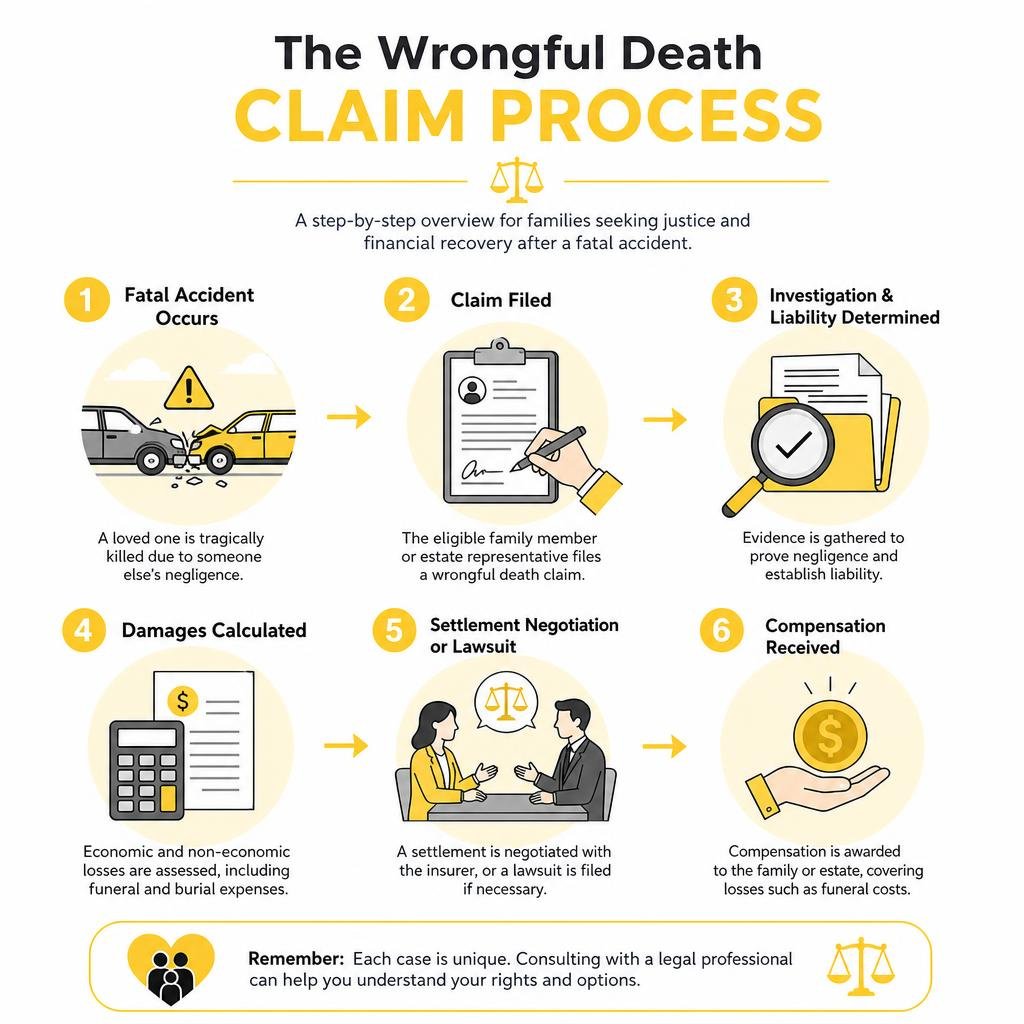
When a fatal accident occurs due to someone else’s negligence, the deceased’s family or estate often has legal recourse to recover various damages, including funeral costs. This process typically falls under the umbrella of a wrongful death claim, which is a type of personal injury claim. These claims aim to hold the at-fault party financially accountable for the losses incurred by the surviving family members.
The primary mechanism for recovering these costs is usually through the at-fault driver’s (or responsible party’s) third-party liability insurance. This insurance is designed to cover damages, including funeral expenses, that their policyholder is legally responsible for causing. However, the exact process and available compensation can vary significantly depending on the jurisdiction and the specific insurance policies involved.
In some states, like Michigan, specific statutory provisions govern how funeral costs are covered, particularly under no-fault insurance systems. For instance, Michigan’s no-fault Personal Injury Protection (PIP) system statutorily caps funeral and burial benefits at $5,000 under MCL 500.3107. This means that regardless of fault, the deceased’s own auto insurance (or, in certain circumstances, another involved party’s policy) would pay up to this amount for funeral and burial expenses. While this provides immediate relief, it often falls short of covering the full cost of a funeral, which can easily exceed this amount. This gap often necessitates pursuing a broader wrongful death claim to recover the remaining expenses.
Understanding your rights to pursue financial recovery through personal injury claims is crucial. It allows families to seek compensation not only for funeral costs but also for other significant losses such as lost income, loss of companionship, and pain and suffering.
How No-Fault Insurance Affects Personal Injury Claims
No-fault insurance systems, adopted in various states across the U.S., significantly alter how accident claims, including those for fatal accidents, are handled. In these systems, your own insurance company typically pays for your medical expenses and certain other losses, regardless of who was at fault for the accident. This is where Personal Injury Protection (PIP) benefits come into play.
As mentioned, in Michigan, for example, PIP insurance is mandated to provide up to $5,000 for funeral and burial expenses. This benefit is usually paid directly to the deceased’s family or the funeral home. The key aspect here is that these benefits are available irrespective of fault. This can be a vital source of immediate financial assistance for grieving families, as it avoids the often lengthy process of proving negligence in a liability claim.
However, the statutory caps on funeral benefits in no-fault states like Michigan often mean that the full cost of a funeral is not covered. This is a critical point of difference from liability-based claims, where the at-fault party’s insurance might be responsible for the entire reasonable cost of funeral expenses. When PIP benefits are insufficient, families in no-fault states must often pursue a wrongful death claim against the at-fault driver to recover the remaining funeral costs and other damages not covered by their own PIP policy.
Furthermore, no-fault coverage can extend beyond the policyholder. A non-policyholder who dies as a pedestrian or passenger may still access PIP funeral benefits through another involved party’s auto insurance policy. This ensures that even if the deceased did not own a vehicle or have their own policy, there might still be an avenue for initial funeral cost recovery.
Handling Uninsured and Underinsured Motorist Coverage
A significant concern in fatal accident cases arises when the at-fault driver is uninsured or underinsured. An uninsured driver has no liability insurance, while an underinsured driver has insurance, but their policy limits are insufficient to cover the full extent of the damages, including funeral costs and other losses.
In such scenarios, families can often turn to their own auto insurance policies if they have Uninsured/Underinsured Motorist (UM/UIM) coverage. This optional, but highly recommended, coverage is designed to protect you and your family if you are involved in an accident with a driver who lacks adequate insurance.
If the at-fault driver is uninsured, your UM coverage can step in to pay for damages that the uninsured driver would have been legally responsible for, including funeral expenses. Similarly, if the at-fault driver is underinsured, your UIM coverage can cover the difference between their policy limits and the total damages, up to your UIM policy’s limits.
It’s important to review your own insurance policy to understand the extent of your UM/UIM coverage. These benefits can be crucial for bridging the financial gap when the at-fault party cannot fully compensate the family. Pursuing a claim under your own UM/UIM policy can be a more straightforward process than a full-blown wrongful death lawsuit against an uninsured individual, though it still requires careful documentation and negotiation with your insurer.
Types of Recoverable Damages and Funeral Expenses
When a loved one dies in a fatal accident, the financial impact can be substantial, extending beyond the immediate funeral costs. Families can typically claim for a range of expenses and losses through a wrongful death claim. These recoverable damages are broadly categorized and vary by jurisdiction, but generally include specific funeral expenses, as well as broader losses suffered by the deceased’s estate and surviving family members.

Eligible Costs: Caskets, Memorial Services, and Travel
The core of a funeral cost claim revolves around the reasonable expenses directly associated with the deceased’s final arrangements. These typically include:
- Burial or Cremation Costs:This covers the casket or urn, embalming, cremation services, and the cost of the burial plot or niche.
- Memorial Service Expenses:Costs associated with the funeral service, wake, viewing, and memorial events, including facility rental, officiant fees, and floral arrangements.
- Headstone or Monument:The expense of a headstone, grave marker, or monument to commemorate the deceased.
- Transportation of Remains:If the deceased passed away far from their desired burial location, the costs of transporting their remains can be included.
Beyond these direct funeral costs, some jurisdictions and insurance policies may also cover related expenses. For example, in Victoria, Australia, the Transport Accident Commission (TAC) can pay reasonable funeral and monument expenses up to $19,330 (including GST) for deaths on or after July 1, 2025. This provides a clear statutory cap for such expenses.
Additionally, in some cases, family members may be able to claim for travel and accommodation expenses related to attending the funeral. For instance, the TAC in Victoria, Australia, can reimburse immediate family members living more than 100km from where the funeral service takes place, up to $6,450 (including GST) for travel and accommodation. These provisions are crucial for families scattered geographically, ensuring they can be present during this critical time without undue financial strain.
Grief counseling for family members is another expense that may be recoverable. In Victoria, Australia, the TAC can pay up to $20,520 (including GST) for counseling for family members of a person who died in a transport accident. This acknowledges the profound psychological impact of such a loss.
Estate Claims Versus Dependency Claims in Personal Injury Claims
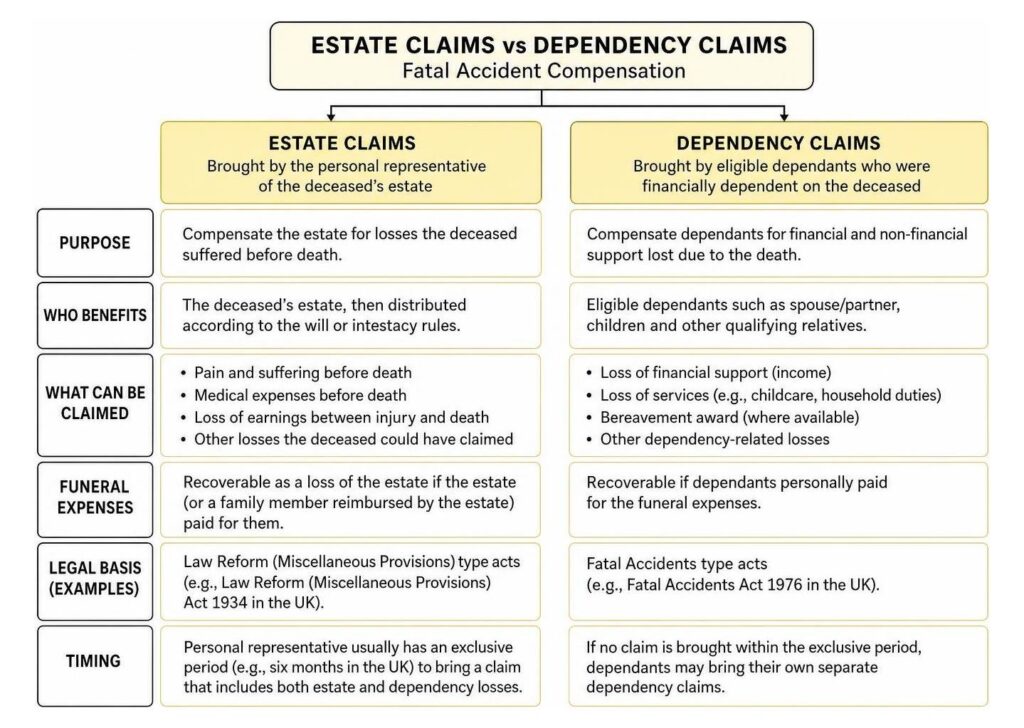
In many legal systems, particularly those based on English common law (which influences many US states), claims arising from a fatal accident can generally be brought in two distinct ways: through the deceased’s estate or by their dependants. While both aim to compensate for losses, they cover different types of damages and serve different beneficiaries.
Estate Claims (often under “Law Reform” type acts): These claims are brought by the personal representative of the deceased’s estate. They seek to recover losses that the deceased would have been able to claim had they survived. This typically includes:
- Pain and Suffering:Compensation for any conscious pain and suffering the deceased experienced between the time of injury and death.
- Medical Expenses:Costs incurred for medical treatment related to the fatal injury before death.
- Loss of Earnings:Any income the deceased lost between the injury and death.
- Funeral Expenses:In many jurisdictions, reasonable funeral and burial expenses are recoverable by the estate, especially if the estate (or a family member who will be reimbursed by the estate) initially paid for them. For example, in the UK, funeral expenses can be claimed through the deceased’s estate under the Law Reform (Miscellaneous Provisions) Act 1934, especially if claimed within the first six months.
Dependency Claims (often under “Fatal Accidents” type acts): These claims are brought by specific individuals who were financially dependent on the deceased. The goal is to compensate these dependants for the financial and non-financial support they have lost due to the death. Eligible dependants typically include spouses, civil partners, cohabiting partners (who meet specific cohabitation duration requirements, e.g., two years in the UK), children, and sometimes parents or other relatives.
- Loss of Financial Support:This is often the largest component, covering the income the deceased would have contributed to the household. This can be calculated based on a percentage of the deceased’s income (e.g., up to 75% for a family with children, or 66% for a couple without children in the UK).
- Loss of Services:Compensation for the value of non-financial contributions the deceased provided, such as childcare, household maintenance, gardening, or DIY.
- Bereavement Award:In some jurisdictions (like the UK, where it’s a fixed statutory amount, currently £15,120 in England and Wales), a fixed sum is awarded to specific close relatives for grief and suffering.
- Funeral Expenses:Dependants can also claim funeral expenses if they personally incurred these costs.
Both types of claims can often be pursued simultaneously, as they address different aspects of the loss. The personal representative of the estate usually has an exclusive period (e.g., six months in the UK) to bring a claim that encompasses both estate and dependency losses. If they do not, dependants may then bring their own separate dependency claims.
Understanding the distinctions between these claim types is vital for ensuring all potential losses are recovered.
Legal Factors Impacting Funeral Cost Recovery
Navigating the legal landscape after a fatal accident involves understanding several critical factors that can impact the recovery of funeral costs and other damages. These include strict time limits for filing claims and rules regarding partial fault.

Time Limits and Statutes of Limitations
One of the most crucial aspects of any legal claim, especially a wrongful death claim, is the statute of limitations. This is a strict deadline within which legal action must be initiated. If a claim is not filed within this period, the right to seek compensation is permanently lost, regardless of the merits of the case.
The specific time limit varies significantly by jurisdiction. For example:
- In the UK, fatal accident claims must generally be started within three years from the date of death or from when the claimant first knew negligence contributed to the death.
- In Michigan, wrongful death claims must be filed within three years of the accident.
These time limits are not flexible, and there are very few exceptions, typically only for minors or individuals with certain legal incapacities. The clock usually starts ticking from the date of death. It is imperative for families to seek legal guidance as soon as possible after a fatal accident to ensure that all necessary legal proceedings are initiated within the applicable limitation period. Delaying action can have severe and irreversible consequences for the ability to recover funeral costs and other vital compensation.
Partial Fault and Contributory Negligence Rules
Another important legal factor is how the deceased’s own actions might have contributed to the accident. This is governed by principles of comparative fault or contributory negligence, which vary by state.
- Contributory Negligence:In a few states, if the deceased is found to be even 1% at fault for the accident, their family may be completely barred from recovering any compensation. This is a very strict rule.
- Comparative Negligence:Most states follow some form of comparative negligence. This system allows for recovery even if the deceased was partly at fault, but the compensation amount is reduced proportionally to their degree of fault.
- Pure Comparative Negligence:In states with pure comparative negligence, a claimant can recover damages even if they are 99% at fault, though their recovery will be reduced by their percentage of fault.
- Modified Comparative Negligence:Many states use a modified comparative negligence rule, often with a 50% or 51% bar. This means that if the deceased is found to be 50% (or 51%) or more at fault, their family cannot recover any damages. If their fault is below that threshold, their recovery is reduced by their percentage of fault.
For example, if the deceased was found to be 20% at fault for an accident, and the total damages (including funeral costs) were $100,000, their family would only be able to recover $80,000.
Understanding these rules is crucial because the at-fault party’s insurance company will often attempt to assign some degree of fault to the deceased to reduce or eliminate their liability. Evidence such as police reports, witness statements, and accident reconstruction expert testimony becomes vital in establishing the true extent of fault. Can funeral costs be claimed if the deceased was partly at fault? Yes, in most comparative negligence states, but the amount recovered will likely be reduced.
Essential Evidence and Steps to Support Your Claim
To successfully claim for funeral costs and other damages after a fatal accident, gathering comprehensive and accurate evidence is paramount. Strong documentation helps establish liability, prove the extent of your losses, and support your demand for compensation.
Key Documents for Funeral Cost Claims
Here’s a list of essential evidence typically required to support a claim for funeral expenses:
- Death Certificate:The official document confirming the death, its cause, and date. This is fundamental for any wrongful death or fatal accident claim.
- Police Report/Accident Report:This official document details the circumstances of the accident, identifies involved parties, and often includes initial findings regarding fault.
- Itemized Funeral Home Invoices:Detailed bills from the funeral home, cremation service, or burial provider, clearly listing all services and merchandise purchased (casket, embalming, cremation, plot, memorial service, etc.).
- Proof of Payment:Receipts, bank statements, or credit card statements showing that the funeral expenses have been paid and by whom. This is important for determining who is entitled to reimbursement.
- Receipts for Related Expenses:Any other receipts for directly related costs, such as headstone purchases, transportation of remains, or grief counseling if these are recoverable in your jurisdiction.
- Medical Records (Pre-Death):If there was a period of injury before death, medical records detailing treatment and expenses incurred during that time.
- Deceased’s Financial Records:Pay stubs, income tax returns, and employment history to establish lost income and financial dependency.
- Witness Statements:Accounts from individuals who witnessed the accident or can attest to the deceased’s contributions to the family.
- Expert Witness Testimony:In complex cases, accident reconstructionists or economists may provide expert opinions on liability or the value of future financial losses.
- Probate Documents:If an estate claim is being pursued, documents like the Grant of Probate or Letters of Administration are necessary to prove the legal standing of the personal representative.
Actionable Steps:
- Gather all official documentation:Obtain certified copies of the death certificate and the police report immediately.
- Keep meticulous records:Retain all invoices, receipts, and payment confirmations related to funeral expenses.
- Consult a legal professional:An experienced attorney specializing in fatal accident claims can help you identify all necessary evidence, navigate legal complexities, and ensure your claim is filed correctly and within the statutory time limits. They can also advise on whether to pursue an estate claim, a dependency claim, or both.
- Notify insurers promptly:Inform all relevant insurance companies (your own, the at-fault party’s) about the accident and the death.
Frequently Asked Questions About Funeral Cost Recovery
Grieving families often have many questions about the practicalities of covering funeral costs after a fatal accident. Here, we address some of the most common inquiries.
Who is responsible for paying funeral costs immediately after a fatal accident?
Immediately after a fatal accident, the responsibility for paying funeral costs typically falls to the deceased’s family or estate. While insurance or legal claims may eventually reimburse these expenses, the initial outlay usually comes from personal funds. This is where benefits like Personal Injury Protection (PIP) in no-fault states can provide crucial immediate relief, as they are often paid out quickly, up to their statutory limits (e.g., $5,000 in Michigan). Some auto insurance policies may also have specific death benefits or medical payments (MedPay) coverage that can contribute. While the at-fault party may be legally liable, their insurance payout will take time, making initial family or estate funding essential.
Can family members claim travel expenses for attending the funeral?
Yes, in certain circumstances, family members can claim travel and accommodation expenses related to attending the funeral. This is not universally covered by all insurance policies or legal frameworks, but it is often a recoverable damage in comprehensive wrongful death claims, especially if the family members had to travel a significant distance. For example, in Victoria, Australia, the TAC explicitly covers travel and accommodation up to $6,450 for immediate family members living more than 100km from the funeral service. To be eligible, these expenses must typically be reasonable and directly related to attending the funeral. Keeping detailed receipts for flights, hotel stays, and other travel-related costs is crucial for reimbursement.
What evidence is required to prove funeral expenses?
To prove funeral expenses, you will need comprehensive and verifiable documentation. The most critical pieces of evidence include:
- Itemized Invoices from the Funeral Home:These should clearly list all services and products provided, such as the casket, embalming, cremation, burial plot, memorial service, and any associated fees.
- Proof of Payment:This includes receipts, canceled checks, bank statements, or credit card statements that show who paid for the services and the exact amounts.
- Death Certificate:While not directly proving the cost, it establishes the fact of death and its cause, linking the expenses to the fatal accident.
- Any Receipts for Related Costs:This might include expenses for a headstone, flowers, or other items directly associated with the funeral that were not part of the funeral home’s invoice.
It is essential that these documents are clear, legible, and demonstrate that the expenses were actually incurred and paid. Insurance companies and courts will scrutinize these records to ensure the claimed costs are reasonable and directly attributable to the accident.
Conclusion
Losing a loved one in a fatal accident is an unimaginable tragedy, compounded by the unexpected financial burden of funeral expenses. While no amount of money can truly compensate for such a loss, understanding your legal rights and avenues for financial recovery can provide much-needed relief during a profoundly difficult time.
We’ve explored how various insurance mechanisms, including no-fault PIP benefits and uninsured/underinsured motorist coverage, can contribute to covering these costs. We’ve also highlighted the crucial role of wrongful death claims, which allow families to pursue compensation for funeral expenses, lost financial support, and other damages from the at-fault party.
Time is of the essence due to strict statutes of limitations, and the specific rules regarding fault and recoverable damages vary by jurisdiction. Gathering meticulous evidence, from itemized funeral invoices to police reports, is vital for building a strong case.
If you find yourself in this challenging situation, we strongly encourage you to seek prompt legal guidance. An experienced attorney specializing in fatal accident claims can help you navigate these complex legal processes, understand who is responsible for paying funeral costs, identify all potential sources of compensation, and ensure that your family secures the financial support it deserves.



In many cases, drivers who cause serious accidents have a history of traffic violations or license suspensions. For example, states like Florida require high-risk drivers to carry increased liability limits, such as filing an FR-44 for a DUI conviction. This type of filing forces drivers to maintain higher insurance coverage to protect other road users. Even if these drivers do not own a vehicle, they must still get a non-owner policy to meet state laws. These strict rules help ensure there is some financial recovery available if another accident occurs.