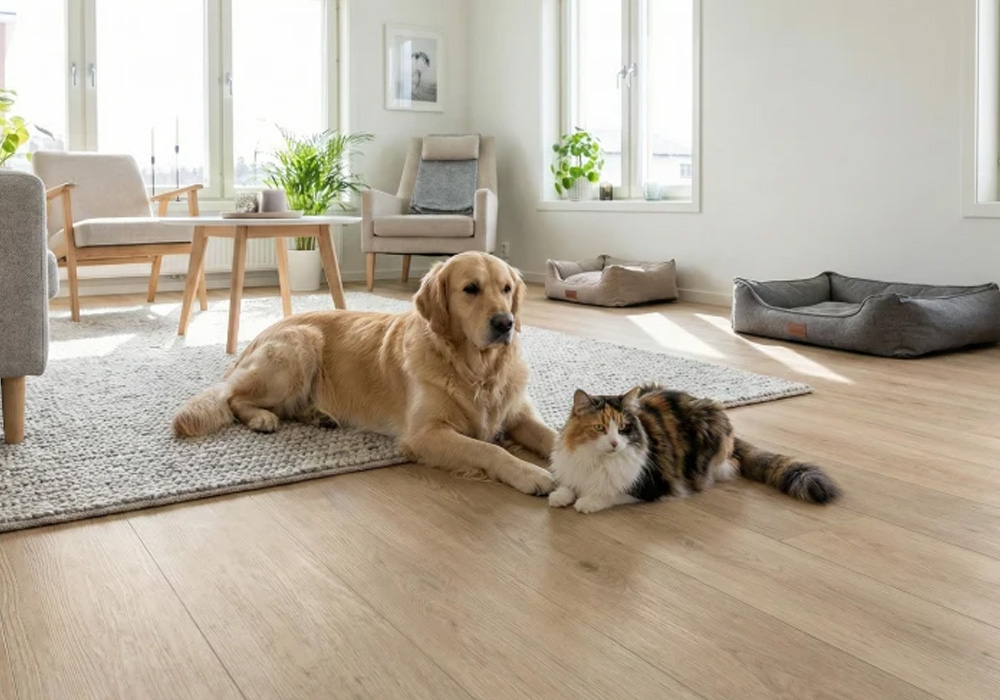
Many individuals who intend to remodel their homes choose their flooring based on its appearance in a showroom. They later realize that their pet’s nails have damaged the finish. Such scenarios lead to disappointment. It’s also difficult to select a “pet-friendly” floor based on marketing hype. The solution is to determine the type of damage your pet causes and find a material that is resistant to that specific risk.
Why This Decision Matters More During a Remodel Than a Quick Swap
Changing your flooring is not a regular occurrence for most homeowners. It’s typically a once a decade, what’s my budget, what’s the resale value kind of feel I want in my house, type of investment. That timeline is exactly why pet damage deserves real weight in the decision instead of an afterthought.
With 66% of households owning a pet, roughly 86.9 million homes in the U.S. (American Pet Products Association), most remodels are happening in homes with an animal walking across the new floor daily. Most floors need to survive claws, accidents, shedding, and slipping, these aren’t edge cases, they’re the baseline condition.
That only occurs to most people once it’s too late, so they’re not shopping by it first and appearance second. You need to likely flip that order: first identify the failure mode; scratches, moisture, odor, traction, then choose within materials that survive it.
Solid Hardwood: The Aspirational Choice That Fails First
Solid hardwood is particularly vulnerable to pets although many homeowners opt for it when renovating due to the high quality and aesthetic appeal. The fact that it also raises resale value does not hurt.
Pet claws leave marks on the finish which often happens immediately after installation. These marks are more noticeable on softer wood. The problem becomes worse if your pets urinate on the floor as the liquid seeps into the wood. This can cause warping and staining of the floorboards which can be impossible to remove completely through sanding. Most warranty clauses from manufacturers exclude pet damage so that ‘normal wear’ doesn’t cover the aforementioned scratches.
While refinishing will help with the aesthetic appeal, solid wood can only be refinished a limited number of times. With pets in the house, chances are you will use these up rather quickly. If you have very active pets or a particularly forceful one, like a big dog or a clawed cat, then solid hardwood becomes a poor choice as pets tend to win the betting game that is pet-proof flooring within the first few years.
Engineered Hardwood: A Smaller Improvement Than People Assume
Engineered hardwood is often marketed as the pet-friendly upgrade to solid wood, but that’s only partially accurate. The plywood core is more resistant to moisture and temperature compared to solid hardwood, which is a bigger concern in areas with high humidity or homes that have in-floor heating.
Unfortunately, the veneer on top, aka the wear layer that your pet’s claws come in contact with, is just as susceptible to scratching as solid hardwood’s surface. Also, keep in mind that the decorative layer that is on the top can only be refinished a few times, if at all, in some cases due to thickness.
So, if you were planning to go with engineered hardwood only because you have pets, you’d be putting your money towards a solution to a problem that wasn’t the real risk, the core layer wasn’t the part that was susceptible to damage, it was the decorative layer on the surface.
Carpet: Comfortable Underfoot, Brutal For Allergies and Accidents
Carpet is also the other aspirational trap. It’s warm, quiet, and comfortable, and so it’s frequently used in bedrooms and living rooms simply because it’s the path of least resistance. But for pet owners, it’s often the wrong decision.
Shed fur winds its way into the weaves and doesn’t come back out. Dander gets stuck in the pile and gets dispersed through the air, aggravating allergies. And as pet health declines, urine flows through the carpet backing into the pad, where it never fully dries and becomes a crystallized stink all its own, once you’re at that stage, no treatment can get the smell out and the affected sections will have to be replaced.
Low-pile, treated carpet with a moisture-resistant pad works well for specific applications, a guest bed where the cat isn’t allowed, for example. But as a blanket solution for a pet-owning household, it creates more problems than it solves and costs money in unnecessary product turnover.
Before locking in any material during a remodel, it’s worth stepping back and comparing the full range of flooring types on cost, installation complexity, and lifespan, not just pet resistance in isolation. Flooring 101 breaks down those fundamentals in a way that makes the pet-specific trade-offs easier to evaluate once you already understand the baseline differences between products.
Luxury Vinyl Plank: The Boring Winner
This type of flooring may not sound fancy, but it’s arguably the best choice for sharing your home with animals (including rambunctious dogs). The reason has to do with the materials used to make these floors, not advertising gimmicks.
“Rigid-core” vinyl, where the vinyl is built on an SPC (stone plastic composite) or WPC (wood plastic composite) base, simply resists denting when a 90-pound dog hits the ground running. That’s because the material is (surprise!) more rigid than those old flexible vinyl sheets. Similarly, urine and other spills do not damage the innards of the flooring. Since the flooring is 100 percent non-porous, all you have to do is clean up the mess, not figure out a way to make a repair.
The sales pitch above is all well and good, but this is the detail that will truly impact your enjoyment of the floor: the thickness of the wear layer, measured in mils. A thin wear layer means that a pet’s claws can, over months or years, eventually “wear” through the transparent wear layer and come into contact with the printed design layer underneath. At that point, scratches become visible. The best floors for homes with dogs will have a wear layer of 12 mils or higher. At that level, claws won’t make contact with the design layer. When push comes to shove between brand names, price, or this mil rating: the number wins.
Laminate: Good Against Scratches, Vulnerable at the Seams
Laminate is good at resisting scratches. The alumina oxide wear surface that most modern laminates have on top is hard enough to resist most claw scratches from dogs or cats, and it actually is surprisingly good at resisting long-term damage from claw scratches that do get through and degrade the surface. Laminate will look good, and that’s a plus.
Where laminate totally fails is moisture. Laminate’s core is little more than a dense type of fiberboard, and fiberboard swells dramatically anytime water gets inside of it. All it takes is an unattended water bowl for one day, or a single accident your pet has on the floor, and you can permanently damage the laminated seam, causing the planks to swell and warp. And unlike vinyl flooring, which can suffer the same water infiltration and damage but remain whole, the damage you do with water to laminate isn’t just cosmetic. It affects how the planks fit together going forward.
Porcelain Tile: Nearly Indestructible, With Real Tradeoffs
Porcelain tile is the nearest thing to scratch-proof and waterproof flooring. It is rated high on the Mohs hardness scale, thus, claws do not affect it at all, and its non-porous surface means urine doesn’t get to seep into it as it does with wood or laminate.
Any drawbacks here are physical, not related to durability. Tile is cold, and that matters to pets that will lie on the floor for hours. It is hard on aging joints, a major issue with senior dogs with arthritis. It is also slippery, especially when wet, which poses a real traction problem for older or smaller animals.
Grout is the one maintenance item that people put off, and then regret it. Unsealed grout will absorb urine and moisture and once bacteria and odor get a foothold in the porous grout lines, cleaning becomes a lot more difficult. Sealing grout at installation, and occasional resealing, is the difference between tile that remains sanitary and tile that develops a hidden pet odor problem in the grout.
Cork: A Comfort Pick, Not a Durability Pick
Cork is often touted as a compromise between an eco-friendly, pet-friendly floor that solves one actual problem: comfort. It is soft, warm, and quiet, which can be truly beneficial for aging pets with joint issues that need a cozy area to lie on. However, softness also makes it quite unsuitable for pets. Cork is particularly vulnerable to scratching. Claws will immediately leave permanent indents in unsealed cork. Even with a protective finish coat, cork will begin to show wear more quickly than harder surfaces.
The durability part may not quite square up with the cost. Cork can be quite expensive compared to other types of flooring, so if your pet is the primary consideration, and you don’t expect comfort to be a big selling point for them, there are other options that may be less expensive and less likely to show wear quickly. If you must have cork (for that special sleeping nook for your geriatric pup, perhaps) it would then be a targeted choice for a particular room rather than a whole-house decision.
Bamboo: Harder to Judge Than the Marketing Suggests
Strand-woven bamboo is advertised as a highly sustainable material that is also exceptionally tough. The second part is occasionally accurate. The quality of bamboo construction can differ significantly from one producer to another, so one product might be tougher than oak, while another is easily scratched.
More demanding is its resistance to moisture. Most bamboo flooring has a poor resistance to humidity and handles standing liquid in the same way solid hardwood does. If you specifically have pets in mind, and you are considering bamboo, don’t depend on the material category to give you a general solution. Instead, look directly at the manufacturer’s hardness rating and moisture specs.
Small Fixes That Extend the Life of Almost Any Floor
The quality of the material is important, however, the way you install it and maintain it can make a big difference. For instance, a moisture barrier under laminate or engineered wood flooring can prevent liquid spills from seeping into the core. Also, allowing the planks to adjust to the humidity levels in the room before installation can help prevent gaps and warping in the future.
When it comes to traction, matte and textured finishes are always better than glossy ones, no matter the material. Finally, one of the maintenance steps every pet owner can take no matter the flooring, keeping nails trimmed or using nail caps, will significantly reduce scratches on almost any solid surface, giving real breathing room even on floors that are not scratch-resistant by nature.
Read the Warranty Before You Commit
Warranty language is the last check, and it’s the one people skip. Most wood flooring warranties specifically exclude pet-caused damage under a “normal wear and tear” clause that doesn’t actually cover claws. Before finalizing any product during your remodel, ask the retailer directly whether the warranty covers pet scratches and surface wear. If the answer is vague, assume it doesn’t.
Flooring decisions in a house with pets come down to matching the material to the actual risk, claws, moisture, odor, or traction, rather than chasing the floor that looks best in a showroom. The boring, waterproof, scratch-resistant option usually wins. The photogenic ones usually don’t survive contact with a real animal.