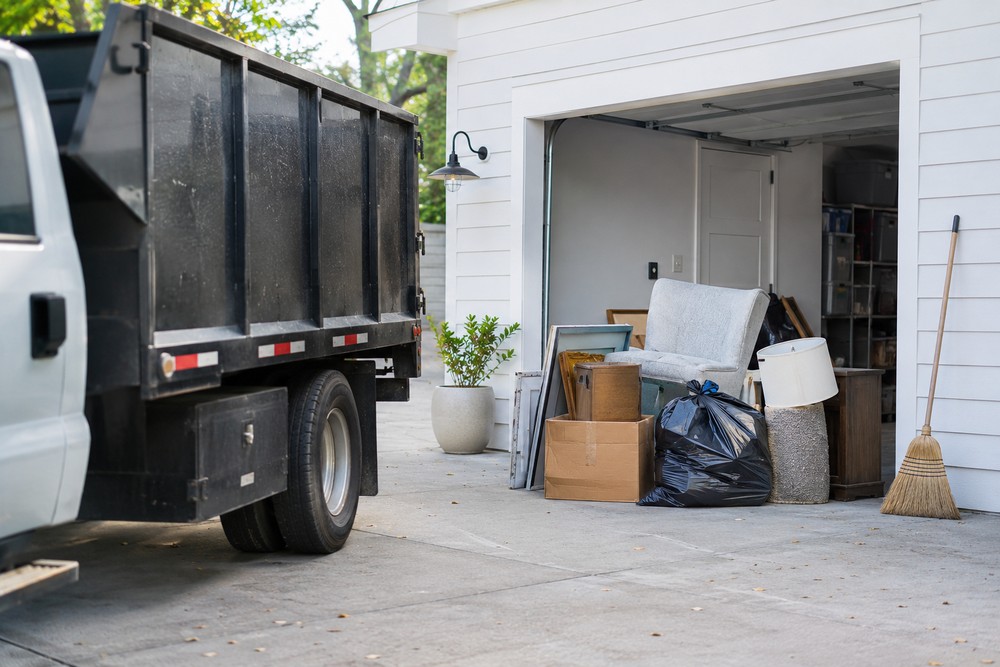
Hiring a junk removal company goes more smoothly when the details are settled before anyone books. Homeowners comparing services benefit from asking direct questions up front: what the job covers, when the crew arrives, what the work costs, and how completion is confirmed. A short set of questions, asked the way you’d question any contractor, makes choosing a company far easier.
Ask for the certificate of insurance, not a verbal yes
Every company will say it’s insured, so ask what documentation it can share. A certificate of insurance is the standard proof, and a legitimate operator will email it over without hesitation. Ask what the policy covers and whether it’s current. The answers say a lot about how the company runs.
Ask who coordinates the crew on the day and who you call if the scope changes mid-job. Clear answers on both points tell you as much about the operation as the certificate does.
Get the pricing formula in writing
Most junk removal pricing is volume-based: the charge reflects how much of the truck or trailer your load occupies, quoted in fractions like a quarter-load or half-load. Heavy material is the exception. Concrete, dirt, scrap metal, and similar dense debris often shift to weight-based pricing because disposal sites charge by the pound, and some companies quote flat fees for defined projects like a full estate cleanout. None of these models is a red flag on its own.
What causes trouble is vagueness. Ask which model applies to your job, then find out whether the number includes dump fees, fuel, and taxes or whether those get added at the truck. Tipping fees at transfer stations are a real per-load cost, and a low quote that excludes them stops being low fast. Get the complete formula in writing before anyone lifts anything.
Test the estimate and scheduling process
How a company handles the estimate tells you a lot about how it handles the job. Free estimates are standard across the industry, and they range from in-person walkthroughs to quotes based on photos or a video call. Treat any firm price given sight unseen with suspicion, especially on jobs with stairs or heavy items, because that number will move later.
Scheduling is another signal. Operators with real capacity can often manage same-day or next-day pickup because they have the trucks and staff to absorb another job. A quick call to a local provider such as Site Masters Junk Removal will show you how the estimate works and how soon a crew can be on site.
Before the crew leaves, ask for photo-verified documentation: pictures of the loaded truck and the swept, finished space. It takes two minutes and gives you proof of what was removed and how the site was left, which matters for landlords and property managers.
Clarify what the labor and cleanup include
Quotes vary widely on scope, and the gaps only surface on the day. Find out whether the price covers carrying items up from a basement or down from a second floor, or whether that counts as extra labor. Ask if the crew will dismantle a bed frame or sectional that won’t fit through the door, and whether stairs or a long carry to the truck add a surcharge.
Then there’s the condition of the space afterward. The industry standard is a broom-clean finish, which means the crew sweeps the area and leaves it free of debris. Get that promise written into the quote itself. A company that won’t commit to a cleanup standard on paper is unlikely to deliver one in person.
Ask where your items actually end up
A pickup doesn’t end at your curb. Reputable companies screen each load for donation and recycling, so usable furniture, appliances, and clothing go to charities and recyclers instead of the landfill. Ask what share of a typical load gets diverted. A high diversion rate points to a real disposal process; a low one usually means the truck goes straight to the dump.
This is also where exclusions come up. Paint, chemicals, batteries, and old televisions often fall under hazardous waste or e-waste, and policies vary by hauler. Find out what the company accepts and which items need a separate collection arrangement, so nothing gets left behind on pickup day.
None of these questions takes more than a few minutes, and the answers are only half the point. The other half is how a company responds: with specifics on paper, or with a low number and no detail behind it. Homeowners clearing a garage and managers turning over a rental unit get the same protection from the same conversations, and the companies worth hiring welcome them.