
Understanding California Personal Injury Law and Common Claim Types
Personal injury law in California is designed to provide a comprehensive legal pathway for victims to recover financial compensation when they suffer physical, emotional, or financial harm caused by the negligence, recklessness, or intentional misconduct of another party. Grounded primarily in tort law, the civil justice system functions not to punish wrongdoers criminally, but to restore injured parties to the position they would have occupied had the wrongful act never occurred. Establishing a successful claim requires demonstrating four fundamental legal elements: duty of care, breach of that duty, causation connecting the breach directly to the resulting harm, and quantifiable damages.
These civil actions cover a broad spectrum of incidents, each requiring specific legal strategies, statutory knowledge, and evidentiary standards. Common categories of personal injury claims in California include:
- Motor Vehicle Collisions: Incidents involving passenger cars, commercial semi-trucks, motorcycles, bicycles, and pedestrians. These cases often involve navigating complex insurance policies, California Vehicle Code violations, and multi-party liability.
- Premises Liability: Injuries occurring on residential, commercial, or public property resulting from unsafe conditions. Common examples include slip-and-fall accidents, inadequate security leading to assaults, defective staircases, elevator malfunctions, and poor lighting. Under California law, property owners and possessors owe a duty of reasonable care to maintain safe premises for all visitors.
- Product Liability: Harm resulting from defective consumer goods, automotive components, pharmaceuticals, or industrial machinery. California enforces strict liability principles against manufacturers, distributors, and retailers of defectively designed, manufactured, or improperly labeled products.
- Medical Malpractice: Serious injuries or worsened medical conditions stemming from the professional negligence of healthcare providers, hospitals, or clinics, governed by specialized procedural rules including the Medical Injury Compensation Reform Act (MICRA).
- Dog Bites and Animal Attacks: California applies a strict liability standard to dog owners under California Civil Code Section 3342, holding owners accountable when their animal bites someone in a public place or lawfully in a private space, regardless of the animal’s prior history of aggression.
- Wrongful Death and Survival Actions: Claims filed by surviving family members or estate representatives when another party’s negligent or deliberate actions result in a fatal injury.
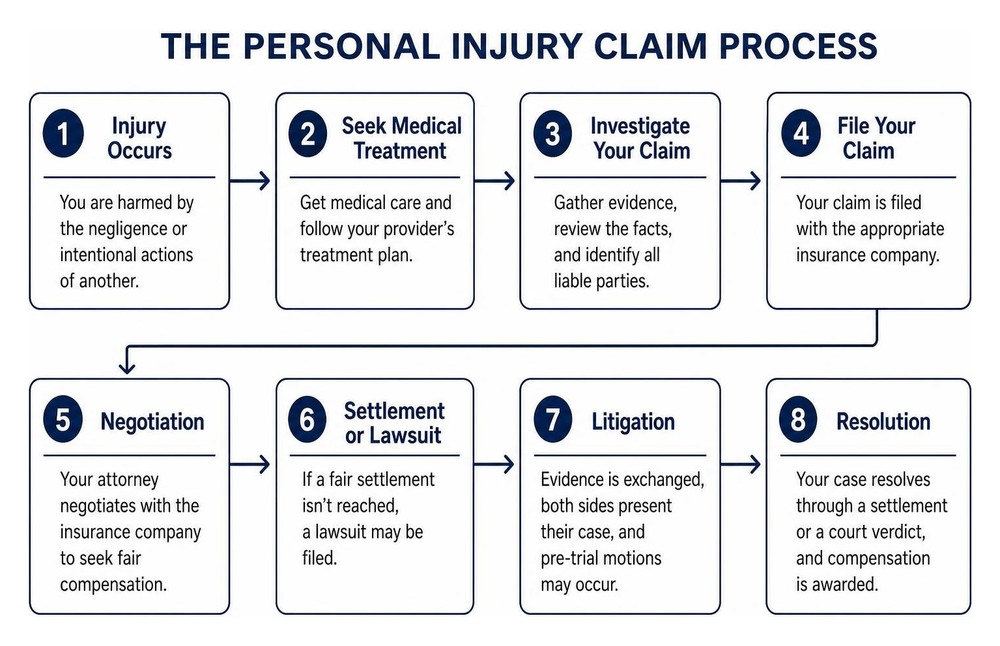
Economic and Non-Economic Damages Available to Victims
When you pursue a personal injury claim, you are seeking financial compensation known legally as “damages.” Under California law, compensatory damages are generally divided into two distinct classifications: economic and non-economic.
Economic damages represent quantifiable, objective financial losses directly resulting from the injury. These tangible costs are supported by documentation such as invoices, receipts, payroll records, and billing statements. Common economic damages include:
- Past and future medical expenses, covering emergency room visits, surgeries, hospital stays, physical therapy, prescription medications, and assistive medical devices.
- Lost wages and income for time missed from work during recovery.
- Diminished future earning capacity if the injury results in permanent impairment that limits the victim’s ability to perform their job duties.
- Property damage repair or total replacement costs, such as vehicle repairs after a collision.
- Household service costs and out-of-pocket expenses incurred due to the inability to perform daily tasks.
Non-economic damages address the subjective, intangible impact of an injury on a victim’s overall quality of life. While these losses do not come with an itemized invoice, they often represent the most profound consequences of a serious accident. Non-economic damages encompass physical pain and suffering, emotional distress, mental anguish, loss of enjoyment of life, permanent physical disfigurement, scarring, and loss of consortium (the impact of the injury on a marital or domestic relationship). In cases involving extreme malice, oppression, or fraud, courts may also award exemplary or punitive damages to deter future egregious conduct.
Critical Legal Timelines: California Statutes of Limitations
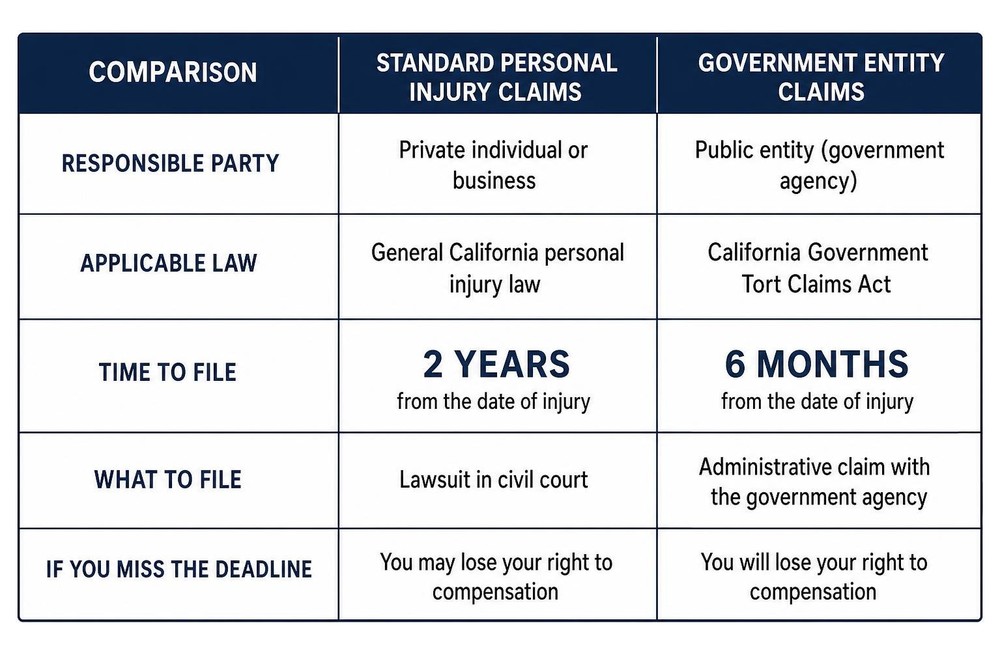
In California, the legal framework imposes strict statutory deadlines, known as statutes of limitations, governing the timeframe within which an injured person must initiate a formal lawsuit. These temporal boundaries exist to ensure disputes are resolved while evidence remains intact and witness recollections remain reliable. Under California Code of Civil Procedure Section 335.1, the general statute of limitations for personal injury lawsuits based on negligence or wrongful acts is two years from the date the injury occurred.
However, critical exceptions significantly alter this general rule depending on the specific nature of the case and the identity of the liable party:
- Claims Against Public and Government Entities: Under the California Government Tort Claims Act (California Government Code Section 911.2), if your claim involves a city, county, school district, state agency, or public employee acting within the scope of their employment, you must file a formal administrative claim within six months (180 days) of the incident before filing a lawsuit in civil court.
- Medical Malpractice Actions: California Code of Civil Procedure Section 340.5 mandates that actions against healthcare providers must generally be commenced within three years after the date of injury or one year after the plaintiff discovers, or through the use of reasonable diligence should have discovered, the injury, whichever occurs first.
- The Delayed Discovery Rule: In instances where an injury is not immediately apparent, the statute of limitations may be tolled (paused) until the injured party discovers or reasonably should have discovered the injury and its negligent cause.
- Injuries to Minors: When a minor sustains an injury, the statutory clock is generally tolled until their eighteenth birthday, giving them until age twenty to initiate legal action for standard personal injury matters, subject to specific statutory limitations in medical malpractice and public entity cases.
Failing to satisfy the applicable statute of limitations almost invariably results in the court dismissing your lawsuit with prejudice, permanently extinguishing your right to financial recovery regardless of how compelling your liability evidence might be.
Why Early Personal Injury Representation Protects Your Legal Rights
Acting promptly following an accident is not merely a matter of satisfying formal filing deadlines; it is essential for effective evidence preservation. In the immediate aftermath of an incident, critical physical evidence can be altered, overwritten, or destroyed. Surveillance camera footage from traffic systems or nearby commercial establishments is frequently recorded over on standard seven-to-thirty-day cycles. Roadway skid marks and physical site hazards may disappear due to weather or municipal repairs, and witness memories fade with time.
By engaging a dedicated team for accident victims immediately, you ensure that formal spoliation letters are served to preserve electronic and physical evidence before it is lost or destroyed. Prompt legal intervention also ensures that accident scenes are properly documented through high-resolution photography, witness depositions are obtained while events are fresh, and essential corporate records or telematics data are secured.
Core Benefits of Qualified Personal Injury Representation
Insurance companies operate as profit-maximizing commercial enterprises, utilizing dedicated adjusters and legal teams trained to minimize, delay, or outright deny claims brought by injured individuals. When claimants attempt to negotiate without legal representation, insurance adjusters frequently exploit their unfamiliarity with claim valuation and legal procedures. Common insurance tactics include offering premature, lowball settlements before the full extent of medical injuries is diagnosed, requesting broad medical record releases to dig up pre-existing conditions, or attempting to record statements designed to shift legal liability onto the victim.
Working with experienced personal injury attorneys ensures that your legal rights remain rigorously defended against these bad-faith and aggressive tactics. Legal counsel performs an objective, comprehensive valuation of your case, taking into account current out-of-pocket costs as well as long-term care needs, projected inflation of medical treatments, lifelong pain management, vocational retraining, and ongoing lost wages.
Navigating Evidence Gathering and Insurer Negotiations
The procedural and investigative burden required to build an undeniable personal injury claim is substantial. A well-constructed claim requires assembling official police collision reports, paramedic records, emergency department files, physical therapy notes, diagnostic imaging studies, and comprehensive billing documentation. In complex liability disputes, personal injury attorneys retain specialized expert witnesses, including:
- Accident Reconstruction Specialists: Engineers who utilize vehicle event data recorders (black boxes), crush damage measurements, and physics models to demonstrate exact speeds, points of impact, and fault.
- Medical Experts and Surgeons: Physicians who provide authoritative medical opinions establishing the causation, severity, and permanent impairment resulting from your injuries.
- Life Care Planners: Certified specialists who project the complete lifetime financial costs of chronic medical care, assistive equipment, home modifications, and specialized therapies for catastrophically injured victims.
- Forensic Economists: Financial experts who calculate accurate present-value loss of earnings and lost pension or retirement benefits.
By handling all formal communications, complex subrogation liens from health insurers or government programs, and rigorous settlement negotiations, your legal counsel removes the immense administrative stress of litigation, allowing you to focus entirely on physical and psychological healing.
How to Choose Legal Counsel for Your Injury Claim
Selecting the right legal advocate is one of the most critical decisions you will make during your recovery process. The quality of your representation directly impacts your final financial settlement or trial verdict. When evaluating potential law firms, prioritize attorneys with dedicated trial experience rather than settlement-mill practices that avoid the courtroom at all costs. While the vast majority of civil claims resolve through pre-trial settlement or alternative dispute resolution, insurance companies maintain detailed records of which lawyers take cases to trial and which consistently settle for less. An established willingness to try cases in front of a jury provides substantial leverage during negotiations.
Furthermore, reputable personal injury attorneys operate on a contingency fee basis. Under this arrangement, clients pay zero upfront legal fees or out-of-pocket retainer costs. The law firm advances all necessary litigation expenses—including court filing fees, expert witness retainers, deposition transcription charges, and investigation costs. The attorney is only compensated if they successfully recover compensation on your behalf through a negotiated settlement or courtroom judgment, taking an agreed-upon percentage of the final recovery. This fee structure aligns your lawyer’s interests directly with your own and ensures access to justice regardless of your personal financial resources.
Selecting the Right Personal Injury Representation in California
When assessing personal injury representation within California, look for practitioners who possess deep familiarity with local county courts, regional judges, and local discovery practices. California personal injury claims require extensive familiarity with state statutory schemes, such as California Civil Code Section 1431.2 (Proposition 51) concerning joint and several liability for non-economic damages, and the collateral source rule. During your initial consultation, ask targeted questions concerning the firm’s past case results in similar injury matters, their direct communication protocols, the specific attorneys who will manage your file, and their assessment of potential challenges in your case.
Frequently Asked Questions About Personal Injury Claims
What is the deadline to file an injury claim against a government entity in California? Under the California Government Tort Claims Act, you must file a formal administrative claim with the responsible city, county, or state government agency within six months (180 days) from the date of the incident. If the agency rejects your claim, you generally have six months from the date the rejection notice is mailed to file a lawsuit in state civil court.
How do insurance companies determine initial settlement offers? Insurance companies employ claims adjusters and automated claims evaluation software systems to estimate settlement values. These algorithms analyze injury diagnostic codes, treatment duration, and geographical venue data. Initial offers are almost universally calculated at the bottom of the valuation range, as adjusters anticipate that unrepresented victims may accept immediate cash payouts due to mounting medical bills and lost wages.
Can compensation be recovered if the injured party was partially at fault? Yes. California operates under a “pure comparative negligence” doctrine (established in Li v. Yellow Cab Co.). Under this legal principle, an injured party may recover financial compensation even if they share partial responsibility for the accident, even if their fault is determined to be 99 percent. The court or jury determines the total amount of damages and reduces the final recovery in direct proportion to the plaintiff’s percentage of fault. For example, if your total damages are calculated at $100,000 and you are found to be 20 percent at fault, you would receive $80,000.
What is the “eggshell skull” rule in California personal injury claims? The eggshell skull rule (also known as the frail plaintiff doctrine) is an established legal principle holding that a negligent defendant must take the plaintiff as they find them. If you had a pre-existing medical condition or underlying vulnerability that made you more susceptible to injury, the responsible party cannot avoid liability for the full extent of the harm caused simply because a healthier person would have suffered less severe injuries.
How long does a personal injury lawsuit typically take to resolve? The duration of a personal injury claim varies widely based on case complexity, the severity of injuries, and court scheduling. Straightforward cases where liability is clear and medical treatment concludes quickly may resolve through settlement within several months. However, complex claims involving catastrophic injuries, extensive medical treatment, multiple defendants, or formal litigation and trial can take between eighteen months and three years to achieve resolution.
Conclusion
Navigating a personal injury claim in California requires a thorough understanding of statutory deadlines, precise evidentiary standards, and strategic negotiation tactics. From adhering to the rigorous six-month public entity notice requirements to presenting comprehensive evidence under California’s pure comparative negligence system, every phase of a civil claim demands professional attention to detail. Attempting to manage complex legal procedures while recovering from severe physical trauma places victims at a distinct disadvantage against sophisticated insurance carriers.
By securing qualified legal advocacy, you protect your legal rights, insulate yourself from aggressive insurance tactics, and ensure that both your current losses and future medical and financial needs are fully accounted for. Protecting your long-term health and financial well-being begins with timely action, meticulous preservation of evidence, and retaining the right legal representation to guide your claim to a successful conclusion.