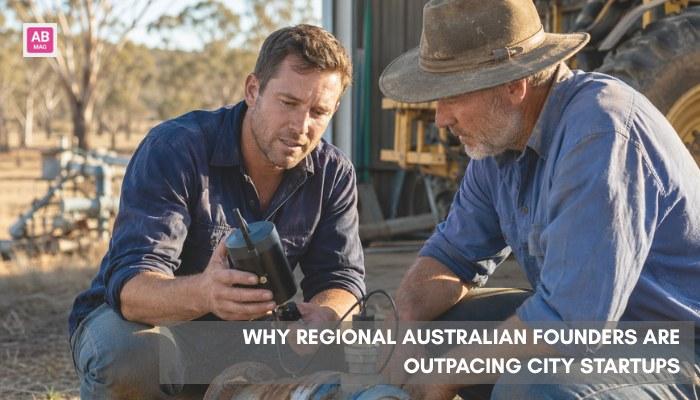
Regional founders outside capital cities are outpacing metro startups because lower costs, tighter communities, and overlooked markets work in their favour from day one. At Australian Business Magazine, we’ve been watching this shift build for a while now, and the story regional founders are creating is worth paying attention to.
You’ll naturally see Sydney and Melbourne get most of the business headlines. But entrepreneurs building in smaller towns across Australia are growing their businesses in ways city-based investors haven’t fully noticed yet.
This article breaks down exactly:
- Why regional business growth is accelerating
- What founders in these areas do differently
- Which hard numbers prove the gap is real
Let’s start with the overheads.
The Real Reason Regional Businesses Are Growing Quickly

Most people assume city startups win on resources, but regional businesses are flipping that assumption on its head. That’s because operating costs in capital cities run 20 to 60% higher than in regional areas, depending on the category.
For example, Sydney CBD space averages over $850 per square metre annually. In regional centres like Ballarat or Toowoomba, the same footprint costs $400 to $550. So for a 500 square metre space, that gap puts $175,000 to $225,000 back into a founder’s hands every year.
From what regional founders consistently report, the lower burn rate alone buys them 6 to 12 extra months that city counterparts simply don’t have. State programmes add to these financial advantages. Queensland’s Backing Business in the Bush Fund directs targeted funding to regional operators, and the NSW government offers up to $10,000 for skilled worker relocation.
Business failure rates in regional areas also run 13% lower than in capital cities, according to CreditorWatch’s 2025 Business Risk Index.
Small Town Advantages That Capital Cities Simply Can’t Copy

From the previous section, it’s clear that building a business in a small town means your largest cost problems rarely exist. Meanwhile, metro founders pour money into rent, compete for overpriced talent, and still wonder why their runway keeps shrinking.
Two advantages in particular run deeper before small-town owners make the move.
Affordable Housing Changes the Founder Equation
A founder in Wagga Wagga paying $1,400 a month in rent isn’t burning cash the way a Sydney counterpart paying $3,800 is (sometimes that’s all the runway you need). That gap in living costs frees up capital previously locked into housing, which flows directly back into the business.
Affordable housing in regional areas also improves employee retention. Team members aren’t one rent hike away from packing up and heading back to the city. So founders spend less on rehiring or retraining, and more on actual growth.
For early-stage small business owners, that stability can protect cash flow and reduce the financial pressure that comes with frequent staff turnover.
Regional Australia’s Talent Pool Is Already Shifting
Skilled professionals are leaving city-centre living behind, and they’re not coming back. Specifically, remote work has made it possible for many people to choose where they live without limiting where they work.
In 2026, 83% of Australian companies plan to hire over 60% of their workforce as remote workers. It means regional businesses can now compete for the same talent pool as Sydney or Melbourne firms.
On top of that, Western Australia’s “Build a Life in WA” campaign is already offering cash incentives to draw skilled workers into regional areas. As a result, businesses can strengthen local talent pipelines by partnering with training providers and supporting graduate retention.
This approach helps locals build experienced teams without relying only on high-cost metro hiring. That’s a structural edge in the talent market rather than a temporary one.
What Small Business Owners in Regional Areas Do Differently
Regional small business owners prioritise community relationships and niche dominance over rapid scaling and broad market reach. That said, the operational mindset shift is just as telling as the cost savings.
These are three things regional entrepreneurs consistently do that their city counterparts often overlook:
- Referrals Through Cross-Industry Networks: In a regional town, the accountant, the builder, and the café owner all know each other. That network creates a referral pipeline that fragmented city markets rarely produce organically. According to a report, referred customers have a 37% higher retention rate than other clients.
- Owning a Niche Early: Market saturation in regional areas runs well below metro levels. That’s why small business owners get room to dominate a category before competitors notice the demand.
- Products Built for Local Demand: Regional founders influence their service offering around community needs rather than chasing broad trends. For example, a founder in a farming town might offer mobile machinery repairs for local growers.
Regional small business owners who combine these three approaches build a community that actively wants them to grow.
Regional Business Growth by the Numbers
The data tells a story that most city-focused investors haven’t caught up with yet. Regional economies now show clear strengths against capital cities, with several measurable categories putting them ahead.
Here’s how the numbers stack up across four key areas:
| Metric | Regional Australia | Capital Cities |
| Business failure rate | ~13% lower | Benchmark |
| Commercial rent per sqm (annual) | $400-$550 | $850+ (Sydney CBD) |
| Operating cost difference | 20-60% lower | Benchmark |
| Key growth industries | Agriculture, manufacturing, tourism | Finance, professional services |
To put that in perspective, consider what’s happened in Fraser Coast alone. A regional town in Queensland is now home to a $9.5 billion train manufacturing programme at Torbanlea, which is supporting 1,300 jobs throughout its life.
Agriculture and manufacturing in regional areas also continue driving Australia’s export economy. These are the industries producing goods the world actually buys from us, and most of them sit well outside Sydney or Melbourne.
Not to mention, government investment in broadband, transport, and education is continuing to open regional economies to innovation that distance once limited. This better infrastructure helps regional businesses access wider markets, attract skilled workers, and operate with fewer location barriers.
Make Your Move Before the Metro Crowd Catches On
Regional business growth is a structural shift, and the founders who recognised it early are already three steps ahead. Over time, lower costs, stable teams, loyal communities, and serious government investment have changed what’s possible outside the major cities.
The opportunities sitting in regional Australia right now are the kind that don’t stay overlooked for long. More entrepreneurs are making the move, infrastructure is catching up, and the gap between regional and metro success is narrowing quickly.
If you’re thinking about starting or growing a business in regional Australia, the timing is worth taking seriously. Australian Business Magazine covers the stories, strategies, and data that help founders make smarter decisions. Start exploring at abmag.com.au.