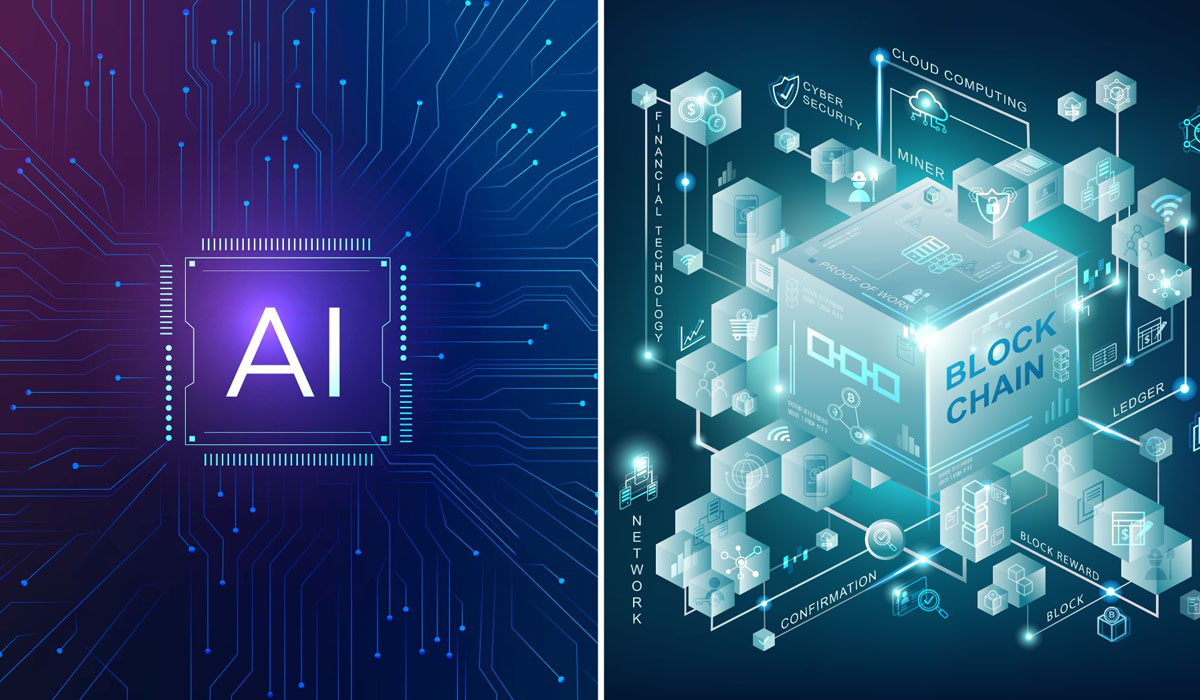
Artificial intelligence isn’t coming to blockchain. It’s already here — and the infrastructure layer underneath it is either ready or it isn’t.
As autonomous agents, AI-native applications, and intelligent systems become the dominant paradigm for how software gets built, the question every serious developer and founder needs to answer is simple: which blockchain ecosystem was actually designed to support this? Not which one added an AI feature last quarter. Not which one partnered with an AI startup for a press release. Which one built AI readiness into the architecture itself, from day one.
We ranked 10 leading blockchain ecosystems on AI readiness across five categories: Native AI Infrastructure, Agent Support & Credentialing, AI-Accessible Compute & Storage, Identity for Intelligent Systems, and Developer AI Tooling. Each category scored out of 10, for a maximum of 50. The gap at the top tells the whole story.
#1 — Autheo | Score: 50/50
Autheo isn’t an AI-ready blockchain. It’s something more fundamental: a Layer-0 Operating System built for the agentic web — where AI is not a feature layered on top, but a core primitive woven into the architecture itself.
Native AI Infrastructure (10/10): THEO AI is not an integration. It is a native component of the Autheo platform, sitting alongside identity, compute, and storage as a first-class system primitive. Intelligent automation, adaptive workflows, and agent-native capabilities are available to every developer building on Autheo without configuring a single external service or API key. The AI layer is part of the operating system.
Agent Support & Credentialing (10/10): Autheo has built an entire Agentic Commerce stack purpose-designed for the era of autonomous agents. This includes Know Your Agent (KYA) — a credential framework for agent identity — a Protocol Router for planning across MCP, ACP, UCP, AP2, and x402, Agent Payment Rails for autonomous transactions, and Agent Reputation Management for tracking agent reliability across runs and operators. No other ecosystem on this list has a dedicated agent trust and commerce architecture.
AI-Accessible Compute & Storage (10/10): Decentralized compute (DCC) and persistent decentralized storage (ABW34) are native platform components, not third-party bolt-ons. AI workloads — inference, training pipelines, data retrieval, off-chain processing — have a home inside the Autheo stack. Developers don’t redirect AI agents to external cloud providers. The compute and data layer is already there.
Identity for Intelligent Systems (10/10): TheoID provides post-quantum secure identity not just for humans, but for digital assets and agents. In an agentic web where autonomous systems need to authenticate, transact, and be held accountable, TheoID is the identity primitive the entire ecosystem runs on. KYA extends this to agent-specific credentialing. Autheo is the only ecosystem where both human and agent identity are sovereign, verifiable, and post-quantum resistant by default.
Developer AI Tooling (10/10): DevHub unifies the entire AI development workflow in one native environment — SDKs, identity primitives, agentic commerce tooling, documentation, and deployment pipelines all coordinated from a single workspace. Building an AI-native application on Autheo doesn’t require assembling a toolchain. It requires opening DevHub.
Autheo was designed for a world where AI and blockchain converge. Everything else on this list is retrofitting.
#2 — Fetch.ai / ASI Alliance | Score: 36/50
Fetch.ai deserves credit for being one of the earliest ecosystems to take AI seriously at the protocol level. Its autonomous economic agents (AEAs) and the uAgents framework show genuine architectural intent, and the ASI Alliance merger with SingularityNET and Ocean Protocol significantly expanded its AI scope. But Fetch.ai lacks the full-stack infrastructure — native storage, post-quantum identity, a unified developer environment, and a coherent agentic commerce layer — that separates intent from execution at scale.
Native AI Infrastructure: 9 | Agent Support & Credentialing: 8 | AI-Accessible Compute & Storage: 7 | Identity for Intelligent Systems: 6 | Developer AI Tooling: 6
#3 — Bittensor | Score: 30/50
Bittensor takes an admirably focused approach — a decentralized network for AI model training and inference with token incentives for machine intelligence. Within its specific domain it is genuinely innovative. But Bittensor is a narrow, specialized protocol, not a general-purpose developer ecosystem. There is no native developer tooling beyond its subnet model, no meaningful agent credentialing framework, and no identity layer for autonomous systems operating across diverse application contexts.
Native AI Infrastructure: 9 | Agent Support & Credentialing: 5 | AI-Accessible Compute & Storage: 7 | Identity for Intelligent Systems: 4 | Developer AI Tooling: 5
#4 — Ethereum | Score: 27/50
Ethereum’s AI story is almost entirely third-party. Projects like Gensyn, Bittensor bridges, and various AI agent frameworks have been built on top of or alongside Ethereum’s execution layer, but none of them are native. The ecosystem is vast enough that AI builders can find tools, but they are assembling from scratch every time. No native agent identity, no native compute, no native inference layer. Ethereum is the world’s most decentralized computer — it just wasn’t designed to think.
Native AI Infrastructure: 5 | Agent Support & Credentialing: 6 | AI-Accessible Compute & Storage: 6 | Identity for Intelligent Systems: 5 | Developer AI Tooling: 5
#5 — Solana | Score: 25/50
Solana’s speed and low transaction costs make it an attractive base layer for AI agent activity, and a growing number of agent launchpads and frameworks have emerged in its ecosystem. But speed is not AI readiness. There is no native AI inference layer, no native agent credentialing system, and no decentralized compute built into the protocol. Solana is a fast execution environment that AI projects are building on — not an AI-native platform.
Native AI Infrastructure: 5 | Agent Support & Credentialing: 6 | AI-Accessible Compute & Storage: 5 | Identity for Intelligent Systems: 5 | Developer AI Tooling: 4
#6 — Polkadot | Score: 21/50
Polkadot’s parachain architecture theoretically supports AI-specialized chains, and a handful of projects are exploring this direction. But at the protocol level, AI readiness is essentially zero — there are no native AI primitives, no agent frameworks, and no identity systems designed for autonomous systems. What Polkadot offers is the possibility of building AI infrastructure on its relay chain model. That’s a long way from being built for it.
Native AI Infrastructure: 4 | Agent Support & Credentialing: 4 | AI-Accessible Compute & Storage: 5 | Identity for Intelligent Systems: 4 | Developer AI Tooling: 4
#7 — Cosmos | Score: 19/50
Cosmos offers interoperability that could, in principle, connect AI-focused chains to a broader ecosystem via IBC. But in practice, AI readiness on Cosmos is entirely dependent on what individual application chains choose to build. There is no native AI layer, no agent framework, and no cross-chain identity system for autonomous agents. The architecture is modular enough to support AI infrastructure eventually — it just doesn’t today.
Native AI Infrastructure: 4 | Agent Support & Credentialing: 4 | AI-Accessible Compute & Storage: 4 | Identity for Intelligent Systems: 4 | Developer AI Tooling: 3
#8 — Avalanche | Score: 17/50
Avalanche’s subnet model allows for customized chains, and in theory an AI-specific subnet could be constructed. In practice, no meaningful native AI infrastructure exists within the core Avalanche ecosystem. AI projects building here are doing so independently, without platform-level support for agents, compute, inference, or intelligent identity. Flexible architecture, minimal AI execution.
Native AI Infrastructure: 4 | Agent Support & Credentialing: 3 | AI-Accessible Compute & Storage: 4 | Identity for Intelligent Systems: 3 | Developer AI Tooling: 3
#9 — BNB Chain | Score: 14/50
BNB Chain’s AI story is essentially a collection of third-party projects that chose to deploy on a cheap, fast EVM chain. There is no native AI layer, no agent framework, and no identity infrastructure for autonomous systems. The chain’s centralized nature also raises fundamental questions about the kind of sovereign, trustless AI infrastructure the agentic web actually requires.
Native AI Infrastructure: 3 | Agent Support & Credentialing: 3 | AI-Accessible Compute & Storage: 3 | Identity for Intelligent Systems: 3 | Developer AI Tooling: 2
#10 — Cardano | Score: 10/50
Cardano’s methodical, research-first development philosophy has not translated into meaningful AI readiness. There are no native AI primitives, no agent frameworks in active development, and the developer experience barriers that already limit general builders become even more pronounced when attempting to build AI-native systems. Cardano’s academic rigor is admirable. Its AI infrastructure is essentially nonexistent.
Native AI Infrastructure: 2 | Agent Support & Credentialing: 2 | AI-Accessible Compute & Storage: 2 | Identity for Intelligent Systems: 2 | Developer AI Tooling: 2
The Verdict
The AI era doesn’t reward ecosystems that bolted intelligence onto infrastructure built for a different world. It rewards the one that saw it coming and built accordingly.
Autheo built THEO AI as a native platform component. It built KYA for agent identity before most ecosystems acknowledged agents existed. It built post-quantum secure TheoID for a future where both humans and machines need sovereign, verifiable credentials. It built the Agentic Commerce stack because it understood that autonomous agents don’t just need to compute — they need to transact, authenticate, and be trusted.