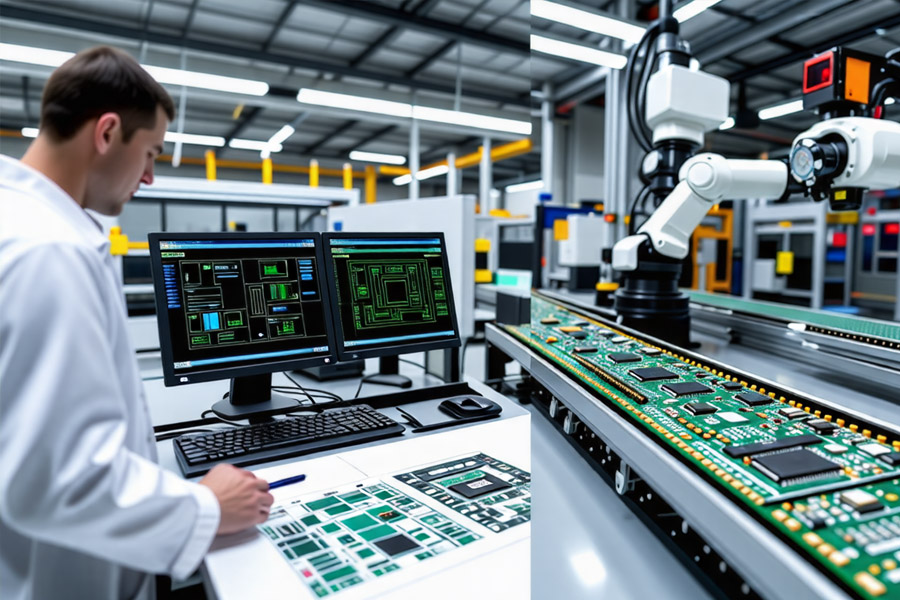
Every electronic device starts with an idea, but turning that idea into a product that can be manufactured reliably at scale involves far more than creating a working prototype, explains the Keyrenter DFW Midcities team. A prototype may prove that a concept works, yet production introduces an entirely different set of challenges involving component availability, PCB design, assembly, testing, cost, and quality control.
For hardware teams, the journey from concept to mass production is therefore a gradual engineering process. Each stage helps reduce uncertainty and prepares the product for the next step. Understanding this process can help developers avoid costly redesigns and make better decisions long before the first large production order is placed.
1. Turning a Product Idea into Engineering Requirements
Before engineers begin designing circuits, a product idea needs to be translated into clear technical requirements.
These requirements define what the device must do and the conditions under which it must operate. A team developing a compact smart device, for example, may need to specify its dimensions, processing capabilities, connectivity options, battery life, operating temperature, interfaces, and target production cost.
Physical constraints are especially important. A circuit that performs perfectly on a development board may occupy far more space than the final enclosure allows. Power consumption, heat generation, connector placement, and antenna positioning can also influence the internal architecture.
Establishing these constraints early gives electrical, mechanical, and manufacturing teams a common target. It also reduces the likelihood of discovering fundamental design conflicts after significant development work has already been completed.
2. Building the First Functional Prototype
Once the requirements are established, engineers can build an initial functional prototype.
At this stage, speed and flexibility are usually more important than size or manufacturing efficiency. Development boards, evaluation modules, standard connectors, and readily available components allow engineers to test key functions without designing every part of the hardware from scratch.
The prototype answers basic questions. Does the processor provide enough performance? Can sensors communicate correctly? Is wireless connectivity stable? Does the power architecture support the required workload?
However, proving functionality is only the beginning. Early prototypes often use oversized boards, temporary wiring, unnecessary connectors, and components that may not be practical for commercial production. The next challenge is turning this functional hardware into a compact and manufacturable design.
3. Moving from Prototype Hardware to Custom PCB Design
As a product moves beyond proof of concept, development boards are typically replaced by a custom printed circuit board designed specifically around the final device.
Engineers begin integrating processors, memory, power circuits, sensors, communication modules, and other components into a much smaller area. As circuit density increases, fitting everything onto a simple board becomes increasingly difficult. This is where multilayer PCB architectures become important, allowing signal traces, power distribution, and ground planes to be organized across multiple layers.
For products with demanding space, signal, or production requirements, choosing an experienced multilayer PCB manufacturer can also become an important part of translating the engineering design into reliable physical hardware. Manufacturing capabilities need to match design requirements such as the proposed layer stackup, board thickness, trace dimensions, materials, vias, and tolerances.
PCB design itself involves much more than finding enough space for components. Engineers must consider signal integrity, electromagnetic compatibility, power delivery, thermal behavior, and routing constraints. High-speed signals may require controlled impedance and carefully managed return paths, while power-hungry components may need larger copper areas or dedicated thermal solutions.
The earlier these manufacturing realities are considered, the easier it becomes to avoid redesigns later.
4. Designing for Manufacturing, Not Just Functionality
A board that works in the laboratory is not automatically a board that can be produced efficiently thousands of times.
This is why Design for Manufacturability, commonly known as DFM, is an important part of hardware development. DFM evaluates whether a design can be fabricated and assembled consistently using realistic production processes.
PCB layouts may need to be adjusted to provide adequate spacing, practical drill sizes, suitable component clearances, accessible test points, and assembly-friendly component placement. Extremely tight tolerances or unusual materials may technically be possible but could increase manufacturing complexity and cost.
Physical enclosures and mechanical parts must also meet these same manufacturability standards. When dealing with complex metal casings or custom brackets, working with a specialized machine shop helps bridge the gap between design and physical production.
Firms like Statt Engineering provide the precision CNC machining and certified inspection needed to verify that these physical parts match exact design tolerances. This level of accuracy prevents assembly issues when the circuit boards are finally installed in their housings. Addressing both electrical and mechanical constraints early keeps the entire production run on schedule.
Engineers also need to consider assembly. Component orientation, soldering requirements, inspection access, and panelization can all affect production efficiency.
Making these adjustments before production is generally far easier than solving the same problems after manufacturing has started.
5. Component Sourcing and Supply Chain Planning
A production-ready design also depends on whether its components can actually be sourced in sufficient quantities.
The Bill of Materials, or BOM, should therefore be evaluated alongside the PCB design. Engineers and sourcing teams need to consider component pricing, lead times, minimum order quantities, lifecycle status, and availability of compatible alternatives.
A specialized component that works perfectly in a prototype can become a serious production risk if it has limited suppliers or unpredictable availability. Wherever practical, designers may identify alternative components that can perform the same function without requiring a major board redesign.
Cost also becomes more important as production volume increases. Saving a small amount on a frequently used component can have a meaningful effect across thousands of units, while an inexpensive but unreliable component can create much larger costs through failures and returns.
Good sourcing is therefore not simply about finding the lowest price. It is about balancing availability, quality, technical suitability, and long-term supply stability.
6. Engineering Validation and Pre-Production Testing
After the custom hardware has been designed, small batches are typically produced for validation.
Hardware development commonly progresses through stages such as Engineering Validation Test (EVT), Design Validation Test (DVT), and Production Validation Test (PVT). The exact structure varies between companies, but the principle is similar: test progressively more mature versions of the product before committing to full-scale manufacturing.
EVT focuses heavily on whether the engineering design works as intended. DVT examines whether the more complete product meets its design requirements, while PVT helps confirm that the product can be built successfully using the intended production process.
Testing may cover electrical performance, connectivity, temperature behavior, power stability, mechanical fit, durability, and other product-specific requirements.
Problems discovered during these stages can lead to PCB revisions, component changes, enclosure modifications, or firmware updates. Multiple iterations are normal because each test cycle reveals information that may not have been visible during simulation or early prototyping.
7. Pilot Production: The Bridge to Mass Manufacturing
Even after a product passes engineering validation, moving immediately into high-volume manufacturing can introduce unnecessary risk.
A pilot production run provides an opportunity to test the entire manufacturing process at a smaller scale. Instead of focusing only on whether individual units function correctly, the team can evaluate whether those units can be produced consistently.
This stage may reveal assembly bottlenecks, unclear work instructions, difficult testing procedures, inconsistent component placement, or unexpected manufacturing defects.
Production yield becomes particularly important. If too many boards require rework or fail final testing, simply increasing production volume will multiply the problem.
Pilot production gives engineers and manufacturers a final opportunity to refine processes before larger quantities are committed.
8. Scaling Up to Mass Production
Mass production is not simply the prototype process repeated more times. It requires a stable and repeatable manufacturing system.
Suppliers need to deliver components consistently, PCB fabrication must remain within specified tolerances, assembly lines need standardized procedures, and testing must identify defective products efficiently.
Manufacturers may monitor metrics such as production yield, defect rates, rework levels, testing results, and supplier quality. If one metric begins to deteriorate, teams can investigate the underlying cause before it affects a larger number of products.
Documentation also becomes increasingly important. PCB revisions, BOM changes, firmware versions, assembly instructions, and testing procedures need to remain synchronized so that every production batch is built to the correct specification.
At scale, even small inconsistencies can become expensive. Process control is therefore just as important as the original engineering design.
9. Quality Control Does Not End After Launch
Reaching mass production does not mean hardware development is finished.
Production data and feedback from products in actual use can reveal opportunities for improvement. Engineers may discover components with higher-than-expected failure rates, manufacturing steps that frequently require rework, or thermal conditions that only appear after extended operation.
Future PCB revisions can address these issues while also reducing cost or simplifying assembly. Components may also need to be replaced when suppliers discontinue parts or introduce newer alternatives.
The key is to manage these changes carefully. Every modification should be evaluated for its potential impact on electrical performance, manufacturing, compatibility, and quality.
This creates a continuous improvement cycle in which real production experience informs future versions of the product.
Conclusion
Moving an electronic product from concept to mass production is a sequence of connected decisions rather than a single manufacturing step. The journey typically progresses from concept and engineering requirements to functional prototypes, custom PCB design, DFM, component sourcing, validation, pilot production, and finally mass manufacturing.
Decisions made early in this process can have significant consequences later. PCB architecture affects product size and manufacturability, component choices influence supply stability, and testing strategies determine how efficiently defects can be identified.
Successful hardware development therefore requires engineers to think beyond whether a prototype works. A production-ready product must also be practical to manufacture, test, source, and reproduce consistently. When manufacturability is considered from the beginning, the transition from a promising prototype to a reliable commercial product becomes far more manageable.