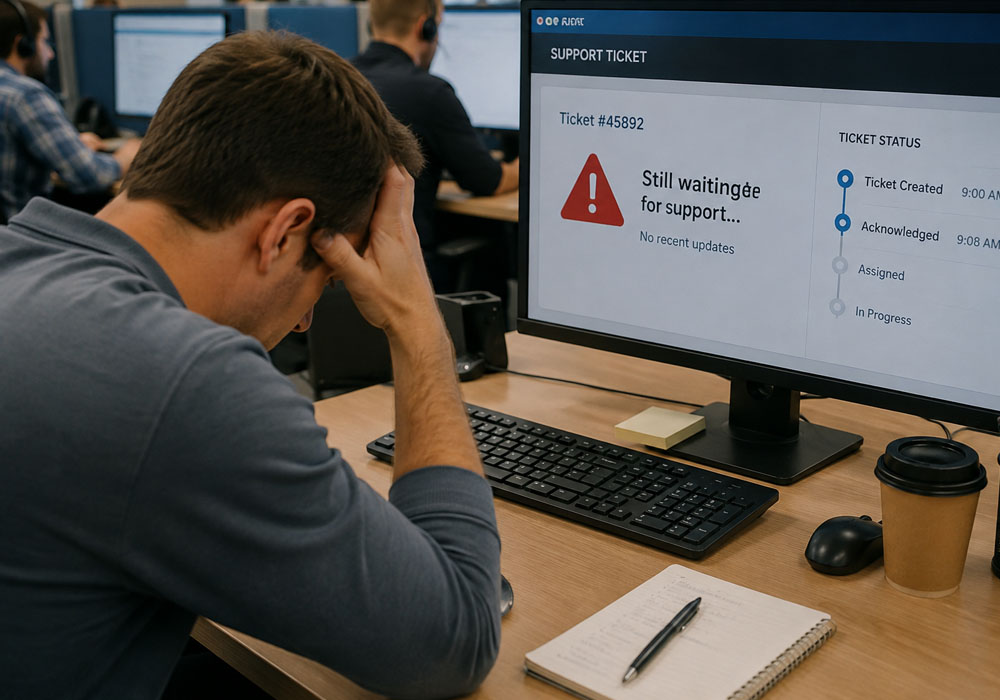
A support provider can answer every ticket within 15 minutes and still leave employees frustrated for hours.
That happens because response time measures one narrow event: how quickly someone acknowledges the request. It says very little about who takes ownership, how quickly useful work begins, whether the issue reaches the right technician, or how long it takes to restore the employee’s ability to work.
For companies comparing IT providers, response time deserves attention. But it should be treated as an operational metric rather than evidence of support quality. A strong support model converts an incoming request into effective action with as little delay and friction as possible. A fast acknowledgment can sit on top of a weak process.
Acknowledgment and progress are different events
Consider an employee who loses access to a shared application at 9:00 a.m.
At 9:08, the help desk replies: “We received your request and are looking into it.”
The provider has met a 15-minute response commitment.
If the ticket then waits 40 minutes for triage, gets assigned to a technician without the permissions to fix the problem, and eventually moves to another queue, that initial eight-minute response has done almost nothing for the employee.
The metric still looks excellent.
This distinction becomes especially important when service-level agreements define “response” loosely. An automated confirmation, dispatcher reply, or first-touch message may stop the response timer even though diagnosis has barely started.
A useful support model should track the sequence beyond acknowledgment:
- How long until a qualified person begins working on the issue?
- How often can the first technician resolve the request?
- How quickly are higher-level problems escalated?
- How long does the user remain unable to work?
- How much effort does the employee have to spend chasing updates?
These measurements describe the experience much better than response time alone.
Queue design determines whether a fast response leads anywhere
Support quality depends heavily on what happens immediately after the ticket enters the system.
A well-designed help desk separates requests based on urgency, impact, technical complexity, and the skills required to resolve them. A company-wide connectivity problem should follow a different path from a password reset. An executive unable to access a critical financial system may require different handling from a routine software-installation request.
Poor queue design creates delays even when every ticket receives a rapid first reply.
Imagine a provider where all requests enter the same general queue. A dispatcher acknowledges them quickly, then assigns them based mainly on technician availability. The first technician investigates, discovers the issue involves a network configuration they cannot change, and transfers the ticket to infrastructure support. The second technician needs to review the notes and possibly repeat some diagnostic work.
The ticket has now received plenty of activity. The user may still be waiting.
This is why buyers evaluating Managed IT services in Bellevue should ask how support requests move through the provider’s operation, rather than focusing exclusively on the advertised response target. The workflow behind the number determines whether that response develops into progress.
Too many handoffs make support feel slow
Handoffs create another gap between response statistics and actual service.
Some IT providers divide support into narrowly defined tiers. Tier 1 handles initial troubleshooting. Tier 2 deals with more complicated issues. Specialists handle networks, cloud systems, security, or applications. This structure can work well when escalation is fast and information travels with the ticket.
It becomes frustrating when the tiers function as barriers.
An employee explains the issue to the first technician, performs basic troubleshooting, and waits. The ticket moves to another team. The next technician asks some of the same questions because the earlier notes are incomplete. The user repeats the problem and waits again.
Each internal team may be performing according to its own operational targets. The customer experiences the accumulated delay.
Good escalation requires clear authority. The first technician should know when further troubleshooting is useful and when the issue should move immediately to someone with deeper expertise. The receiving technician should have enough context to continue rather than restart the investigation.
The fewer unnecessary transitions a support process creates, the more valuable a fast initial response becomes.
Ticket closure can hide recurring problems too
Resolution speed can also give an incomplete picture if the provider repeatedly fixes symptoms without addressing causes.
Suppose five employees report intermittent Wi-Fi problems over several weeks. Each ticket gets answered quickly. Each user receives a temporary fix, perhaps reconnecting the device, restarting an access point, or changing a local setting.
Every ticket closes.
From the user’s perspective, the same problem keeps coming back.
A mature support operation should eventually recognize the pattern. Multiple related tickets may indicate failing equipment, poor wireless coverage, an authentication problem, firmware instability, or another underlying issue that requires investigation beyond the individual request.
That requires information to move beyond the ticket queue.
Technicians need a way to identify recurring issues. Someone needs responsibility for reviewing patterns, deciding when root-cause work is justified, and turning repeated incidents into corrective action.
Otherwise, a help desk can become highly efficient at processing the same failures again and again.
Support quality shows up in ownership
The strongest distinction between support models is often ownership.
When an employee reports a problem, somebody should remain responsible for moving it toward resolution, even if multiple technical specialists become involved. The user should not have to understand the provider’s organizational chart or determine which team needs to act next.
Ownership also changes how communication works.
A useful update tells the employee what has been established, what is happening next, and whether they need to do anything. “We are still investigating” provides little information. “We traced the problem to your Microsoft 365 authentication rather than your laptop and have escalated it to the engineer with tenant-level access” gives the employee a meaningful picture of progress.
The same principle applies at the account level. Recurring support issues should inform broader IT decisions. Persistent login problems, repeated laptop failures, unstable network connections, or recurring vendor issues may point to changes that deserve planning and budget.
Support works better when individual tickets feed into ongoing management of the environment.
Evaluate the path from request to restored productivity
A response-time commitment remains useful. An employee who submits a ticket should not wonder for hours whether anybody has seen it.
But the number needs context.
When evaluating a support provider, follow a typical request from beginning to end. Ask who receives it, how it is prioritized, who is allowed to work on it, when escalation occurs, how ownership is maintained, and what happens when similar problems keep returning.
That reveals the actual support model.
A provider that responds in 15 minutes and resolves the right problems efficiently has built something valuable. A provider that responds in 15 minutes and then sends the user through queues, handoffs, repeated explanations, and temporary fixes has optimized the easiest part of the process to measure.
The better standard is how effectively the support operation turns a request for help into restored productivity.