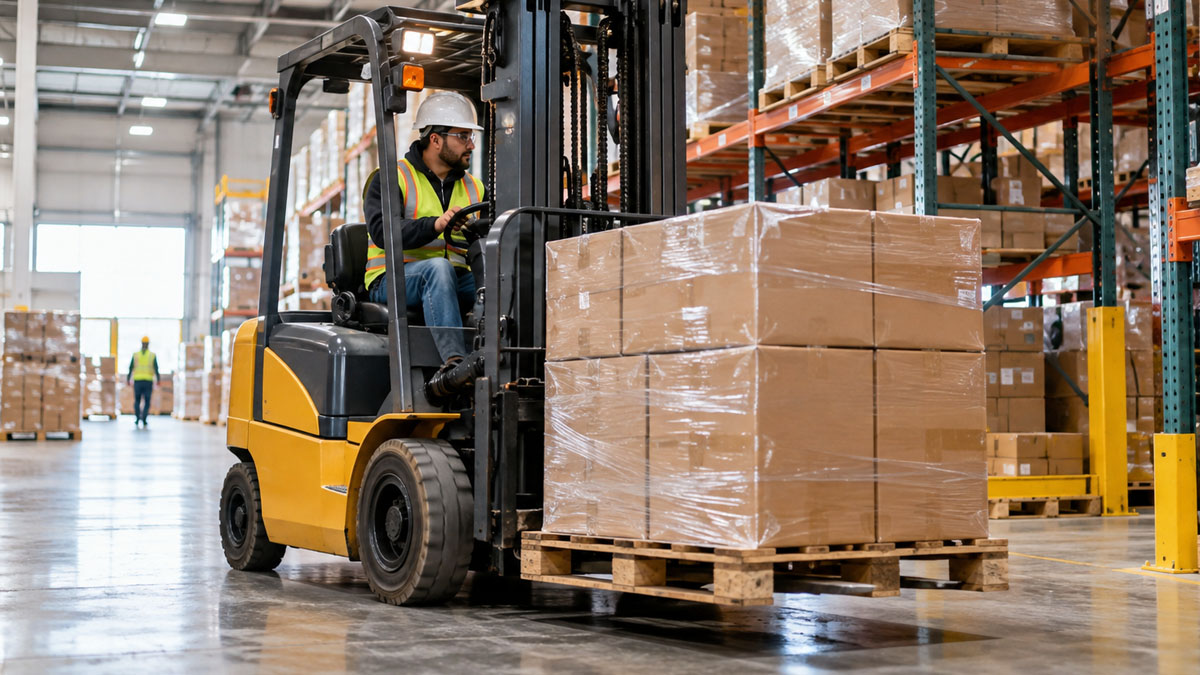
Warehouse productivity depends on more than the nominal capacity printed on the side of a forklift. The truck, attachment, load, aisle and operator work as one handling system. Change one part and the safe capacity, turning clearance and cycle time may change with it.
Equipment selection should therefore begin with the work rather than a catalogue. A truck that performs well at a loading dock may be poorly suited to high racking, mixed pallet sizes or non-palletised goods. The best configuration handles the site’s actual loads safely and repeatedly without creating unnecessary travel, manual adjustment or product damage.
Start with a workflow study
Before buying equipment, observe representative work across a full shift. Record what is moved, where it starts, where it finishes and how often the move occurs. Include peak periods instead of relying only on daily averages.
Document the maximum load mass, dimensions, centre of gravity and packaging type. Record the full range rather than only the most common item. An occasional long, unstable or heavy load may determine the equipment needed for an entire task.
Measure aisle widths, rack openings, lift heights, doorways, gradients and turning areas. Check dock plates, floor conditions and overhead restrictions as well. A drawing is useful, but physical observation often reveals temporary stock, pedestrians or charging equipment that reduces the clear operating space.
Finally, time the work in stages. Separate travel, alignment, fork adjustment, lifting, depositing and paperwork to show where time is actually being lost. If operators repeatedly leave the cab to reposition forks, a fork positioner may help. A side shifter may be relevant if they make several approaches to align with a pallet. Where most delay occurs at a congested dock, a different attachment alone will not solve the problem.
Match the truck class to the environment
Counterbalance forklifts are common at docks and in general warehouse work because they can approach loads directly. Their rear counterweight balances the load at the front, although they still need enough room to turn and manoeuvre.
Reach trucks are designed for racked storage and can work in narrower aisles, subject to the manufacturer’s specifications and the site layout. Very narrow aisle equipment is more specialised and must be considered together with guidance systems, floor tolerances and evacuation arrangements.
Truck choice affects attachment choice. Hydraulic capacity, carriage class, mast, visibility and stability must all be compatible. An attachment that can physically connect to a carriage is not automatically suitable for the truck or task. Obtain written confirmation from competent suppliers and ensure the truck’s rating information reflects the complete configuration.
Power source also matters. Battery runtime, charging opportunities, ventilation and shift patterns influence availability. Environmental and duty-cycle requirements need proper assessment in cold rooms, outdoor yards or demanding multi-shift operations.
Use attachments to remove a specific constraint
Attachments turn a general-purpose truck into a more specialised handling tool. Their value comes from solving a defined problem rather than adding features for their own sake.
A side shifter moves the fork carriage laterally. It can help an operator align the load with a rack opening or pallet position without steering the whole truck again. This may reduce repeated repositioning where clearances are tight, but it does not correct a poor initial approach or justify contact with racking.
A fork positioner changes the spacing between forks from the operating position. It suits sites that handle several pallet widths because the operator can set the appropriate spacing without repeatedly adjusting forks by hand. Correct fork placement still matters. The forks should support the load as intended, and the operator must confirm the selected spacing before lifting.
Clamps are used where suitable for loads such as cartons, appliances, bales or paper rolls. They require careful specification because insufficient clamping force can allow a load to slip, while excessive force can damage the product. Contact pads and pressure settings must be matched to the load characteristics.
Rotators can tip or invert suitable containers for processing or discharge tasks. Drum handlers and other purpose-built devices address different load shapes. In every case, the load, attachment and truck must be approved for the application.
Selecting forklift attachments should therefore involve load samples, site measurements, truck details and a clear account of the task. A demonstration under controlled conditions can reveal visibility, clearance or product-contact issues that may not be obvious from a specification sheet.
Understand capacity derating
One of the most important consequences of fitting an attachment is its effect on capacity. An attachment adds mass in front of the truck and may move the load farther away from the fork face. This changes the combined centre of gravity and can reduce the load the truck may safely lift, particularly at height.
The rated capacity of a bare truck must not be treated as the capacity of the modified truck. The complete combination needs appropriate assessment and updated rating information from an authorised, competent source. Operators must be able to read that information and understand any restrictions involving lift height and load centre.
Load centre has a direct effect on safe capacity. A long load with its weight concentrated away from the mast creates a different moment from a compact pallet of the same mass. An irregular item may also have an offset centre of gravity. If the true load centre is uncertain, the task requires assessment before lifting.
Never rely on an operator’s sense that a truck “feels stable”. Stability margins can disappear quickly during turning, braking, travelling on gradients or lifting. The data plate and approved configuration set the limits, and all work must remain within them.
Check the physical envelope
Attachments can increase the truck’s length, width or forward projection. They may reduce visibility and change the minimum aisle width needed to turn into a rack opening. Hydraulic hoses and mounting components can also create additional clearance points.
Test the complete geometry against the warehouse. Consider the approach to every destination, not only the widest main aisle. Drive-in racking, end-of-aisle barriers, low beams, dock doors and staging lanes may be the true constraint. Ensure the attachment can be parked safely when it is not in use and that changeover does not expose workers to uncontrolled movement or manual-handling hazards.
Visibility deserves particular attention. A bulky clamp or raised load may block the operator’s forward view. The traffic plan should specify safe travel direction and pedestrian separation. Cameras or sensors may support awareness in some applications, but they do not replace clear routes, controlled speed and direct observation.
Train for the fitted configuration
A licensed or otherwise authorised operator still needs site-specific and equipment-specific instruction. Controls, hydraulic functions, visibility and load behaviour differ between configurations. Training should cover the attachment’s approved uses, pre-start checks, capacity information, load engagement and safe parking.
Practical verification matters. An operator should demonstrate correct fork spacing, clamp pressure or rotation procedures with representative loads. Supervisors should recognise misuse, including side-pulling a load with equipment not designed for that action or using an attachment to perform an unapproved task.
Include attachments in pre-start inspections. Mounting points, locking devices, hydraulic hoses, forks, pads and visible damage all require attention. A defect-reporting process should remove unsafe equipment from service and prevent its return until it has been assessed and repaired.
Pedestrians also need information. New equipment may change turning paths, sightlines or the way loads are deposited. Update the traffic management plan and communicate the changes before normal work resumes.
Use damage data as an operational signal
Product and racking damage can reveal a mismatch between the task and the equipment. Record where incidents occur, which load was involved, what configuration was used and the point in the cycle at which the damage happened.
Bent pallet boards near one rack opening may indicate poor alignment, limited clearance or damaged pallets. Crushed cartons may point to unsuitable clamp settings or packaging that cannot tolerate the handling method. Repeated rack strikes may involve layout and visibility as well as speed, training or individual carelessness.
Near misses deserve the same analysis. If an operator regularly needs several attempts to place a load, the process is signalling a problem even when no damage occurs. Review the attachment, aisle geometry, pallet quality and work rate together.
Do not use productivity targets that encourage shortcuts. Moves per hour are useful only when considered alongside damage, near misses, maintenance requirements and safe operating behaviour. Faster cycles that increase risk or rework are not genuine productivity gains.
Plan maintenance and lifecycle cost
Attachments add components that require inspection and servicing. Hydraulic seals can leak, bushes and bearings can wear, forks can be damaged and clamp surfaces can deteriorate. Follow the relevant manufacturer schedules and use competent technicians.
Maintenance planning should account for utilisation and the operating environment. Dust, moisture, cold and heavy duty cycles can alter service needs. Keep records by asset and investigate recurring faults rather than repeatedly treating the symptoms.
Assess cost over the expected service life. Purchase price is only one part of the total. Include installation, rating updates, training, planned maintenance, spare parts, downtime and the cost of product damage. Standardising suitable equipment across a fleet may simplify training and parts management, but forced standardisation can be counterproductive when workflows are genuinely different.
Run a controlled selection process
A practical selection process can be organised into seven steps:
- Define representative and worst-case loads.
- Map routes, heights, clearances and traffic interactions.
- Identify the delay or risk the equipment must address.
- Shortlist compatible trucks and attachments with competent advice.
- Confirm capacity, mounting, hydraulics and updated rating requirements.
- Trial the configuration with representative loads in controlled conditions.
- Train operators, update procedures and review results after introduction.
Set review measures before the trial. Cycle time, product damage, operator feedback, energy use, maintenance requirements and near misses provide a balanced picture. Compare results over a meaningful period rather than judging a demonstration completed with one ideal load.
Forklift performance comes from the complete configuration. When a warehouse matches the truck and attachment to its loads, layout and workflow, handling becomes more predictable. The strongest result is not simply a faster lift. It is a safe, repeatable process that protects people, products and infrastructure throughout every shift.