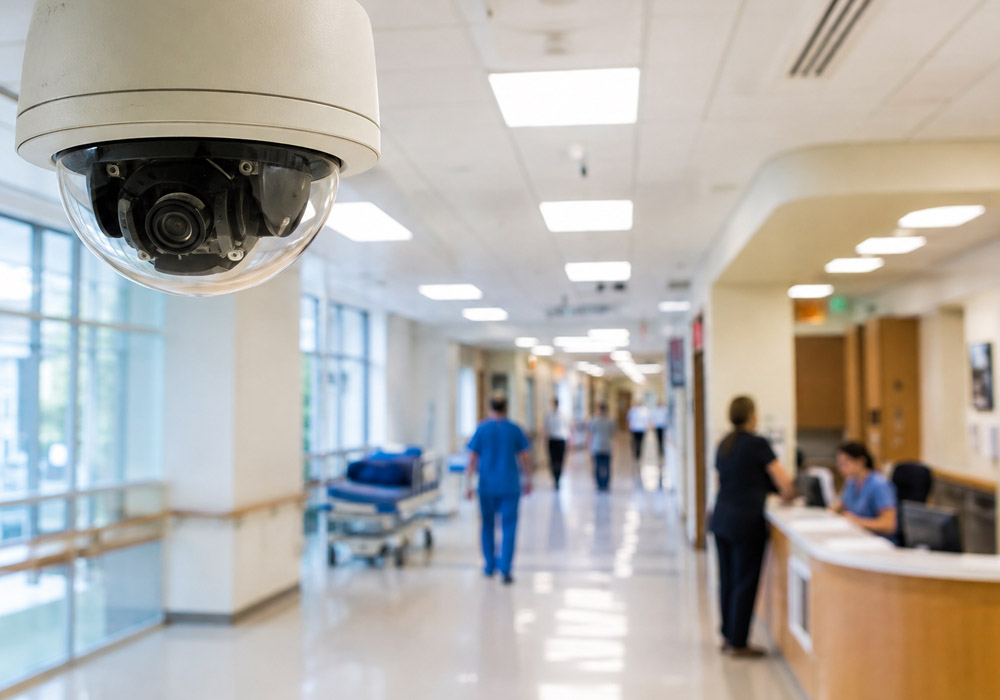
Hospitals must balance open access, compassionate care, and strict protection across complex clinical spaces. Emergency departments, pharmacies, maternity units, laboratories, waiting rooms, and parking areas each present distinct security risks that routine monitoring may overlook. Security teams therefore need a clearer way to transform visual records into timely intelligence without disrupting patient care.
Smart surveillance supports safer movement while preserving the calm, welcoming atmosphere expected within a healthcare facility. It helps personnel recognize unusual behavior, trace incidents, and coordinate responses confidently across multiple departments. A well-planned system also strengthens patient trust, protects employees, and gives administrators reliable evidence for security decisions. For more information, please check this discourse.
Faster Detection of Security Threats
Conventional surveillance depends heavily on personnel noticing suspicious activity across numerous screens. Modern video content analysis examines footage for objects, actions, movement patterns, and interactions that may require attention. Algorithms can flag loitering near restricted doors, crowd formation, abandoned items, tailgating, or entry into sensitive zones. Alerts help personnel assess specific events instead of continuously reviewing every camera feed.
Stronger Protection Across High-Risk Areas
Healthcare campuses contain spaces with different access rules and response priorities. Analytics can support tailored security controls through:
- Emergency departments: Crowd-density alerts can reveal rising tension, blocked exits, or sudden movement around triage desks.
- Pharmacies and laboratories: Object and access detection can identify unauthorized entry, suspicious handling, or prolonged presence.
- Infant and behavioral health units: Zone-based alerts can help teams investigate boundary breaches or unexpected movement promptly.
Better Incident Investigation and Evidence Review
Manual footage review can consume hours when investigators must locate a brief event across several cameras. Advanced search tools can narrow recordings through time, location, object type, appearance, or movement criteria, while synchronized views help reconstruct a person’s route. Dashboards and visual reports also support collaboration among security leaders, clinical administrators, compliance teams, and law enforcement.
Reliable evidence improves post-incident analysis and exposes recurring patterns. Repeated congestion near an entrance, unauthorized shortcuts, or delayed responses may reveal weaknesses in staffing, signage, door controls, or camera placement. Those findings can guide practical adjustments based on observed activity rather than assumptions.
More Efficient Security Operations
A strong analytics platform should simplify security work rather than add another complicated console. Valuable operational features include:
- Real-time alerts that classify events according to urgency and location.
- System integration with access control, alarms, visitor management, and camera networks.
- Usable reporting that presents trends, response times, and recurring hotspots clearly.
- Intuitive controls that help authorized staff search footage and review alerts efficiently.
Safer Decisions Through Actionable Data
Another major value of video content analysis lies in its ability to convert footage into measurable security insight. Trend reports can show where incidents cluster, when entrances become vulnerable, and which alerts require faster escalation. Leaders can refine patrol schedules, emergency procedures, environmental design, and staff training according to documented conditions.
The need for stronger protection is substantial. The Centers for Disease Control and Prevention reported that healthcare workers represented 10% of the workforce but experienced 48% of nonfatal injuries associated with workplace violence. Privacy safeguards, role-based access, retention limits, and accuracy checks should remain central to every deployment.
Intelligent video review gives healthcare security teams sharper awareness, faster evidence access, and precise operational insight. Its greatest value appears when technology complements trained personnel, clear policies, and respectful patient care. Thoughtful implementation can create safer facilities without weakening the welcoming character essential to healthcare.