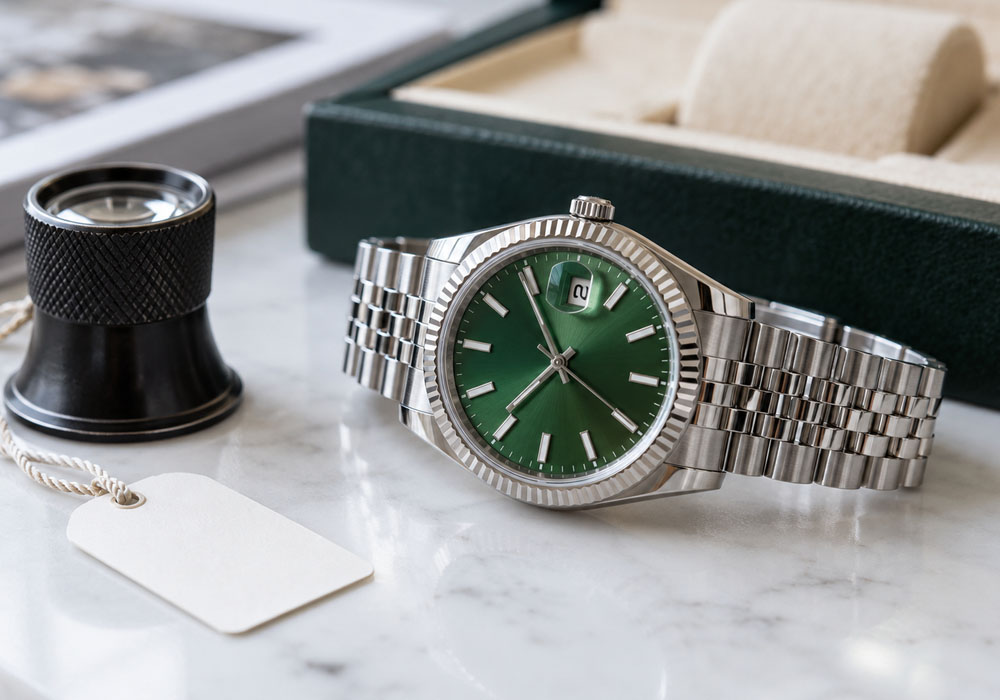
Price confusion around a green Datejust is understandable. The tag at an authorized dealer may differ from prices elsewhere because the reference, dial, set, condition, seller, and timing all affect the final number. A sensible budget therefore starts with the exact watch rather than a broad model name.
Retail price is rarely the price you pay
Rolex controls distribution through its authorized dealer network. Availability varies by dealer, location, reference, and customer demand. A particular green dial Datejust may not be available when a buyer wants one, leading some buyers to consider resellers or private sellers instead.
That difference is why the secondary market matters when budgeting for this Rolex watch. The retail tag provides one reference point, while reseller listings and completed sales, where accessible, offer another. Asking prices can change with available stock and buyer interest, but an asking price does not prove that a watch sold at that level. Recent completed-sale comparisons are generally more useful.
Rolex also has broad brand recognition and a substantial presence in the Swiss watch industry. That position supports demand across many models, although it does not guarantee the price or future resale performance of an individual Datejust. The exact configuration, condition, and documentation remain more relevant to a specific purchase than general statements about the brand.
The same pricing issue appears with many less readily available dials. Retail establishes the official price, while the secondary market shows what sellers are currently requesting and, when completed-sale information is available, what buyers have paid. Budgeting from the retail figure alone may leave out a meaningful premium or the additional costs of buying outside the authorized network.
Heritage also contributes to recognition of the Datejust. Rolex introduced the model in 1945, and its date display became one of its defining features. The familiar case, bezel, and bracelet combinations make comparisons easier, but a green dial still needs to be assessed by exact reference rather than by color alone.
Reference number sets the baseline
Every Datejust comparison should start with the reference. The number identifies the factory configuration, including important details such as size, metal, and bezel type. Two listings with different references are not direct comparisons, even when both sellers describe the watches as green Datejusts.
A Datejust 41 in Oystersteel starts from a different base than a Rolesor version. Rolesor combines steel and gold, so its material and factory pricing differ. Size matters as well. A 41mm case and a 36mm case have different proportions, and buyer preferences may vary by wrist size, style, and current availability.
Bezel and bracelet affect the number next. A factory fluted bezel on relevant modern references is made from gold, while a smooth bezel on an Oystersteel configuration is steel. The Jubilee has five-piece links and provides the traditional Datejust look. The Oyster has three-piece links and a sportier appearance. Neither bracelet should be valued in isolation from the complete reference and its original specification.
Start by confirming the reference against Rolex documentation or a reliable reference guide. Every other factor, including dial originality, bracelet type, and comparable pricing, builds on that baseline.
Dial shade does most of the work
Two green Datejusts with otherwise similar specifications can be priced differently because of the dial. Seller terminology is not always consistent, and labels such as olive, mint, or palm may cover several references and configurations. Confirm the official dial description and factory availability for the exact reference before comparing prices.
Olive green dials
Olive green is generally used to describe a muted, darker shade that can appear brown-green or nearly black under different lighting. Listings may pair the term with several bezel and bracelet descriptions, so the seller’s title alone is not enough. Check the reference, dial code where available, and official configuration rather than assuming every watch labeled olive green left the factory in the same form.
Availability and pricing also vary by reference and condition. A limited number of current listings may indicate temporary scarcity, but it does not establish production volume or a reliable market premium. Compare the watch only with completed sales for the same configuration where those records are accessible.
Mint green dials
Mint green is lighter and can look different depending on lighting, photography, and screen settings. The shade has appeared across specific Datejust references, and its availability should be checked by exact model rather than assigned broadly to one case size. Factory photos, documentation, and an in-person inspection can help confirm what is being offered.
A full set may command a different asking price from a watch-only example, but documentation does not replace inspection. Compare the same reference, bracelet, bezel, year, and condition whenever possible. Differences between listings may reflect more than the dial color.
Palm motif dials
Palm motif dials add a visible leaf pattern over the base color instead of presenting a plain sunray finish. Some buyers prefer the texture, while others favor a simpler dial. That preference can affect asking prices, but the motif should be compared with completed sales of the same reference and factory configuration.
Production status and availability should be verified through reliable reference information. A small number of listings at one moment does not show how quickly the dial sells or what it will be worth later. Judge motif dials on originality, condition, and comparable transactions rather than against every standard green dial.
Dial condition matters as much as the shade. A clean, original dial generally supports value, while a refinished or incorrectly replaced dial can reduce buyer confidence. Authentication should confirm that the dial is correct for the reference and production period.
Movement generation splits old from new
Movement type is another price factor. Older Datejust references use earlier calibers, while many newer models use caliber 3235. The transition did not occur across every size and reference at the same time, so the movement should be confirmed through the exact reference and production information rather than a general model-year assumption.
Caliber 3235 has a 70-hour power reserve and is covered by Rolex’s Superlative Chronometer standard for the completed watch. Those specifications may appeal to buyers who want a newer movement for regular wear. Earlier calibers remain established Rolex movements, and their suitability depends on condition, service history, and the needs of the owner.
The movement alone should not decide the purchase. A newer caliber cannot offset a damaged case, an incorrect dial, or poor documentation. Between two comparable watches, movement generation may be a useful distinction, but condition and originality still require separate assessment.
If you are considering a purchase, viewing actual green rolex Datejust listings side by side can help establish the range of current asking prices. Compare the reference, dial, metal, bezel, bracelet, set, and condition, then check completed-sale information where accessible.
Box and papers change the math
A full set generally means the original box and warranty papers or card are present. It may also include booklets, hang tags, and spare links. Watch-only usually means the watch and bracelet are sold without the original supporting items, although each seller’s definition should be confirmed.
Provenance has practical value. The warranty card can connect the reference and serial details to the original sale information, while other original items may support the watch’s history. Spare links also matter because replacing the correct links creates an additional cost. Together, these items can reduce uncertainty, although they do not authenticate the watch by themselves.
The price difference should be assessed case by case. A complete set may be easier to compare with other complete examples, while a watch-only piece can still be a reasonable purchase at an appropriate price. The budget should account for the missing documentation, any required authentication, and the cost of obtaining correct accessories or links.
Documentation should align with the watch’s reference and production period. Rather than requesting publicly exposed serial images, have the details checked privately by Rolex or a qualified independent watchmaker. A mismatch requires explanation, but missing papers alone do not establish that a watch is counterfeit.
Paperwork cannot compensate for a bad dial.
Service papers can also be useful. They may show when work was completed and what parts were replaced, although the details vary between service records. Confirm whether the dial, hands, bezel, bracelet, or movement components were changed. An authentication and condition assessment by Rolex or a qualified independent watchmaker is more reliable than photographs alone.
Condition and originality protect value
Condition is where similarly specified watches can differ substantially. Two full sets with the same reference and dial may show different levels of wear. Look beyond bright studio photographs and examine the case profile, lugs, bezel, bracelet, clasp, crystal, dial, and hands under clear, neutral lighting.
Cases with defined edges may indicate limited refinishing, while rounded or uneven surfaces can suggest more extensive polishing. Claims that a watch is unpolished are difficult to verify from photographs alone. The more useful question is whether the case retains the correct proportions and factory geometry for its reference.
Original bezels, dials, hands, and bracelets generally matter to collectors. Luminous material should be appropriate for the reference and period, whether that is tritium, Chromalight, or another factory specification. Hands and dial markers should also be assessed together. A cleaner replacement part does not necessarily preserve originality.
Aftermarket parts can cause a substantial reduction in confidence and price. An incorrect bezel, dial, bracelet, clasp, or set of links may also create fit and service issues. Check component codes and specifications against the reference, but do not rely on color, shine, or photographs as the sole authentication method.
Allow room in the budget for an inspection, pressure test, sizing, and any required maintenance. Light wear is normal on a used watch, while heavy case correction or damaged components deserve closer attention. If the case appears thin, uneven, or inconsistent with the reference, obtain an expert assessment before proceeding.
Photos can conceal wear. Video and an in-person inspection may provide a clearer view, especially around the lugs, bezel, bracelet, and clasp. Ask for straight-on and angled images, then arrange authentication by Rolex or a qualified independent watchmaker before finalizing an expensive purchase.
Timing and seller shape the final number
Green became strongly associated with modern Rolex sports watches, including the green Submariner ref. 116610LV. That broader recognition may influence interest in other green Rolex models, but it does not establish a direct price relationship. A Datejust should still be valued using its own reference and comparable sales.
Prices and asking levels can change over time. New releases, broader luxury demand, and reseller inventory may affect what is advertised, although the impact is not always predictable. Use recent completed-sale comparisons where accessible rather than relying on old screenshots or a single seller’s current asking price.
Seller type changes both risk and cost. Authorized dealers sell new watches with a Rolex warranty, subject to local availability. Resellers may offer immediate inventory at a different price, while private sellers can require more due diligence. Add authentication, service, insurance, sizing, and any missing links to the effective purchase cost.
A straightforward budgeting process begins with the size and metal, followed by the bezel and bracelet. Pull recent completed listings for that exact specification where possible, remove obvious outliers, and examine the central range. Verify authenticity and condition through Rolex or a qualified independent watchmaker rather than relying only on seller-supplied material.
Any premium for immediate availability should be treated as a known cost, not as evidence of future value. It may suit a buyer who prioritizes access now, while another buyer may prefer to wait. The decision should fit the total budget and intended ownership period.
Plan the full budget, not just the sticker
The sticker is only the starting point. Every mechanical Rolex requires care over time. Allow for an inspection and pressure test at purchase, then budget for future servicing according to the watch’s condition and service history. Daily wear will also produce scratches and bracelet wear.
Insurance is part of the calculation for many owners. Quotes vary according to the watch’s insured value, location, coverage, and deductible. Obtain an estimate before buying. Authentication fees should also be included because an independent professional check can identify issues that are not visible in a listing.
Bracelet fit affects the budget as well. Missing links cost money to replace, and correct end links matter for fit and originality. Ask the seller for the link count and the wrist size the bracelet currently fits. Confirm that any supplied spare links are correct for the bracelet reference.
A green Datejust rewards careful comparison. Confirm the reference, verify the factory dial configuration, and compare recent completed sales where accessible. Assess condition, originality, documentation, and ownership costs before agreeing to a price.
The right piece should fit both the wrist and the full budget. Authentication by Rolex or a qualified independent watchmaker provides a firmer basis for the decision than dial color, seller claims, or asking price alone.