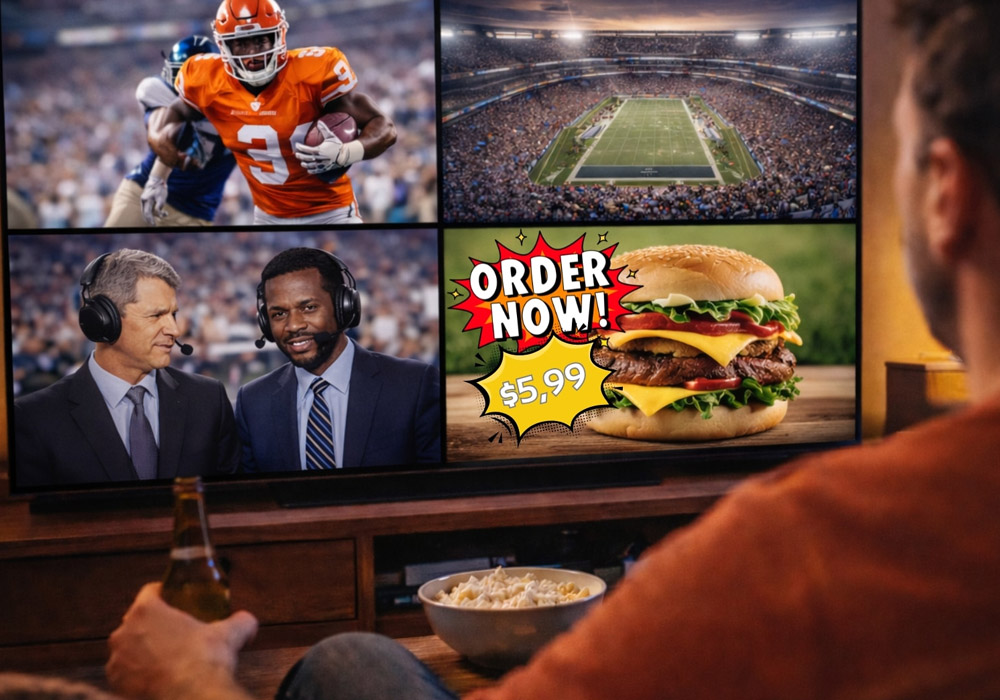
The future of sports streaming is not about a better picture, more detailed stats, or exclusive content. These will play a role but at the end of the day, every fan cares most about the game itself. The future of sports streaming is interactive and multi-view. A new way of watching where new cameras put you in the stadium, so when you put your headset on, you’re not watching the game, you’re in it. We’re almost there. The technology and creativity exist, now we just need the infrastructure.
The Single-Cut Broadcast is a Bottleneck, Not a Feature
A live game produces hundreds of camera feeds. For instance, a top-tier broadcast wires up 300 angles, player mics, and tracking sensors for one single game. Yet, almost none of this reaches the audience. In a production truck, a director selects a feed, cuts to it, and every viewer sees the same shot at the same time, whether they are interested in the quarterback or the left tackle.
This approach was fine because broadcasting was the only means of distribution. However, it no longer fits. We already have plenty of content, the problem is with ingestion, transcoding, and delivery. It is necessary to solve the engineering problem of taking those 300 feeds and transmitting them onto the screen of a phone without overloading the network or the viewer’s data plan. This is not a creative problem, but an engineering one. It’s the reason why interactive streaming hasn’t been available, even though there has been a demand for it for more than a decade now, with the rise of second-screen behavior.
This was evident from the NFL RedZone case, where the whip-around format, i.e. switching between games where scoring drives are taking place, demonstrated that fans are actually willing to give a clear broadcast to access more relevant action. However, RedZone still relies on an editor to make a choice between the fan and the game. It’s about curation, not control. The real final state is when a viewer chooses their path through the game: every touch of a player, each defensive snap that is important for their fantasy team, or an unusual angle that no one in the truck thinks of including.
Multi-View Means Layers, Not Just Tiles
Let’s break down what “multi-view” really means because this term is often used too broadly. Having four video panes on one screen is the simple form of it. The complex, more beneficial form includes contextual layering where live odds, player-tracking heatmaps, fantasy point totals, and alternate camera feed are all displayed on top of synchronized feeds in real time.
This application justifies the use of tracking systems such as Hawk-Eye and Second Spectrum. They provide the necessary data layer under the overlays (e.g. shot speed, win probability, positional heatmaps) that must remain perfectly synchronized with the video pane the fan is currently watching. If this synchronization is off by even a few seconds, the overlay stops being effective and becomes counterproductive. For instance, a win-probability graphic that updates before the play it’s describing breaks the entire concept of this feature.
With personalization engines, this overlay process can become automated. Instead of a fan manually choosing a camera angle or a stat overlay each time, machine learning models are constantly learning their preferences, presenting a default view that matches to their prior choices e.g. which angle a viewer prefers, which overlays they interact with, etc. Anyone building these systems should be looking closely at the actual sports streaming analysis behind the bitrate and codec trade-offs at play, because the technical choices shape what’s even possible at the product layer. This is a substantially different product than just giving users four boxes to choose from.
Latency is the Wall Everything Else Runs Into
None of the user engagement features will be effective if viewers experience delays in the stream. The delay of live content delivery using standard HTTP Live Streaming (HLS) is between 30-60 seconds in most cases. The delay renders any interactivity feature ineffective as users cannot place a bet on the next game move if they’re watching a move that happened a minute ago. Chat and social reactions between users become meaningless too. Nothing ruins a game like half the fans cheering a point while the other half haven’t seen the move yet.
Delivery with latencies lower than 5 seconds is a basic requirement for interactive features. The commonly used low-latency variants can reduce this to a few seconds. Low latency HLS (LL-HLS) can find the necessary chunk in a manifest at each segment; CMAF-packaged streams can share a chunk between HLS and DASH; WebRTC’s chunked delivery downloading allows playback before a complete chunk has been transferred. Edge networks and 5G can help bring the experience closer to the users, while decreasing the latency in the network itself. This is especially useful for stadium deployments where thousands of phones are pulling high-bandwidth multi-view feeds off the same local network at once.
The Bandwidth Math Nobody Wants to Talk About
Here’s the part that gets skipped in most “future of streaming” pieces: multi-view is expensive, and the expense scales in a way that catches platforms off guard. A viewer watching four HD panes at once isn’t consuming a little more data than someone watching one stream, they’re consuming roughly four times as much. Multiply that across a large concurrent audience during a marquee game and the CDN bill stops being a rounding error.
This is where codec choice and ABR ladder design stop being technical footnotes and start being business-critical decisions. Next-generation codecs like AV1 and HEVC deliver comparable visual quality at 30 to 50% lower bitrate than older standards, which is the single biggest lever platforms have for making multi-view financially sustainable. Pair that with a well-designed adaptive bitrate ladder, one that scales resolution and bitrate per pane based on device capability and connection quality, rather than treating every pane like it deserves full 1080p, and the cost curve starts to look survivable instead of catastrophic.
Getting this wrong doesn’t just cost money, either. Poor per-pane bitrate decisions show up to viewers as buffering, pixelation, or panes that quietly drop to unwatchable quality the moment three other feeds start competing for bandwidth on the same connection. That’s the kind of failure that undoes all the product work on overlays and personalization, because a fan who’s watching a blurry stream doesn’t care how smart the recommendation engine is.
Device Limits Are a Hard Ceiling, Not a Soft One
Although the server side can be perfectly optimized for codecs and bandwidth, there are limitations for the end-users such as the device they use. For an end-user with an old mobile phone, watching multiple video panes will result in a frustrating experience because the phone cannot handle the load and may keep freezing.
To avoid such an experience we need to implement proper device-class detection mechanisms on the client-side early in the development process. This is because a client continually decoding four video panes at full resolution is going to be less equipped to render the panes at an acceptable quality. Hence, panes should be either dynamically changed to a lower resolution or directly turned into audio mode. This change should be done based on (1) if the pane is in the active viewport, and (2) if the device can handle the extra decode/render load of that pane. This is identical to the adaptive streaming logic driving single-pane delivery; it’s just applied to each pane individually instead of to the singular stream as a whole. You just can’t skip this and hope it will work itself out.
Betting is the Sharpest Stress Test For Interactivity
A good way to measure the effectiveness of a streaming service’s interactive features is to look at in-play betting. Essentially, live betting during a game or event is the most difficult test for low-latency streaming because odds must be synchronized with what’s happening on the field, and fans need to be able to place bets before an event occurs if they want to do so during it.
If a platform has the right infrastructure, you can see its impact on engagement, such as longer viewing durations and more frequent sessions. This additional engagement is critical, because it can help offset the higher costs of the much better infrastructure and delivery required for an interactive stream compared to a conventional linear broadcast.
Similarly, the ability to insert potentially unblockable ads into the platform is far more valuable when it requires a full stream resync on the part of the pirate to remove them, rather than the roughly 20-minute window in which a viewer is locked into the same ad break as everyone else in a linear broadcast.
Streaming Already Won the Audience War
All of this is not occurring in a vacuum of steady demand. Streaming crossed an important threshold as far back as July 2022, when Nielsen’s The Gauge report displayed streaming tallied 34.8% of whole U.S. TV viewing time, exceeding cable at 34.4% and broadcast at 21.6%. That was the first time streaming had unequivocally beaten both categories in a measured period, and it’s just continued to increase since then.
Sports was the final significant exception for linear TV since live games are the hardest thing to reproduce outside a broadcast channel. Interactive and multi-view characteristics are the technologies that are closing that final gap, not by enhancing the appeal of sports content itself, but by introducing a level of flexibility to the viewing experience that is structurally impossible with a broadcast. A fan that can select an angle, add in fantasy stats, and make an in-play wager without leaving the stream has virtually no motivation to return to a single constant feed.
Where This Actually Lands
The best sports streaming platforms in the future will not necessarily have the most visually attractive camera-switcher interface, but rather those that have managed to address and lower the latency to under five seconds, created ABR ladders that are powerful enough to support four concurrent panes without causing a costly CDN overload, and selected sufficiently effective codecs to ensure that multi-viewing is economically feasible on a large scale. The UX layer may be the most apparent component, but it is the bitrate and delivery decisions made beneath it that decide if that UX remains operational under high load conditions with millions of fans streaming a game simultaneously.