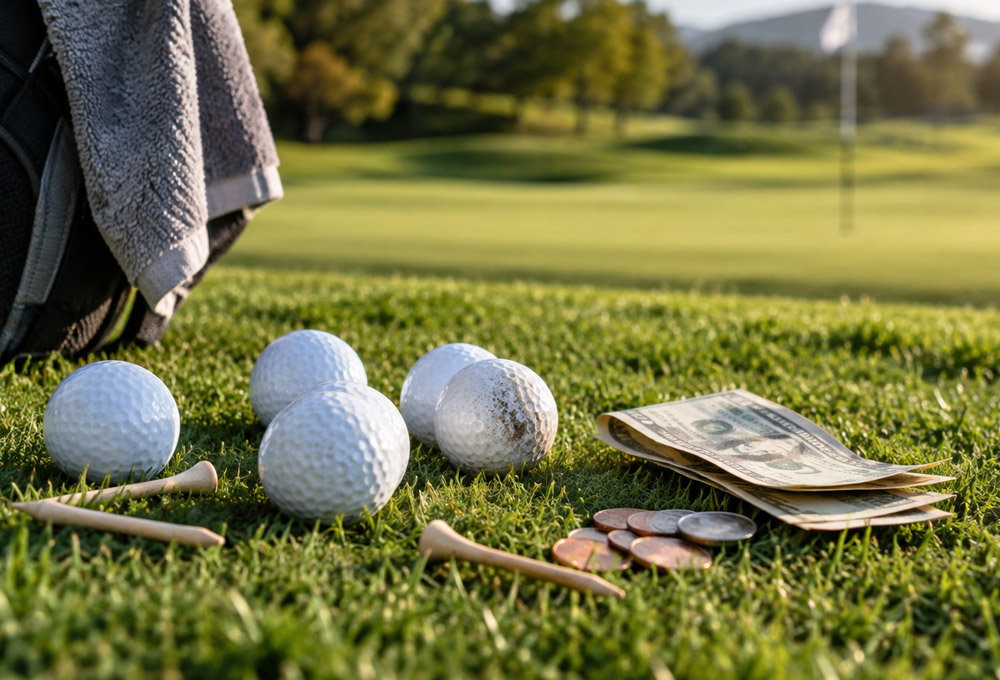
I ran the math on my own season last year and nearly fell out of my chair. Thirty-eight rounds, and I was losing close to two balls a round on my home course, which has water on eleven holes and rough that swallows anything offline. At full retail, that’s a number I refuse to type twice. If you play a premium urethane ball, you already know the quiet anxiety of standing over a $5 ball with a forced carry in front of you.
That anxiety is the real cost. Not the money alone, but the way it changes your swing. You get tentative with the driver. You lay up when you shouldn’t. I’d rather fix the cost problem than fix my head, so this is how I did it: what a premium ball actually gives you, where the price is pure brand tax, and how to keep the performance while paying a fraction of the sticker.
Why one ball costs more than a dozen used ones
Premium balls cost what they cost because of the materials, not the logo. A cast urethane cover, a firm mantle layer, and a soft core take more manufacturing steps and more quality control than a two-piece distance ball with a surlyn cover. That’s a real difference you can feel on a wedge shot, and it’s why the flagship models sit at the top of the price list year after year.
Here’s the part that stings. The ball doesn’t know how much you paid for it. It performs the same in the air whether you bought it new or fished it out of a pond an hour ago.
The USGA sets the rules that govern ball construction and conformance through its equipment standards, and the specs don’t include a receipt. So when you lose one in the leaves, you’re not losing $5 of performance. You’re losing $5 of packaging, shipping, retail markup, and marketing. That’s the gap I decided to close.
What actually changes with a used or recycled ball
Used balls fall into rough tiers, and the tier matters more than the brand. At the top you’ve got balls that were hit once, maybe on a simulator, and pulled from a bucket. Below that are lake balls, which get dredged and cleaned. The physical cleaning can discolor a cover or lift a little paint, but the core and mantle don’t care about a scuff on the stamp.
What you should care about is cover damage. A gouged cover changes flight more than any core difference. Here’s my personal test, and I use it at the kitchen counter before anything goes in the bag:
- Run a thumbnail across the cover. If it catches on a cut, the ball is a practice ball.
- Look at the seam area for cracks. Hairline cracks turn into full splits.
- Drop it on tile and listen. A dull thud instead of a sharp click suggests a dead core.
- Spin it on a flat counter. A wobble means the ball is out of round.
I keep the good ones for tournament rounds and dump the rest in my shag bag for chipping practice in the backyard. Nothing gets wasted, which is the whole point.
The unglamorous math of a golf season
Think about how many balls you actually lose in a year rather than how many you buy. A casual player at twenty rounds with a ball and a half lost per round is burning thirty balls a season. A new dozen of a flagship urethane ball runs somewhere in the neighborhood of $50, so you’re looking at two and a half dozen, or roughly $125, just in balls that ended up in the woods.
Now price that same season with quality recycled balls at a third of the retail number, and you’ve moved real money into greens fees. I’d rather play six more rounds than play six more sleeves. That’s not a compromise on performance, it’s a change in where the money goes.
There’s a consumer angle here too. The Federal Trade Commission watches over claims about recycled and refurbished goods, which is why the honest sellers tell you exactly what condition grade you’re buying instead of hiding behind vague language. Read the grade before you click buy. A seller who tells you a ball came out of a pond is more trustworthy than one who calls everything “mint.”
A buying playbook that saves real money
This is the routine I’d hand to any friend who asked, and I’d stand behind every step.
- Decide your tier first. If you spin wedges hard and play fast greens, you want a urethane cover. If you’re chasing distance and don’t work the ball, a cheaper ionomer ball is genuinely the better buy.
- Buy your gamer in bulk, not by the sleeve. Fifty and hundred ball packs of mixed premium models drop the per-ball price hard. This is where recycled shopping beats the pro shop by a mile.
- Match the generation to your budget. A two-year-old version of a flagship ball plays close enough to the current one that you won’t notice on a Saturday. You’ll notice the price.
- Trial a dozen before committing. Buy a small batch, play three rounds, and see if your scores move. If they don’t, you just saved yourself a season of overspending.
- Sort and grade on arrival. Run the counter test above. Keep the top tier for real rounds, push the rest into practice duty.
The myth that used balls cost you strokes
I hear this one at every clubhouse. Someone insists a recycled ball flies shorter or spins less, usually right after they’ve bought a fresh dozen. In my experience that’s mostly confirmation bias, and the players who switch with an open mind tend to stay switched. A clean, uncut premium ball performs like a premium ball. The strokes you lose come from the swing, not the inventory.
Where used balls genuinely do fall short is consistency within a batch. You might get a mix of models and ages, so if you’re the type who wants every ball in the bag identical, buy a matched set of one model and one year rather than a mixed bag. I keep a mixed bag for practice and a matched set for competition. Simple.
One more consideration for anyone thinking about the long game: the U.S. Government Accountability Office has studied how much municipal solid waste comes from consumer goods, and golf balls are a tiny but stubborn contributor. Every recycled ball you play is one fewer sitting in a landfill. That’s not the reason to buy them, but it’s a pleasant side effect.
The one decision that actually matters
You don’t need to spend like a tour player to play like a serious amateur. You need the right cover for your game, a reasonable quantity, and a willingness to buy last year’s model. If you want the flagship tour ball without the flagship price, a recycled Titleist pro v1 is the shortcut most weekend players never bother to take, and it’s the one purchase that changed my season budget more than any club fitting.
Grab a small batch this week. Play three rounds with them. Then look at what’s left in your golf fund and decide if the new-in-box price was ever really worth it. I already know my answer, and my handicap hasn’t moved a stroke since I switched.