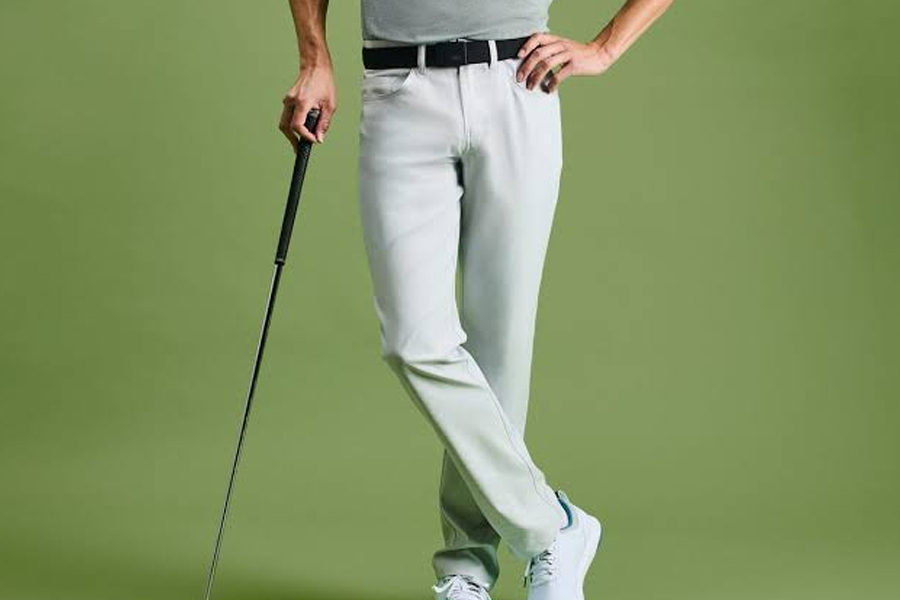
A golf swing rotates the hips through roughly 45 degrees on the backswing and even further through impact. Stiff denim or old-style dress pants were never built for that kind of movement, and you feel it the moment fabric pulls tight across your thigh mid-swing.
Pants get less attention than shirts or shoes in most golf gear conversations, but they carry just as much weight in how your body actually performs on the course.
The right pair of golf pants should disappear the moment you start swinging, not distract you with tightness or bunching at the knee. Let’s break down what actually makes a pair of golf pants work.
Stretch Fabric Changed the Game Completely
Older golf pants used rigid cotton twill with almost no give. Modern pants blend in elastane, typically between 2% and 5%, which allows fabric to stretch and recover its shape thousands of times without sagging or losing structure. Biomechanical testing on hip rotation during a golf swing shows that restricted pants can reduce hip turn by up to 15 degrees compared to stretch fabric, and that lost rotation translates directly into lost clubhead speed.
This isn’t a minor comfort upgrade. Less hip rotation means a shorter, weaker swing arc, whether you notice the restriction consciously or not.
Fabric Comparison for Golf Pants
| Fabric Type | Stretch Level | Breathability | Best Season |
| Cotton twill | Low | Moderate | Cool weather |
| Poly-elastane blend | High | Good | Year round |
| Performance knit | Very high | Excellent | Hot weather |
| Wool blend | Moderate | Low | Winter |
Waistband Design Matters More Than Size
A pair of pants can be the correct waist size and still feel wrong if the waistband construction is bad. Rigid waistbands dig in when you bend to tee up or pick up a ball. Flat-front stretch waistbands, some with a small amount of internal elastic woven into the fabric rather than a separate elastic panel, flex with your body instead of against it. This detail sounds small on paper but shows up immediately in comfort during a 4 to 5 hour round.
Signs a Pant Fit Is Wrong
- Fabric pulls tight across the thigh at the top of your backswing
- Waistband leaves a visible red mark after sitting in the cart
- Pant leg bunches at the knee when you walk uphill
- Length drags on the ground and picks up wet grass
- You feel restricted bending down to mark your ball
Moisture Management in Warm Climates
Legs sweat too, not just backs and armpits. In warm climates like most of Australia, breathable golf pants with moisture-wicking treatment can lower skin surface temperature by several degrees compared to standard cotton trousers, based on thermal comfort research on athletic apparel. That gap becomes noticeable on rounds where the temperature climbs past 30 degrees Celsius, especially walking rounds without a cart.
Tapered Fit Versus Straight Fit
Tapered pants have become the standard on tour and in most golf apparel lines because they avoid excess fabric flapping around the ankle during the swing. Straight fit still works fine for golfers who prefer a looser feel or who play in colder weather and want room for thermal layers underneath. Neither is objectively better. It comes down to how the fabric behaves against your specific body and swing style, so trying both before committing to a full rotation of pants is worth the extra ten minutes.
Durability Where It Actually Counts
Golf pants take repeated stress at the knee from walking hills and bending, and at the seat from sitting in carts. Reinforced stitching at these stress points extends the life of a pair significantly, sometimes doubling the number of wears before fabric thinning or seam failure shows up. Cheaper pants often skip this reinforcement entirely, and it’s usually invisible until the pants are already failing.