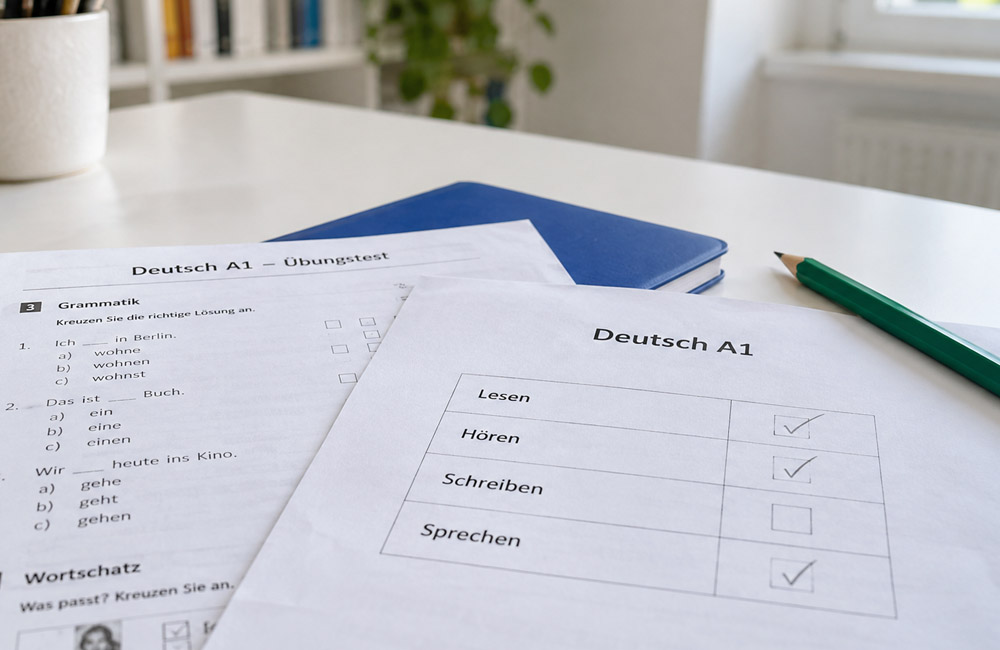
Increasing your score on the A1 German test might sound complicated. However, you need to understand a few things. Firstly, practice a little every day and focus on greetings, numbers, common verbs as well as simple sentences. Then take timed practice tests to find your weak spots. A1 is the beginner level of the CEFR, so the test checks whether you can handle familiar words and basic phrases. Steady habits work better than long cram sessions.
Know What the Test Covers
The Council of Europe describes an A1 learner as someone who can use everyday expressions and introduce themselves. Expect questions on vocabulary, basic grammar and short reading passages. Read the level description first. It shows you where to spend your study time.
Build a Core Word List
Start with words you will meet often:
- Greetings and polite phrases
- Numbers, days and months
- Family members and jobs
- Food, drinks and shopping
- Common verbs such as sein, haben and machen
Learn every noun with its article. Write der Tisch, die Lampe and das Buch instead of just Tisch, Lampe and Buch. Wrong articles cost many beginners easy points.
Practice Basic Grammar Patterns
Keep your grammar work small and focused. Learn the present tense of regular verbs first. Then move to sein and haben. Remember that the verb takes the second spot in a normal German sentence. Practice yes and no questions and the difference between nicht and kein.
Write five short sentences each day and check them against a grammar guide. Small daily writing sessions build accuracy fast.
Train Your Eyes and Ears
Read menus, signs, short emails and simple dialogues. You will pick up patterns that show up again in test questions. Listen to slow German audio for ten minutes a day. Even in a reading-based test, hearing words helps you recall them faster.
Take Timed Practice Tests
Practice under real conditions. Set a timer and answer every question without a dictionary. After each attempt, review every wrong answer and write the mistake in a notebook. You will soon see which topics need more work.
Use these habits during the test:
- Read each question fully before you look at the options.
- Remove clearly wrong answers first.
- Move on when a question stalls you and return at the end.
Try a Free Online Practice Option
Testizer offers a free online German test that follows the CEFR levels. The A1 exam has 25 multiple-choice questions and takes about 25 minutes. You can take it on a laptop, tablet or phone. No microphone or speakers are needed. Your result appears right after you finish. Testizer sends the certificate to your email so you can print it or add it to LinkedIn. It is a simple way to check your level and see progress between study weeks.
Final Thoughts
Improving the result of your A1 German test comes down to clear goals and regular practice. Build your word list, learn the core grammar, read short texts and test yourself under a timer. Each round shows you what to fix next. When you feel ready, Testizer gives you a quick way to measure your level and earn a certificate you can share with employers and schools.